Ten years ago, Justin Kurzel opened his take on “Macbeth” with a funeral. The very first thing we see in his film is an image of a child’s pale corpse. The image originates from a single line in Shakespeare’s original prose, a passing mention from Lady Macbeth, but Kurzel treats it as foundational: the inciting incident for a couple ultimately consumed not only by madness but also by grief. The tragedy of Macbeth does not begin with a prophecy but with tragedy itself, and the tyranny that follows is interpreted as a response to this opening scene.
Released in 2015, Kurzel’s film arrived at the height of a post-”Dark Knight” cultural fixation on gritty realism. Reboots and remakes were often deadly serious and more “grounded” than their sources. Kurzel’s “Macbeth” is a prime example of this approach. It is not interested in the play’s theatrical grandeur or supernatural elements, but rather in reinterpreting the cautionary tale of ambition through a modern lens of grief and trauma.
From the opening onward, Kurzel deconstructs Shakespeare’s play with psychological realism. In the following battle scene, he uses the context of war to establish Macbeth’s pre-existing propensity for violence. There are several expressionist shots of Macbeth standing motionless in the middle of the battlefield, violence and chaos swirling around him as he seems suspended in time.
Later, when Macbeth murders the king, the film cuts rapidly between reaction shots before, during, and after the event to reflect disassociation from the actual act. Kurzel suggests that the impact of death on Macbeth’s mind is akin to the struggles faced by soldiers grappling with post-traumatic stress disorder today. This framing does not necessarily absolve Macbeth of responsibility, but it shifts the source of his brutality to an already present psychological state necessary for survival in eleventh-century Scotland. This makes the violence feel less mythic, more banal, and indeed, more tragic.
As Macbeth ruthlessly beheads the traitorous Macdonwald, we hear a voice-over recounting his victory to King Duncan. Macbeth is showered with praise for his bravery, determination, and viciousness. But Kurzel, freed from the limitations of the stage, undermines that praise by refusing romantic distance from the reality of war. Before the conflict begins, Macbeth helps a younger soldier prepare for battle. He applies black war paint to his face and leaves a tender touch on the soldier’s cheek. Moments later, when the swords begin to clash, Macbeth watches as the boy’s throat is slashed mere feet away from him.
Also Check: Lady Macbeth [2017]: Pugh is the Star of Victorian Tragedy
The boy reappears several times in Macbeth’s visions; he is the one who offers the dagger used in King Duncan’s murder; he is the one who promises that “none of woman-born will harm Macbeth” during an encounter with the witches. The boy could be interpreted as a literal ghost, but is more likely a “dagger of the mind”—an intrusive memory born on the battlefield. The boy’s presence serves as a reminder for both Macbeth and the audience that there is no place for naivety in this unforgiving world. Macbeth is a hardened warrior, someone already used to killing long before Lady Macbeth reveals her sinister plan.
The Weird Sisters still play a central role, but any definitive supernatural power is left ambiguous. Kurzel teases the idea that their influence, too, might be a creation of Macbeth’s mind. The witches inform Macbeth that his life is guided by fate, but fate promises that he is destined to rule. When they first appear, the sisters stand illuminated in a bright yellow-green hue, a sharp contrast to the icy blue of the foggy battlefield. Interestingly, Kurzel adds two additional characters, a child and a newborn, to the play’s trio of sisters. The influence of children extends far beyond the opening scene.
One of his most radical changes to Shakespeare’s play is a subtle one: bringing Banquo’s son, Fleance, to the forefront. Even though he doesn’t have any lines, Fleance is crucial to the story. Early on, Macbeth returns from battle and watches Banquo embrace his son—a reminder of his own misfortune. After Macbeth takes the throne, he sends men to assassinate Banquo and explicitly calls for Fleance’s death as well. When Fleance escapes (aided by the youngest witch), it is a turning point where Macbeth’s veneer of sanity begins to crumble.
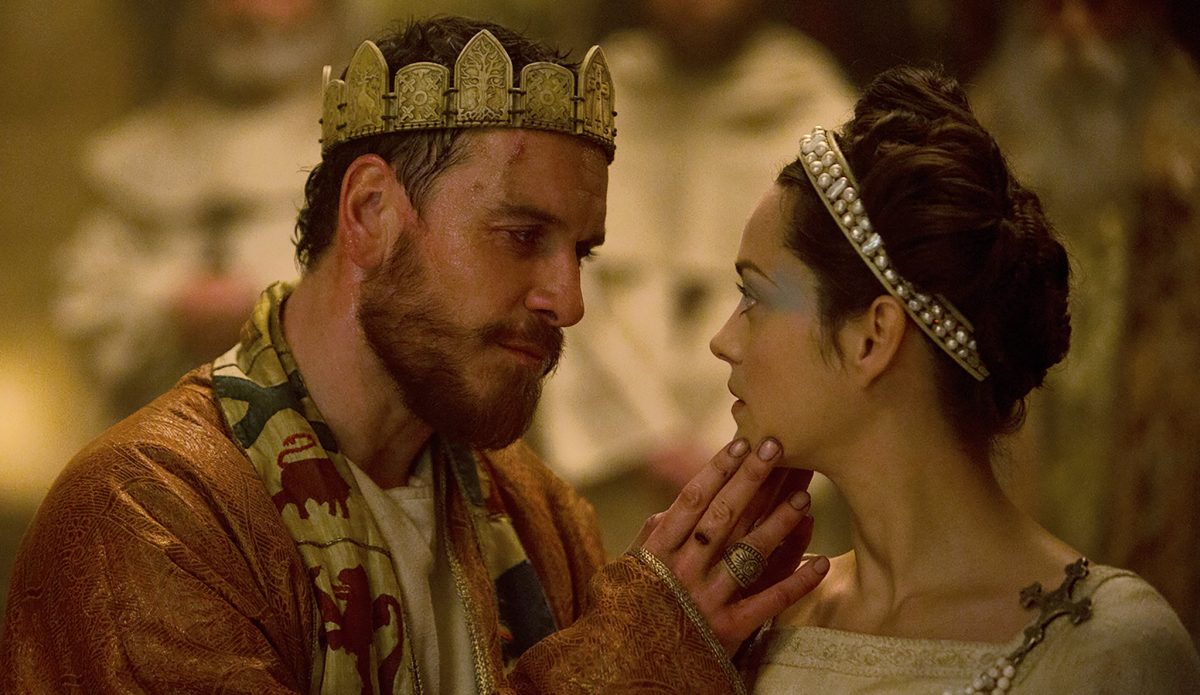
Indeed, Macbeth’s quest for power results from a desire to eliminate potential heirs who might challenge him. It is vengeance on the world for taking his own. When he targets the family of Macduff, the camera lingers on Macduff’s children, bound and waiting to be burned alive. This addition, absent from the play, ultimately compels Lady Macbeth to confront the hypocrisy of her actions.
When she reads Macbeth’s letter discussing the prophecy at the beginning of the film, she prays for dark spirits to “unsex” her and fill her with the direst cruelty imaginable. Her famous plea is now a repudiation of her own maternal potential to love—in this case, a strange form of mourning. During her final and most famous soliloquy, it is revealed to be directed towards a vision of her dead child. Rather than a simple admission of guilt, the scene reads like Lady Macbeth asking her child for forgiveness, another example of grief haunting the Macbeths.
However, Kurzel’s adaptation is also remarkably expressionistic. Slow motion makes certain shots resemble a painting. During the dagger scene, rain pours relentlessly. As the film progresses, the color palette heats up, trading blue and brown for scorching hot red and orange. When Macbeth has his climactic duel with Macduff, the sky itself is painted red by the flames of Birnam Wood, reflecting the hellish purgatory Macbeth finds himself in. Fire is a recurring visual in the film. Macbeth uses it initially to cremate his child, and then to dispose of corpses who perished in battle, and finally to incinerate Macduff’s family. By the end, it has enveloped his entire world.
Must Read: The Tragedy Of Macbeth [2021] Review – Joel Coen’s Retelling Of The Shakespeare Play Is A Classic In Its Own Right
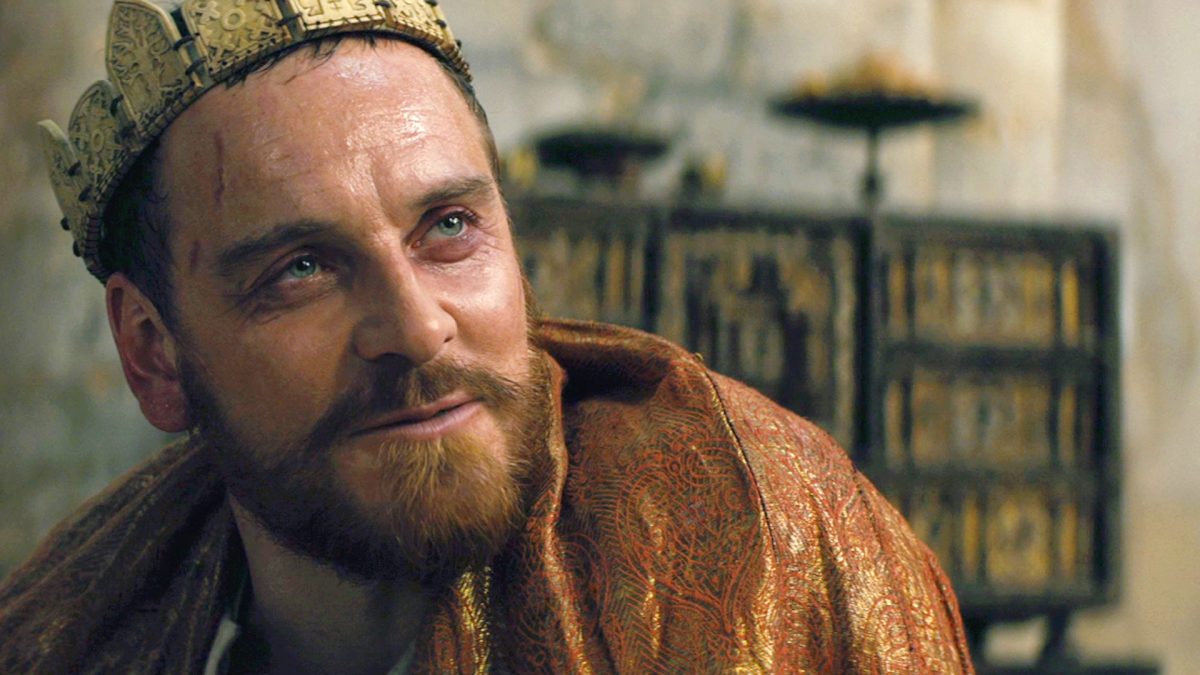
No section does better at deconstructing Shakespeare’s myth than the ending. With Lady Macbeth dead, Macbeth returns to face Macduff like a modern-day soldier reenlisting. When Macduff reveals his birth by Caesarean section—a loophole in the prophecy that no man born of woman can kill him—Macbeth welcomes his own demise and willingly allows his opponent to end his suffering.
Afterwards, Fleance wanders onto the battlefield and retrieves Macbeth’s sword. As Fleance runs towards the setting sun, the scene is crosscut with the newly crowned Malcolm inside the castle, simultaneously walking towards the horizon. The cycle of violence will continue, but not because of destiny, fate, or a supernatural force—but because grief and vengeance are inherent to the world. The film suggests that political order will inevitably change hands, but the structures that produce violence remain intact.
Despite the flourishes that make Macbeth unique, one element remains almost entirely unchanged: the language. Virtually all of the film’s dialogue is lifted straight from Shakespeare’s verse, which has a peculiar effect. On the one hand, the film’s 400-year-old dialect is too dense for most casual viewers to understand.
On the other hand, Macbeth purists have accused the movie of stripping the dialogue of its theatricality, as much of it is delivered in a more “modern” sensibility, quietly and without aplomb. This is a deliberately provocative decision since speech is commonly seen as the most potent element in Shakespeare. Kurzel’s style demonstrates the appeal of expressionism while simultaneously adopting a gritty realist approach that favors slow pacing, muted performances, and an unwaveringly grim tone.
This tension is likely what shaped the film’s positive but somewhat cool reception. Critics admired the visual craft and performances but resisted it as a definitive on-screen take. The film performed modestly in the U.S. and has since settled into a reputation as something of an intriguing outlier. In the history of Macbeths, it is often viewed more favorably than Welles and Polanski’s naturalist take, but inferior to Kurosawa’s apocalyptically mythic “Throne of Blood.”
Additionally, two other films may have helped prevent Kurzel’s film from achieving staying power in the public memory. The first would be Kurzel’s own directorial follow-up a year later: the critically and financially unsuccessful adaptation of “Assassin’s Creed,” which also starred Fassbender and Cotillard (perhaps blurring memories of the two films together). Another would be Joel Coen’s subsequent adaptation, “The Tragedy of Macbeth,” which was released a mere six years later. Coen’s version, austere and theatrical, would find wider approval by rejecting the previous decade’s obsession with realism altogether.
Ten years later, Kurzel’s “Macbeth” remains distinctive—an imperfect yet singular adaptation that vividly reflects the era in which it was made. As the glowing red hills of Scotland stretch across the ending credits, smoke from the final scene spreads beyond the battlefield, as if seeping into our own world. Shakespeare’s play will continue to shape—and be shaped by—our culture.





![On Body and Soul [2017] – A Whimsical Atypical Romance set in a Caustic Environment](https://www.highonfilms.com/wp-content/uploads/2018/02/cover-768x412.jpg)