
“Kokuho” would have value for no other reason than if it simply served as a celebration of the Japanese performance art of “Kabuki.” The traditionalist mix of performance and dance has been a time-honored practice in Japan since the seventeenth century, and continued to be an important aspect of culture, even if it faced a severe reckoning in the post-World War II era. “Kokuho” examines the absorbing, taxing qualifications required of performers, and why kabuki has become a subject affected by changing dimensions of class and gender. However, the value of “Kokuho” isn’t just within its historical perspective, but because it’s a classical epic that tracks a complex friendship. Rarely is a three hour film so immensely watchable, and so light on extraneous material.
Based on the novel of the same name by Shuichi Yoshida, “Kokuho” is centered on the life of Kikuo Tachibana (Ryo Yoshizawa), a talented young performer whose potential is seemingly limited because he is the son of the powerful yakuza clan leader Gongorō Tachibana (Masatoshi Nagase). It’s during a meeting with the clan for a New Year gathering that the accomplished actor Hanai Hanjiro II (Ken Watanabe) recognizes the talent within Kikuo, and asks to take him under his wing; it’s a desire that is granted in the most brutal way possible, as Kikuo’s family is mercilessly killed during a battle with a rival yakuza, which allows Hanjiro to adopt him. Although Hanjiro raises Kikuo in a more privileged background where he can train to be an actor, there is a brewing jealousy from Hanjiroi’s actual son, Shunsuke Ōgaki (Ryusei Yokohama), who feels that his father’s affections have been averted.
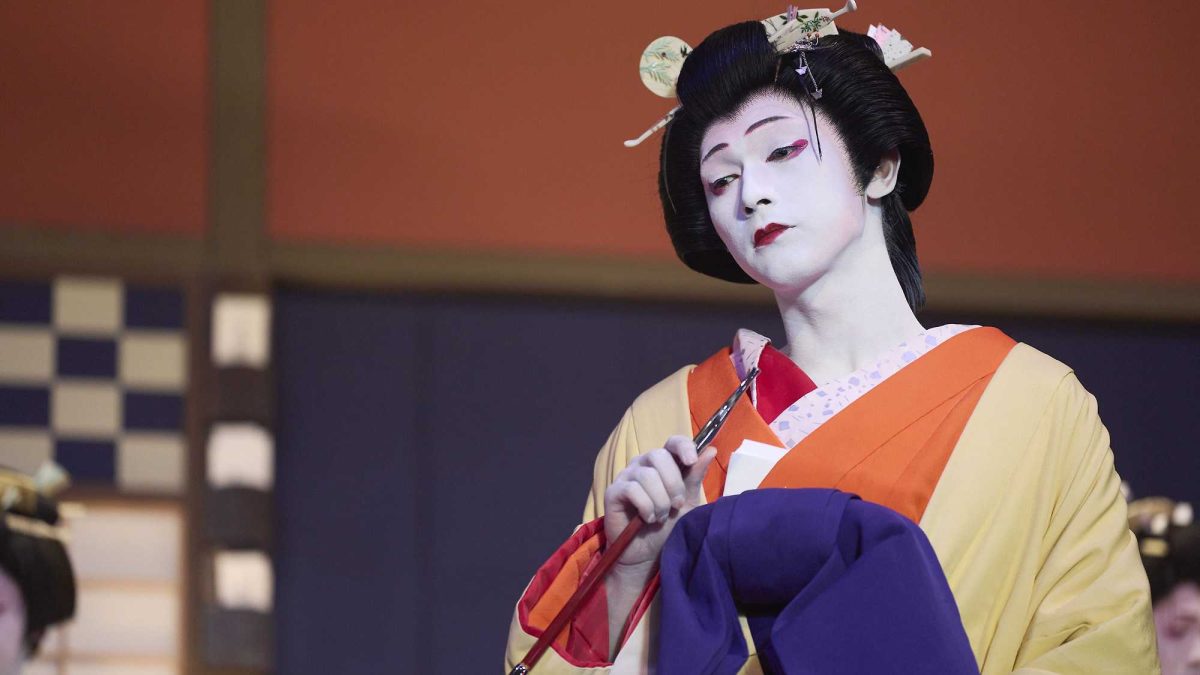
“Kokuho” spans an impressive amount of time without ever collapsing under its own weight. Although the story begins in 1964, director Lee Sang-il is able to adopt nuanced historical details in order to make convincing shifts to different periods leading up to 2014. “Kokuho” isn’t interested in talking down to its viewers, and doesn’t stop its pacing simply to explain historical context that might be relevant. However, the isolated nature of the story is also part of the point that the film is making; because they are within an insular world where the art of performance requires a separation from everything outside the theater, Kikuo and Shunsuke have lived through significant moments in Japanese history without feeling the affects.
The information about kabuki itself isn’t just educational, but inherently cinematic; “Kokuho” breaks down the essence of specific showcases, exploring how Shunsuke and Kikuo have tried to embody their characters by mirroring their mindsets. It’s a dangerous practice, especially in a profession where nothing but perfection is asked of them. Kikuo may have been born outside of nobility, but his seemingly inherent abilities begin to build a haughtiness within him, where he looks past those who were willing to help him along the way. Conversely, Shunsuke has grown embittered because his father rarely makes the distinction between personal affection and professional encouragement; the animosity he begins to develop towards Kikuo isn’t directed at his friend as much as it is an outcry to be loved.
Yet, “Kokuho” isn’t a film with villains, as both Kikuo and Shunsuke are likable and empathetic characters, a fact that is aided by the performances by the younger actors Sōya Kurokawa and Keitatsu Koshiyama, respectively. It’s also not a film that makes judgments about cultural practices that could be deemed outdated, as the prominence of kabuki itself shows why reverence for the past is so important for Japanese families. Sachiko Ōgaki (Shinobu Terajima), wife to Hanjiro and mother to Shunsuke, can seem cross when voicing concern about her husband’s willingness to train a non-family member, but her perspective is made valid when witnessing the psychological torment that their own son faces when trying to raise a family of his own.
If there’s one character who feels underdeveloped, it’s Fujikoma (Ai Mikami), a love interest to Kikuo whose presence is more intermittent due to the implementation of a plot twist. While the development is critical to showing how Kikuo’s relationship with the high society’s theater community changed during the later half of his career, it does mean that Mikami isn’t given much to work with, despite a charismatic performance. The film definitely could have spent more time exploring the roles of geishas like Fujikoma, but its singular focus on the kabuki community is a stylistic choice that pays off. Kikuo’s memories of the yakuza are fuzzy, as he has completely assimilated to a new way of life.
“Kikuho” gained traction with international pundits not only because it became the highest-grossing live-action film in Japanese history, but due to its somewhat surprising nomination for Best Makeup and Hairstyling at the Academy Awards. While there’s meticulous effort put in to ensure that the use of kabuki makeup is as authentic as possible for the time periods in which the film is set, there is also more nuanced craftsmanship meant to show the characters’ aging. Beyond the natural rigors of time, Kikuo begins to face physical challenges due to the intensity of his work, and Shunsuke suffers a critical illness that impedes his ability to operate in both life and theater. It’s not only a film that required passion from all involved on getting it correctly, but a testament to the multifaceted performances by the two stars.
“Kukuho” asks questions about the meaningfulness of art, and whether using performance as a means to wrestle with personal demons is effective or replicable. There’s certainly a lot of affinity for kabuki, as the film’s recreation of “The Love Suicides at Sonezaki” is a mirclous achievement in its own right, but it is by no means a toothless depiction of Japan’s class system or artistic community. The charisma of Yoshizawa and Yokohama is so effective that, even in the brief instance in which “Kukuho” dips into melodrama, it’s hard to not be riveted by the characters’ desire to find artistic serenity. The technical mastery of “Kikuho” is undeniable, but it is surprising the degree to which Lee keeps the spectacle focused on the evolution of a single friendship.
Film Credit
Director: Sang il Lee
Producer: Shinzo Matsuhashi
Screenplay: Satoko Okudera
Based on the novel by: Shuichi Yoshida
Cinematography: Sofian El Fani
Editor: Tsuyoshi Imai
Production Designer: Yohei Taneda
Costume Designer: Kumiko Ogawa
Music: Marihiko Hara
Cast: Ryō Yoshizawa, Ryusei Yokohama, Soya Kurokawa, Keitatsu Koshiyama, Ken Watanabe



![Roots [2021]: ‘KVIFF’ Review – A Distinctively Minimalist Portrait of Landscape and its People](https://79468c92.delivery.rocketcdn.me/wp-content/uploads/2021/08/Roots-2021-768x403.jpg)
![Laura [1944] Review – An Exceptionally Stylized Noir Mystery](https://79468c92.delivery.rocketcdn.me/wp-content/uploads/2019/11/Laura-1944-768x633.jpg)

![The Beach Bum [2019] Review – Freewheeling Poetry of the Excess](https://79468c92.delivery.rocketcdn.me/wp-content/uploads/2019/08/The-Beach-Bum-highonfilms-768x432.png)