David Lynch’s “Lost Highway” (1997) marks a turning point in his body of work, as he transitions from a quirky surrealist to a cerebral genius. More than just a puzzle box narrative or an exercise in cinema, this movie feels like a sustained visualization of psychic damnation. Where many of Lynch’s films flirt with the uncanny while still allowing moments of tenderness, a pause for humor, or a melancholic beauty, “Lost Highway” offers almost no sigh of relief to the viewer. It is cold and relentless, but that is precisely what makes it so powerful in his filmography.
This is not a story about redemption or about empathy; it is about a man who commits an unforgivable act and then attempts, unsuccessfully, to escape the reality of what he has done. Lynch himself has said that this film was mainly inspired by the O.J. Simpson trial, exploring how a person can carry on living after experiencing something traumatic by creating a new identity in their mind. “Lost Highway” and “Mulholland Drive” feel like two halves of the same conversation—films about how the mind survives trauma by inventing projections, and how those projections eventually collapse under the weight of reality.
“|Lost Highway” opens with one of the more famous lines in Lynch’s career: “Dick Laurent is dead.” Spoken through an intercom to Fred Madison (Bill Pullman), the phrase arrives without context. It immediately establishes the film’s logic. Like much of “Lost Highway,” the line feels less like dialogue and more like a pronouncement from some unseen authority. By the time the film loops back to this moment at the end, it becomes clear that this message is not a mystery to be solved but a symptom of a mind trapped in its own recursive nightmare. Bill Pullman’s performance as Fred Madison is central to the film’s suffocating atmosphere and is vastly underrated.
From the opening shots, Pullman plays Fred as a man already hollowed out, consumed by depression and paranoia long before any violence occurs. It makes me wonder what kind of direction Lynch gave Pullman in pre-production. His face often appears withdrawn, as if he is barely present in his own body while interacting with people. Even in moments of calm, there is something wrong in his stillness, a sense that he has already fallen into some dark abyss, and he is merely going through the motions of life.
Pullman resists any attempt to make Fred sympathetic or charming, and that refusal aligns perfectly with the film’s journey. “I like to remember things my own way. Not necessarily how they happened.” Fred says. This quote offers insight into his motivations and a better understanding of the second half of this film.
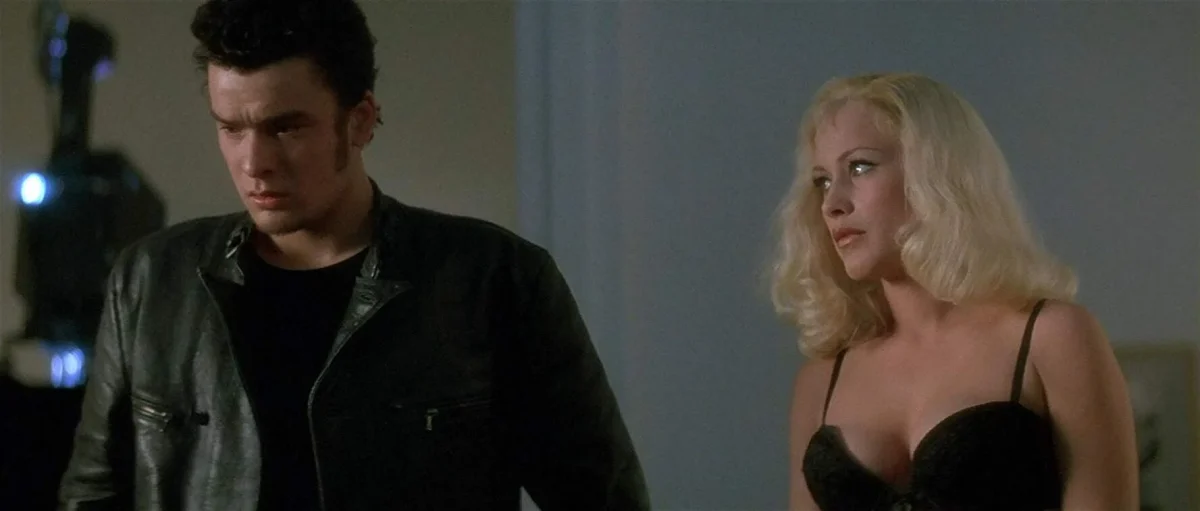
“Lost Highway” is unique among Lynch’s films in its complete lack of empathy for its anti-hero. In “Mulholland Drive,” for example, Lynch expresses genuine sorrow for Diane Selwyn, framing her breakdown as tragic. In contrast, “Lost Highway” offers no such compassion for its main character. The film seems to regard Fred Madison as fundamentally despicable, a man without redeeming qualities, and it never asks the audience to empathize with him. This emotional coldness is one reason the film is often considered Lynch’s darkest.
The first half of the film unfolds like a nightmare. Fred’s marriage to Renee (Patricia Arquette) is defined by jealousy. The videotapes left on their doorstep, first showing the exterior of their house, then the interior, and finally something far more incriminating, feel like manifestations of Fred’s fractured psyche. Seeing as Fred likes to remember things his own way, the videotapes symbolize reality breaking through to him. Someone is always watching in “Lost Highway,” and that watcher is ultimately Fred’s own fractured consciousness. The act of videotaping within the film also mirrors the act of filmmaking, turning Fred into both the subject and unwilling audience of his own crimes.
The tapes force him to confront an image of reality he cannot control or rewrite. It’s a recurring theme in this film, and one that is personified by the Mystery Man character. Lynch intensifies this feeling by filming these scenes inside his actual home, blurring the line between his personal space and a cinematic nightmare. The house itself mirrors a prison, an extension of Fred’s mind, echoing with dread and unresolved violence.
After Fred is convicted of murdering Renee and sentenced to death, the film shifts completely. The prison scene reminds me of the jail level from “Silent Hill 2.” It is a haunting environment. Fred physically transforms into Pete Dayton (Balthazar Getty), a younger man with a different life, different relationships, and a completely different personality. Suddenly, he is released from prison. This second half is best understood not as a literal transformation but as a fantasy constructed by Fred’s mind while he remains on death row. The concept aligns closely with the psychological phenomenon known as a psychogenic fugue, which is what “Lost Highway” is ultimately about.
This phenomenon happens when the mind creates an alternate identity so as to escape unbearable trauma. Unable to live with the reality of his crime, Fred’s psyche invents Pete as a vessel for his denial. Viewed through this lens, the second half of “Lost Highway” becomes a desperate attempt at self-examination. Yet even this constructed reality cannot remain stable. Although it appears more like a fantasy at first, the violence, jealousy, and impotence seep back into reality, suggesting that no amount of psychological disassociation can erase the truth. Just like “Shutter Island,” this movie presents an elaborate mental construct designed to shield a man from his own grief, only to gradually dismantle that construct and force a confrontation with reality.
That reality, however, is not met with redemption. Instead, “Lost Highway” presents evil as something inescapable from this character’s journey. The Mystery Man, played with chilling uncanniness by Robert Blake, feels less like a character and more like an embodiment of Fred’s subconscious guilt, or perhaps something even darker. He does not tempt Fred or trick him. He simply exists to reflect the truth back to Fred in a way that he refuses to accept. The idea of evil in “Lost Highway” is not seductive. In fact, it is suffocating. There is almost no comedic pause in the film, besides a cameo by Richard Pryor, making it arguably Lynch’s bleakest work. This is not an entry-level film in his filmography.
If you want to understand how Lynch uses cinema to convey ineffable experiences dealing with the mind, and why people love him for it, I would suggest working your way up to “Lost Highway.” The main character, Fred, is living in a perpetual hell, both in his mind and in the real world, recalling the torment of Raskolnikov in “Crime and Punishment,” a man psychologically destroyed by his own crime. Patricia Arquette gives a standout performance in this film. Her delivery of the line “You will never have me” gives the viewer goosebumps. When we are reintroduced to her again, in the second half, Lynch utilizes film noir techniques and references Hitchcock with his cinematography.
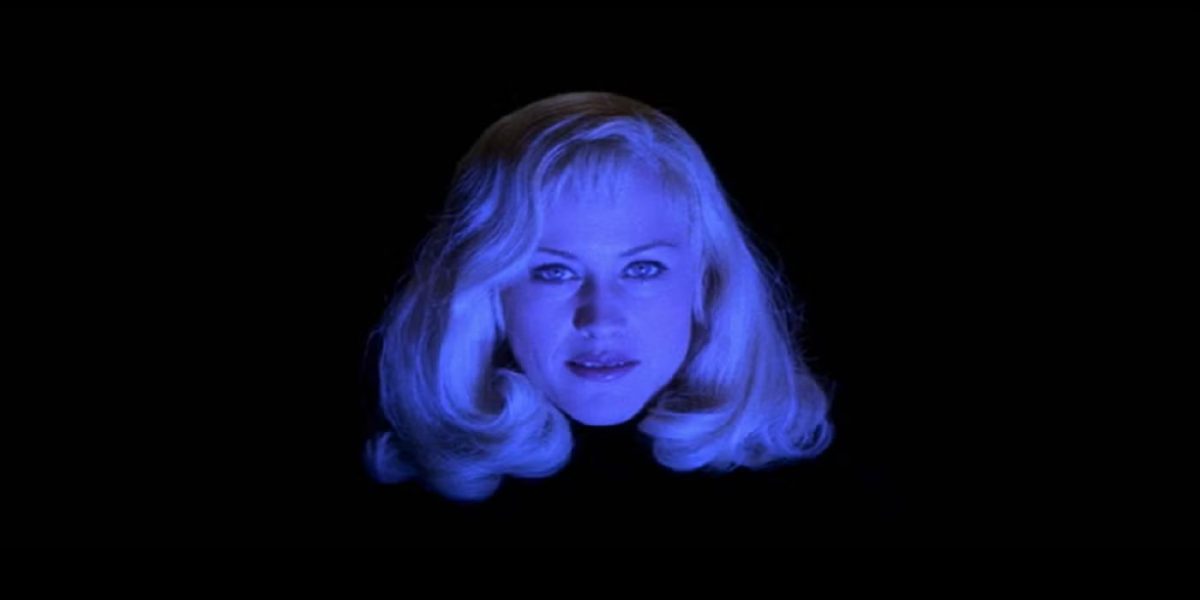
Visually speaking, there is a lot to think about, and there are plenty of motifs that appear in Lynch’s other films. There are long stretches of empty highways, blinding headlights, television static, red curtains, and shadows. Reality itself seems to glitch and fracture, most explicitly for the first time with the Mystery Man during the phone call scene, where Fred claims he cannot comprehend what is happening. “Who is that guy downstairs?” he asks afterwards. “I don’t know, I think he’s a friend of Dick Laurent,” says a partygoer. This moment feels like reality breaking apart, a cinematic representation of cognitive dissonance. Fred’s inability to understand what he is experiencing mirrors his deeper refusal to accept the truth of his actions.
One of the film’s most striking moments is when Fred is in the prison yard, which is composed with a painterly composition. “Is something wrong?” asks the Guard. “My head,” yells Fred. Doesn’t this sum up the film? The scene feels like a modern art installation. Reinforcing the idea that the film is less interested in narrative momentum than in capturing states of mind. Lynch also uses shifts in colored lighting at key moments to mark character realizations, a recurring motif across his films where color signals a turning point in a character’s emotional arc. I also like the soundtrack of “Lost Highway,” using bands like Rammstein during key moments.
The film expresses this inner torment through stark, nightmarish imagery. When we are introduced to Fred’s alter ego, it mirrors Edvard Munch’s “The Scream,” with a woman standing outside a house, her figure distorted by the lighting and framing in a way that suggests existential horror. This reference underlines the film’s obsession with internal anguish made external, emotion transformed into architecture and space. The final moments of “Lost Highway” complete this loop. Peter transforms back into Fred, and he delivers the line “Dick Laurent is dead” himself, sealing his fate and collapsing time in on itself. Rather than suggesting liberation, the ending implies finality.
The fantasy ends, the mind’s defenses fail, and the film strongly suggests that Fred’s story concludes with his execution in the electric chair, the ultimate consequence he has spent the entire film trying to avoid. The house burning seen in the film evokes Tarkovsky, functioning both as an apocalyptic image and a symbolic annihilation of his home. This film also marks the final role of Jack Nance, who played the lead role in “Eraserhead,” among other Lynch collaborations.
The writer David Foster Wallace visited the set of “Lost Highway” and wrote about Lynch’s working methods. He observed that Lynch’s films are often misunderstood as puzzles rather than experiences. “Lost Highway” exemplifies this. Its power lies in how completely it traps the viewer inside Fred Madison’s moral and psychological void. By refusing clarity, “Lost Highway” becomes one of the most uncompromising films of the 1990s, a merciless portrait of a troubled man who discovers that there is no escaping the self.


![Sanak [2021] Review: Works As A Silent Action Movie, Drags As A Character Drama](https://www.highonfilms.com/wp-content/uploads/2021/10/Sanak-2021-768x432.jpg)


![Game Of Death [2017]: Fantasia Film Festival Review](https://www.highonfilms.com/wp-content/uploads/2017/07/GOD-3--768x432.png)