One of the most interesting scenes in George Seaton’s “Miracle on 34th Street” (1947) is a conversation that follows right beside the locker room, between a Janitor and Kris Kringle, who plays Santa Claus at Macy’s, the “biggest departmental store in New York”. Kris Kringle appears to be indignant, and the Janitor remarks that commercialism is one of the worst “isms” out there: they jointly express their disapproval of a profit-making scheme their superior at Macy’s had just introduced to them.
The scheme in simple terms is as follows: every time a child queues up to talk to Kringle-playing-Santa, and asked for a toy (read: commodity), that Macy’s did not have, Kringle’s job was to introduce (read: recommend) to the child a range of other toys which Macy’s did have, toys that could not get sold earlier. In his conversation with the Janitor, Kringle observes that the scheme is morally questionable, since it relies not on fulfilling children’s genuine wishes, but on manufacturing artificial desires to benefit Macy’s.
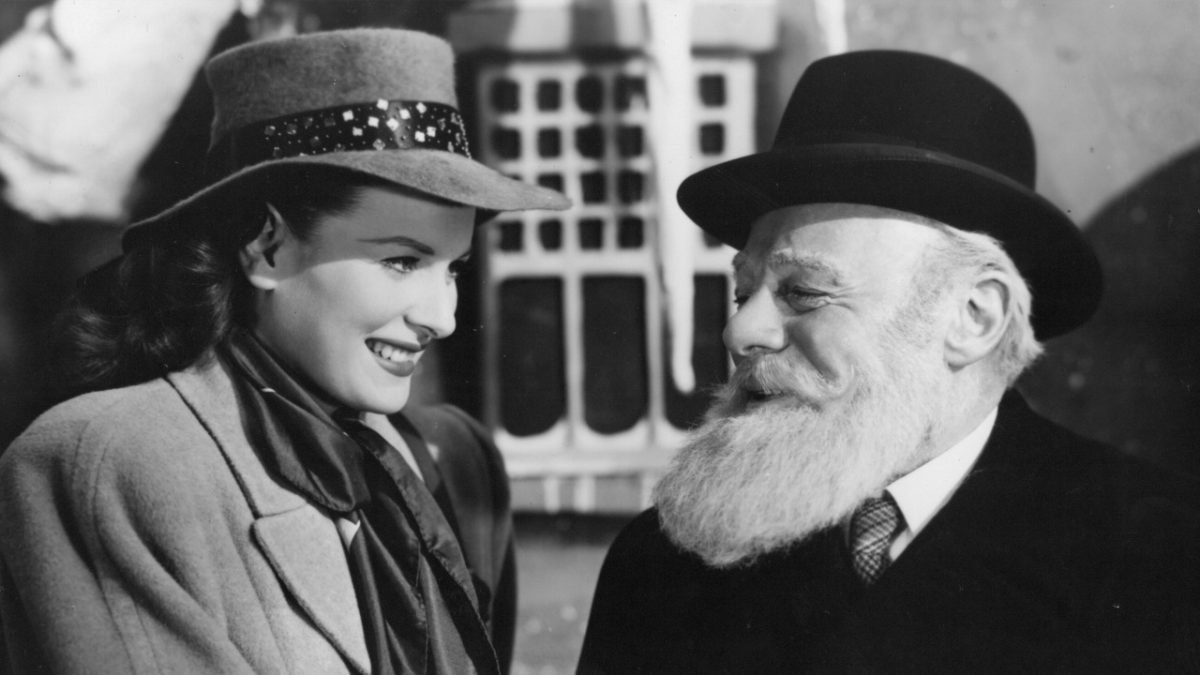
Next, we see Susan, the daughter of one of the store employees, have a brief argument with Kringle about the existence of Santa Claus. Susan, the torchbearer of rationality, denies the existence of Santa Claus, echoing her mother’s ideology of telling children the truth and nothing but the truth. Upon pulling Kringle’s whiskers, Susan realizes that they’re not fake and is further taken aback when Kringle starts conversing with a Dutch orphan girl in her own tongue, something that her adoptive parents hadn’t yet been able to do for her. All of this presents a conflict to Susan: to believe or not to believe in Santa Claus?
The film progresses, and we see a heated conversation transpiring between Susan and her mother, the same Macy’s employee who hired Kringle to play Santa Claus. Susan’s mother desperately tries to convince Susan that Santa is not real, using all rational arguments possible, including saying that just because Kringle speaks Dutch doesn’t mean he’s Santa, etc. Another instance that reveals Susan’s strict “rational” parental conditioning is when Susan remarks at one point that she doesn’t play with the children in the neighborhood, since they play “silly games” like pretending to be animals in a zoo.
Also Read: 15 Christmas Movies You Can Watch On Netflix
It is at this point that there’s a push back offered by Kringle: to play such games, Kringle says one has to have an imagination, and that imagination is a “place all by itself, like a separate country,” like the French nation or the British nation. This is the moment when the film sets up an immiscible dialectic between reality and fantasy, with Susan and her mother insisting on the former, and Kringle defending the latter, even comparing imagination to a nation.
There are at least two things that this comparison of imagination to any other nation tells us about Kringle’s conception of imaginary/fantastical worlds: a) just like a nation state, imagination too, is legitimate, contrary to Susan and her mother’s supposed beliefs, and b) imagination too, can be as concrete as a nation state, its counterpart in reality. Is Kringle then trying to hint that imagination is just another kind of reality, that these two things are not entirely antagonistic in their essential properties?
This dialectic between real vs. imaginary, Kringle vs. Santa Claus, is further problematized when Kringle is alleged with insanity since he won’t accept that he’s not Santa Claus. One thing leads to another, and the matter reaches the Supreme Court of New York. The situation turns murky to the point that the judge is now put in a pickle: he either must rule that Santa Claus doesn’t exist and that Kringle is mentally ill or seemingly agree that Santa Claus exists and that Kringle is Santa Claus.
The obvious problem with ruling the latter is being subject to suspicions concerning the judge’s own sanity, but as it turns out, the first ruling is even more undesirable: the judge denying the existence of Santa Claus would mean children not believing in Santa Claus either, that resulting in a sharp decline in toy purchase rates, making the toy industry suffer, manufactures laying off union employees, resulting in grave political consequences.
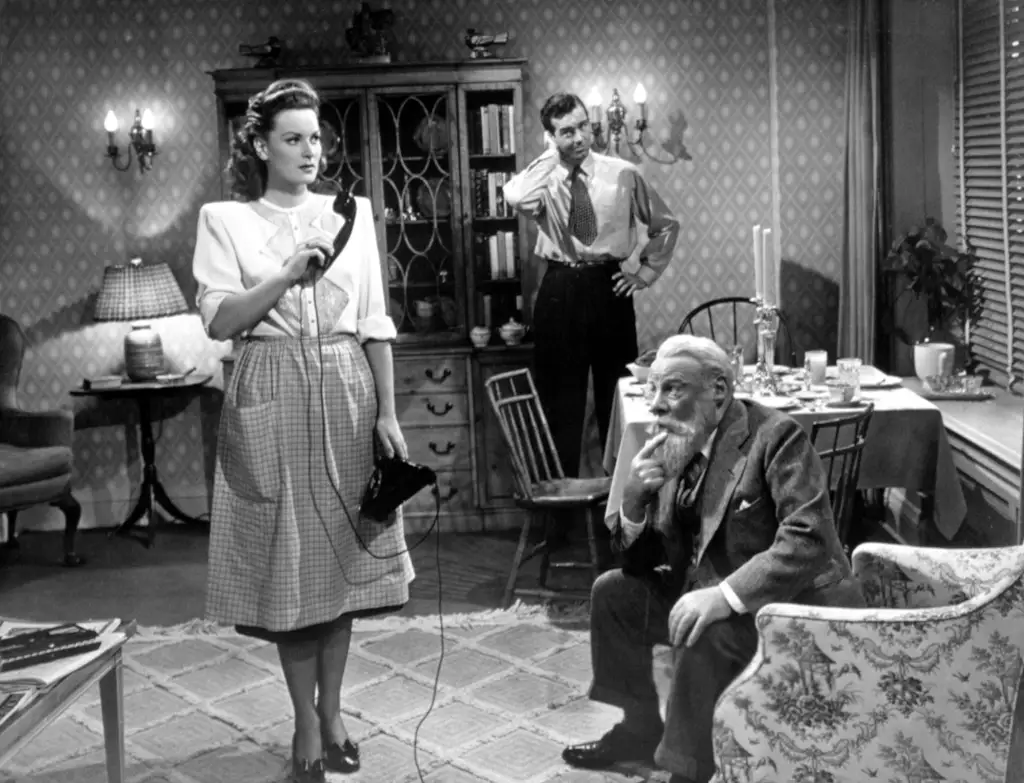
In the meantime, the trial finds a place in popular consciousness and becomes the city’s newest gossip. One strategic move by the post office (to save their own resources) is to make a few thousand letters to Santa Claus, all without an address, and get them delivered to Kringle’s residence. Kringle’s lawyer cites the legitimacy of the post office, a part of the federal government, and produces the letters as concrete evidence to prove that Kringle is indeed Claus in the court of law.
The judge lets out a sigh of relief and rules in favor of the sane Kris Kringle a.k.a Santa Claus. This marks the crucial moment, which is also the climax and one of the final scenes of the film: letters that reached Kringle pile up like a mountain on the judge’s desk as produced evidence, effectively hiding the judge behind the enormous pile. This symbolic moment surely was crafted with a lot of care. The highest seat of rationality, the judge’s court, ultimately depended on—and was eventually overtaken by—the power of faith, popular myth, and imagination, which became essential to sustaining both its authority and the socio-economic functioning of the entire city.
Related: 6 Christmas Movies Topping Streaming Charts in 2025
But that’s not all that the film says about the amorphous dialectic between reality and fantasy. To go back to one of the earlier scenes, where we find an indignant Kringle speaking up against the commercialization of Christmas, it becomes important to note that, somewhere implicit, is his problem with the vulnerability of children as a group that participates in the economy.
After all, the planting of new artificial wants for different, unsold, and available toys makes them an instrument that brings profit to the departmental store, the consumerist apparatus. Children as a class are manipulated “legitimately” by wealthy adults to secure their own benefit, and this is what irritates Kringle.
The film subtly highlights the irony that the system, eager to label Kringle as delusional, in an effort to reinforce a strict divide between reality and fantasy, is itself sustained by the very myth it seeks to dismiss. The consumerist structure of the annual Christmas market, rooted in tradition and legend, begins to unravel the moment it attempts to cast that myth aside. It is amidst these complex co-dependencies that we find Santa Claus/Kringle to be the sole individual who is not interested at all in the market or the economy.
Throughout the film, Kringle never once mentions that any of his actions are intended for anything other than the joy of children. It is not to posit that the market has nothing to do with the joy of children, after all, a huge chunk of the children who believe in Santa Claus will indeed grow up to be factory workers making toys for children, in hazardous conditions.
Instead, the force of the sentimentality of Kris Kringle as a character in “Miracle on 34th Street” accomplishes something applaudable: not only does he acknowledge the status of children in the consumerist economy as mere means, as a vulnerable class, but also, almost in a fit of impulsive righteous-urgency, Kringle puts for himself the joy of children as the topmost priority.
From departmental stores to courts via mental asylums, Kringle accepts his fate of being pushed around by authoritative adults, only to fully submit himself to what he identifies as his supreme cause: the joy of children, which is verily the spirit of Christmas, making him the patron Saint of Children’s strife, humanizing in Kringle the icon of Santa Claus.

![Both Sides of the Blade [2022] Review – The cutting agony of a relationship in splits](https://www.highonfilms.com/wp-content/uploads/2022/07/BOTH-SIDES-OF-THE-BLADE-MOVIE-REVIEW-1-768x432.jpg)