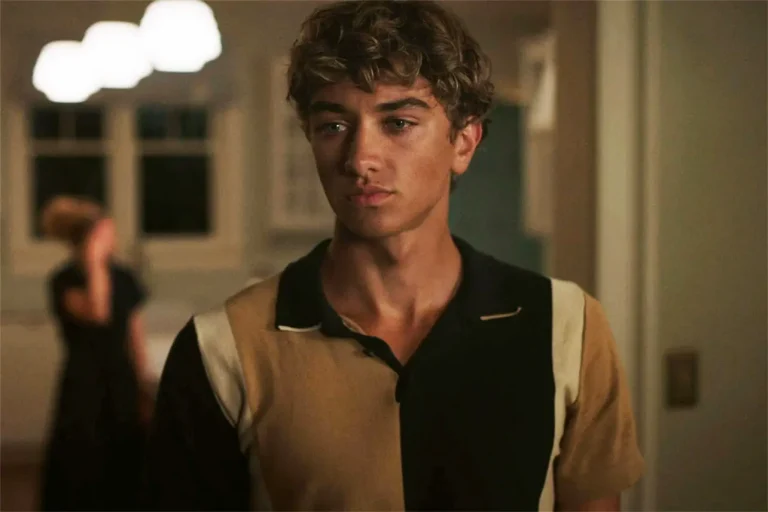
“Power Ballad” (2026) doesn’t have the type of premise that would be expected to be revelatory, and for the most part, it isn’t. However, the film shares a trait with nearly all of John Carney’s films thus far. It has a fascination and affinity for music that is presented without irony. Carney examined the primacy of rock discovery in “Sing Street” and the romanticism of indie folk with “Once,” so his film about pop music should be a bit more skeptical, whilst also playing broader.
There are obvious emotional entry points that Carney has no shame in playing upon, but there’s also some surprising nuance to “Power Ballad” that no other filmmaker would think to include. That the film is immensely entertaining if slightly unclear in its message might be the most truthful representation of what contemporary pop music is.
“Power Ballad” is the story of two very different musicians who have faced a crossroads in their lives. Rick Power (Paul Rudd) is part of a wedding band that performs covers across Ireland, even though he used to tour with his own group. Rick’s job takes him on the road, briefly separating him from the Irish woman he fell in love with and married, Rachel (Marcella Plunkett), and their 14-year-old daughter, Aja (Beth Fallon).
It’s whilst performing at the reception of a friend that Rick is placed in an awkward position in which he must perform alongside the former boy band member Danny Wilson (Nick Jonas), who has struggled to be taken seriously as a solo artist. It’s after getting to know one another that Danny helps to refine Rick’s song “How To Write A Song (Without You)” during a private jam session. While Rick leaves the encounter thinking that they’re friendly, he discovers months later that Danny has released the song as a single, and it has become an instant sensation that revitalizes his career.
The setup isn’t hackneyed, given that there’s a logical reason why these two characters would be in a situation to both perform together and surprise each other. On a surface level, both of their careers feel fairly underwhelming; Rick has a fairly dogmatic view of modern pop music, and Danny sees nothing special in just another wedding band.
What’s key is that they both are unsatisfied, but seek what the other has. Rick has the stability and affection of a family, and Danny has the platform in which to truly succeed professionally. Carney is smart to cast actors who are instantly believable in these roles, but that means that they’re able to dig in deeper by providing their emotional truths.
Also Read: Top 10 Film Soundtracks of 2016
“Power Ballad” doesn’t infantilize pop music, but it seems to understand the value it has emotionally. People react to the simple, often manipulative prose of a pop song because it represents a specific moment in their lives, and the lack of complexity doesn’t matter if it is conveyed in a powerful way.
Carney’s depiction of pop artists is that they have the ability to create lasting memories, but rarely find their work to be satisfying because the impact of their work is entirely experiential. Rick’s job is essentially to offer something soothing, if not necessarily challenging, for people on the happiest day of their lives, whereas Danny realizes that he’s viewed as a disappointment when not packaged as part of a marketable group.
Neither character comes off as pathetic, but Carney shows maturity in reflecting their anxieties. He also doesn’t discredit the audience for whom pop songs ring true. For a generation in which pop music has become corporatized and cynical, it’s reasonable to believe that something as pure as “How To Write A Song (Without You)” would take off, especially if it seemingly came out of nowhere.
As has been the case with Carney’s previous films, “Power Ballad” nails the details of the songwriting process when it comes to fine-tuning lyrics, discovering chords, and altering the presentation for the sake of the best live performance. The fact that he’s willing to iterate on the same song multiple times to show its evolution is refreshing, given that many music films try to cram as many tunes onto the soundtrack as possible.
That’s not to say that there aren’t other standout musical moments in the film (there’s a particularly great cover of Stevie Wonder’s “I Wish”), but it’s about the specific life cycle of one song. Carney is also restrained enough not to make either character a walking encyclopedia of music trivia. Both characters have spent so much of their lives performing that they’ve become a bit desensitized.
“Power Ballad” takes its time to build to the crescendo in its musical scenes, which find an interesting way to feel grounded, even when set within heightened situations. However, there’s also a fair amount of predictable plot points surrounding both characters’ relationships that make the second half of the film an occasionally tough sit.
There’s nothing wrong with “playing the hits” if it feels truthful, but “Power Ballad” includes characters that only exist to provoke. Even though Jack Reynor gave perhaps his greatest performance ever a decade prior in Carney’s “Sing Street,” he has a pretty thankless role in “Power Ballad” as Mac, Ray’s power-hungry manager. Although the scenes with Rick’s family are ultimately charming, his wife and daughter aren’t granted enough interiority to justify the emotional weight that they carry within the story.
What transforms “Power Ballad” from a fun hangout to a great movie is that the two leads have a natural repertoire, and both show a remarkable degree of self-awareness playing roles that are vulnerable. Rick is forced to question whether his younger self would be satisfied by the man he has become, and it’s among the more convincing of Rudd’s many roles as middle-aged, complicated fathers.
Jonas gives what is easily his best performance ever, as Ray is a character who is both burdened and empowered by the fact that he actually cares about his output. “Power Ballad” is actually a conversation-starter due to some of the more nuanced ethical debates it raises, but it’s also a classically well-paced dramedy with some wry observations about maturing. It’s also just a blast to watch, which may have been Carney’s truest intention.




![Phantom Thread [2017]: A Perverse Fever Dream of Love](https://www.highonfilms.com/wp-content/uploads/2018/02/Phantom-Thread-768x462.jpg)