
There’s no doubt that “Run Amok” was made as both a response to recent events and as an inquisitive study on what art can do to heal. Based on her short film of the same name, writer/director NB Mager’s feature-length directorial debut would seem intended to both work through difficult conversations regarding gun violence and provide a sensitive depiction of the unrelenting pressures put upon today’s generation of young people.
The degree to which “Run Amok” shows confidence within its thesis is remarkable, but the film’s attempts to merge approachability with emotional frankness are disastrous in both regards. It’s not that “Run Amok” is insensitive to the issues that it’s covering, but that the authenticity is so lacking that it ultimately says nothing.
It’s been ten years since the high school freshman Meg (Alyssa Marvin) lost her mother, an art teacher, in a school shooting incident that also claimed the lives of two other students and a teacher. Meg has essentially grown up as a sibling to her cousin, Penny (Sophia Torres), whose parents, Aunt Val and Uncle Dan (Molly Ringwald and Yul Vazquez), are apprehensive about talking about the incident.
Meg is neurotypical and struggles to express her feelings in ways that aren’t blatant, but she’s stirred to take action after being informed that the fine arts teacher, Mr. Shelby (Patrick Wilson), is preparing a commemoration to honor the anniversary of the tragedy. Convinced that self-expression is the best way to both reflect on grief and involve her school community, Meg sets off to stage a musical that reenacts the events of the horrible day.
Marvin’s performance is nothing if not sincere, as the young actress is certainly working to find something grounded within a very messy script. The issue isn’t with her interpretation, but with the way that the character is framed. It would seem that Meg’s inability to notice social cues and lack of self-imposed shame have allowed her to make aggrandizing, declarative statements that speak directly to the film’s intended themes.
There’s rarely an instance in which Meg’s emotions aren’t taken as valid, and her greatest crime is reaching out to people who don’t have the same emotional maturity. The issue comes from the fact that, by comparison, the rest of the characters feel devoid of anything that doesn’t resemble a cliche.
Must Check Out: Predicting 2026 Oscar Nominations
Despite the initial presumption that Penny is simply unwilling to deal with the social consequences of being associated with Meg, there’s little friction within their relationship that isn’t explained by teenage irritability. It doesn’t take long for Meg to realize that appealing to Penny’s need for praise will do the trick, and Penny soon commits to the production with the same intensity and self-awareness as her cousin.
The fellow students who join in the production are such hastily designed caricatures that it would almost be too complimentary to describe them as cliches. These are high school characters that only exist in high school movies, which makes it uncomfortable when they’re called to develop discourse about the reactions to gun violence.
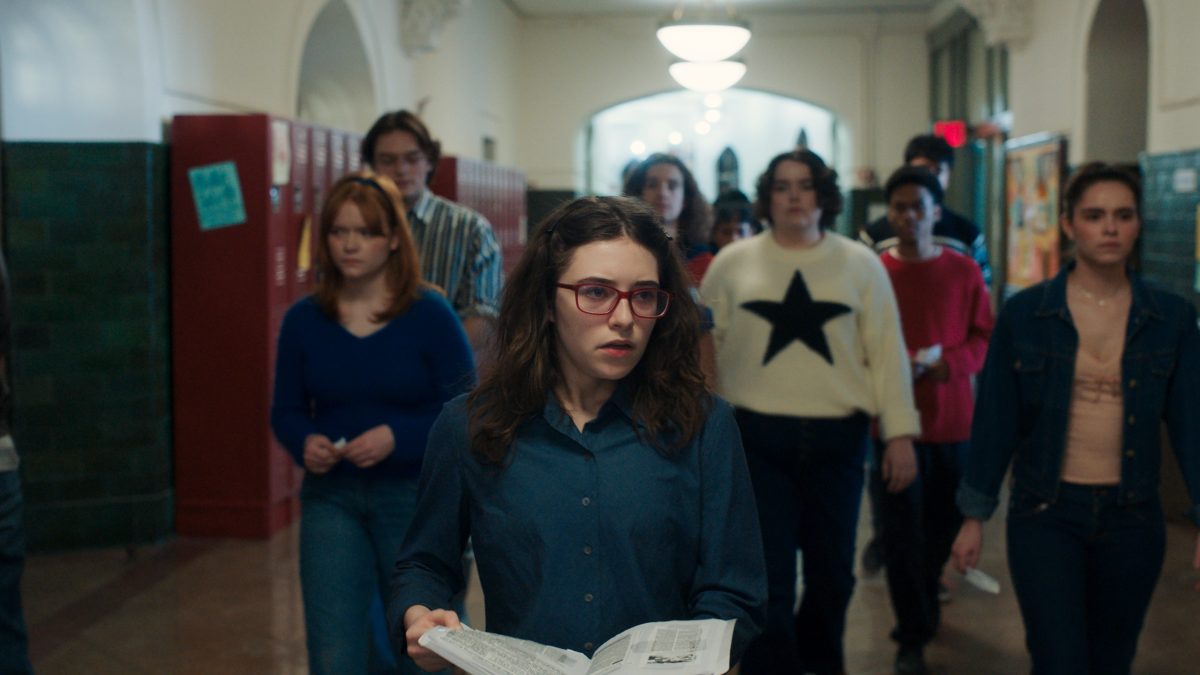
Although the rather slack depiction of high school culture, in which cliques and social media seemingly don’t exist, makes it hard to buy into “Run Amok” as a coming-of-age story, the film’s depiction of gun culture feels legitimately irresponsible. Any legitimate conversations about the way that America’s obsession with gun ownership has diverted attention away from the increasing number of fatalities are replaced with a strange storyline involving armed teachers and a board of parents that is either amateurishly depicted or used as a punchline, depending on the scene.
The rare scenes in which Meg is asked to actually confront what happened, even if she’s only processed the incident through second-hand accounts, are actually discordant with the tone that the rest of the film is at. Having a cast of famous supporting actors will certainly help “Run Amok” gain more attention as an independent feature, but the well-known faces only contribute to the stagedness.
Also Check: 15 Films That Won The Most Oscar Awards
Wilson is an actor so inherently charming that he actually masks the confused depiction of his character, who goes between being a larger-than-life basin of understanding and an aloof stick-in-the-mud, through the course of the musical’s production. Margaret Cho and Bill Camp, two wonderful actors, are cast in the roles of the school principal and the mentally unwell shop teacher, respectively. The former’s performance is dialed up to the point that it’s shocking that there is no subversion, and the latter is saddled with a post-traumatic stress disorder narrative that is indefensibly naive.
The question that Meg is faced with throughout her attempts to plan her project is “What will this do to help?” It’s a question that she isn’t able to ask because there’s nothing realistic about how these students would plan a production without supervision, why it would become so developed without any clarity, and how even a student as curious as Meg wouldn’t be able to see the fallacies. However, the same question could be asked of the filmmakers.
“Run Amok” doesn’t have any suggestions about the recovery process that aren’t more complex than that of a condolences card, and the ensemble is so thinly rendered that its scope would never feel encompassing of perspectives other than those of Meg and, potentially, Penny. It’s telling that a film that’s so willing to broadcast its intention as “Run Amok” plays it ambiguous when it comes to Meg and Penny’s takeaways from their experience, as there’s no means for this specific story to be satisfying.
“Run Amok” may have had the bravery to tackle an important issue, but there’s nothing nuanced enough in its commentary to make that boldness feel earned. The gravity of the material is used as a crutch to mask a lack of understanding on both young people and their ability to make a difference, as it does no favors to students, teachers, survivors, and accommodationists to be so toothless.
What isn’t brazenly misguided in “Run Amok” is a route with the same affinity for quirk that has made American independent cinema significantly less interesting in the last few decades. “Run Amok” may have made for a short worth of conversation, but as a feature, it’s entirely regressive.








![Sun in the Last Days of the Shogunate [1957] Review – Blending Madcap Comedy and Social Commentary](https://www.highonfilms.com/wp-content/uploads/2020/07/Sun-in-the-Last-Days-of-the-Shogunate-1957-768x432.jpg)