
Directed by Nadia Latif, “The Man in My Basement” (2025) is not structured like a conventional thriller. It behaves like a moral interrogation. The mystery is not about who Anniston Bennet is. The film tells you early on that he is dangerous, but the real question is why Charles Blakey allows him to stay, and what that says about power, race, and the architecture of guilt. Every conversation in the basement feels like a transaction. Not of money, but of truth. And truth, in this film, is never neutral. It always comes at a cost.
Spoilers Ahead
The Man in My Basement (2025) Plot Summary & Movie Synopsis:
Why Does Anniston Bennet Lock Himself in a Cage?
Charles Blakey lives in a house that looks larger than his life. The space is inherited, but stability is not. He is broke, unemployed, and quietly collapsing under the weight of past mistakes. The house is the only thing tying him to dignity, and even that is slipping away. So when Anniston Bennet offers him an absurd amount of money to rent the basement, Charles does not see an opportunity.
He sees survival. What he does not realize is that survival, in this case, will demand confrontation. Anniston’s decision to live inside a cage feels theatrical at first. A wealthy White man voluntarily imprisoning himself inside a Black man’s basement carries an immediate symbolic weight. It looks like an inversion of power. But the film slowly dismantles that illusion.
Anniston claims this is punishment. A self-imposed exile. He wants isolation to read, to reflect, to detach from the distractions of his privileged life. But even in confinement, he controls the narrative. He sets the terms, dictates the duration, and chooses the warden. The cage is not about surrender. It is about control disguised as vulnerability. Charles senses this instinctively. A man who can afford to imprison himself can also afford to leave. The power is not in the cage. It is in the choice to enter it. And more importantly, in the choice of who gets to watch.
Why Did Anniston Choose Charles?
Anniston does not choose randomly. He chooses strategically. Charles is not just broke. He is isolated. A man disconnected from his past, his community, and his own sense of purpose. Anniston studies him like a case file. Every detail of Charles’ life becomes evidence: his failed career, his embezzlement, his family losses, his mounting debt.
But the most unsettling part is not the data. It is the intention behind it. Anniston admits that he chose Charles because he is a Black man. This is where the film stops pretending to be subtle. Anniston wants a Black warden because his crimes are tied to systems of racial exploitation. He believes that placing himself under the supervision of someone from the oppressed community creates a form of balance.
But this is not redemption. It is performance. Anniston still dictates the rules. He still holds financial power. Even inside the cage, he remains the architect of the situation. Charles is not his equal. He is part of the design. The experiment is not about justice. It is about control, wearing the mask of guilt.
How does Anniston Still Control Charles from inside the Cage?
This is the film’s most unsettling idea. Physical imprisonment does not equal loss of power. Anniston is locked. Charles is free. Yet every interaction suggests the opposite. When Charles delays a meal, Anniston reacts with quiet authority. When he speaks, he frames Charles’ life in brutally accurate terms. He knows things Charles has spent years avoiding. The dynamic is clear: Anniston owns the psychological space. Charles begins to see it. That even if he unlocks the cage, his life will not improve. The mortgage will remain. His failures will remain. His identity, fractured, ashamed, stagnant, will remain.
Anniston’s greatest weapon is not his money. It is his understanding of systemic reality. He knows that Charles is trapped in ways that are invisible but far more permanent. The cage, then, becomes symbolic. Anniston is physically contained. Charles is structurally contained. And structural containment is harder to escape. The basement holds more than Anniston. It holds history. When Charles discovers the artifacts, masks, objects, and remnants of a forgotten lineage, the film introduces a counter-narrative. Charles is not just a man who failed. He is a man who forgot.

Narciss, the curator, understands this immediately. She sees value not in monetary terms, but in cultural continuity. The artifacts are not objects. They are anchors. But Charles initially treats them like everything else in his life, as something to sell. This is crucial. His disconnection is not just financial. It is historical. He is detached from a legacy that could have grounded him. And that detachment mirrors the larger theme of systemic erasure. Anniston represents a world that exploits. The artifacts represent a past that resists erasure. Charles stands between the two.
What does Anniston reveal about His True Identity?
The shift happens slowly, then all at once. Charles realizes that following Anniston’s rules keeps him in the same position, subordinate, reactive, and dependent. So he rewrites the structure. Food becomes conditional. Water becomes conditional. Light becomes conditional. And truth becomes currency. For the first time, Charles dictates terms.
But even this is not a clean form of empowerment. It is a negotiation. He is still inside a system shaped by Anniston. The only difference is that he is now actively engaging with it instead of passively accepting it. The rule exchange, three questions for one, becomes the film’s core device. It forces both men into vulnerability. Anniston begins to unravel and Charles begins to confront. The revelation of Anniston’s real name, Tamal Knosos, is not just a twist. It is a collapse.
The man who built his identity on whiteness, power, and control is revealed to be someone who constructed himself. The blue eyes were artificial, the name was borrowed. The heritage was fabricated. This moment reframes everything. Anniston is not just a perpetrator of systemic violence. He is also a product of it. He chose whiteness because he understood its power.
Moreover, he weaponized identity because the world rewards certain identities over others. But this does not redeem him. It exposes the mechanism. Anniston is terrified at the possibility that he might be connected to the very people he oppressed. Because that would collapse the distance he relies on to justify his actions. Distance allows cruelty. Proximity demands accountability.
Why does Anniston Kill Himself?
Charles’ confession is quieter but heavier. He did not kill his uncle with a weapon. He killed him with absence. Neglect becomes the method. Silence becomes the act. His uncle was abusive. The resentment was justified. But the act, the refusal to help, the decision to let him die, haunts Charles because it blurs the line between victim and perpetrator. This is where the film becomes deeply uncomfortable. It refuses to offer moral clarity. Charles is not innocent. Anniston is not redeemable. But both are shaped by systems that distort choice.
The difference lies in what they do with that awareness. Anniston’s suicide is not framed as redemption. It is framed as inevitability. When left alone in darkness, stripped of control, he is forced to confront memory. Not as narrative, but as consequence. The faces return, the stories return, and the justifications fail. For the first time, he is not feeling guilty. He is experiencing it. And he cannot survive it. His death is not justice. It is an escape. A final act of control in a life defined by it.
The Man in My Basement (2025) Movie Ending Explained:
Was Anniston Bennet Real, or Just a Projection?
Charles’ transformation is not dramatic. It is deliberate. He refuses the pill. He refuses the easy exit. Instead, he chooses continuity. He keeps the house, honors the artifacts, and builds something with Narciss, a museum, a space of memory, a reclamation of history. The house is no longer just property. It becomes a purpose.
He reconnects with people. Attends funerals. Shows up at weddings. Engages with the community. The final image of him reading The Wretched of the Earth is not symbolic in a vague sense. It is precise. Fanon writes about decolonization not just as a political process, but as a psychological one. Charles is beginning that process.
Freedom, the film suggests, is not the absence of cages. It is the ability to recognize them and choose differently. The film leaves room for interpretation, but the evidence leans toward reality. Anniston affects the world. The foreclosure is real. The money is real. Other characters hear him and interact with the consequences of his presence. If he were imaginary, the system would also have to be imaginary. And the film is not interested in denying reality. It is interesting in exposing it. Anniston is not a metaphor pretending to be a man. He is a man who functions like a metaphor.
The film does not resolve its tension. It redirects it. Anniston dies, but the system that created him does not. Charles survives, but survival is only the beginning. The real work lies ahead. Power, the film argues, is not always visible. It does not need chains. It operates through history, identity, and internalized limitation.
Anniston understood this and exploited it. Charles learns it and resists it. That is the difference. One man builds cages for others and calls it necessity. The other learns he has been living inside one and decides to step out. Not completely or instantly. But consciously. And in a world designed to contain him, that decision is radical.
The Man in My Basement (2025) Movie Themes Analysed:
Power, Guilt, and the Inheritance of Identity
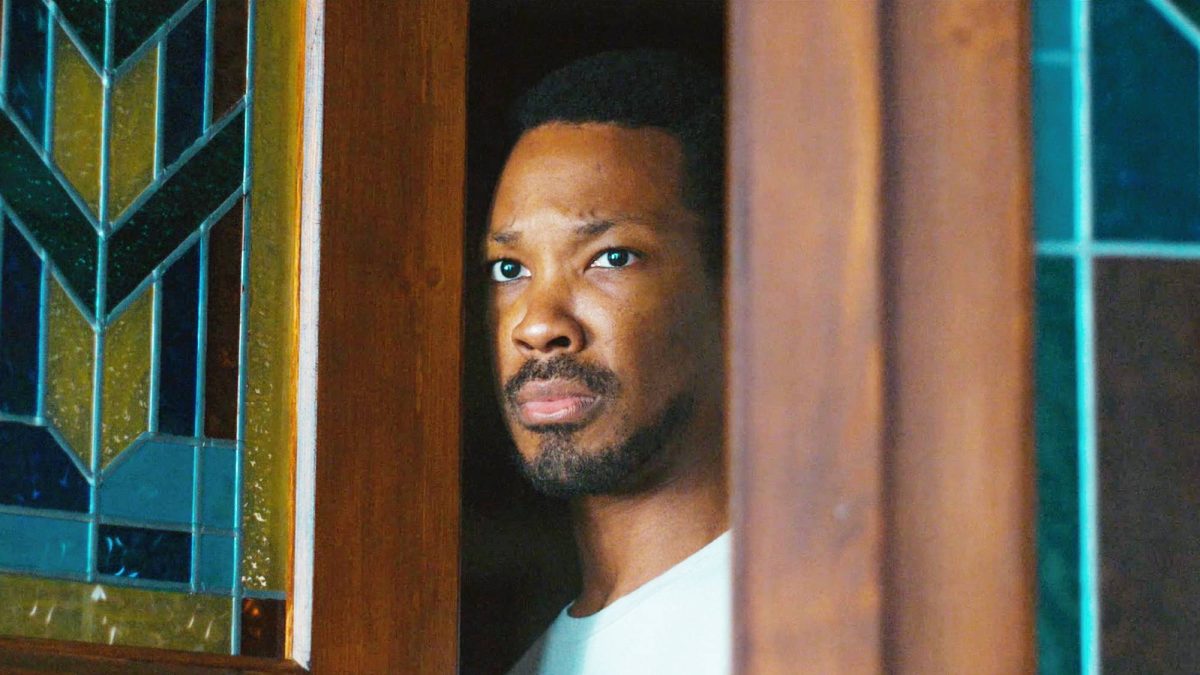
“The Man in My Basement” is directed by Nadia Latif. The movie doesn’t feel so much like a thriller, but more like a psychological exploration. It’s a movie that takes its characters and strips them down to their very moral essence. It’s also a movie that asks the question: are we made more by the world we’re in, or the choices we make within the world we’re in?
One of the main things the movie explores is the concept of power. The concept of power, as it’s explored in the movie, is not loud or flashy. It’s quiet, hidden, and inherited. The main character, Anniston Bennet, may seem powerless on the surface. He’s in a cage, and he’s dependent on Charles for his very existence. However, as the movie progresses, it’s made very clear that power is not about where you are or what your circumstances are. Power is about the choices you make, the story you create, and the perception you control.
Closely tied to this is the film’s exploration of race and structural inequality. Anniston’s confession that he chose Charles specifically because he is a Black man is not just provocative; it is diagnostic. It reveals how deeply race informs opportunity, consequence, and identity. Anniston recognizes this about Charles. This is not by accident.
This is systemic. The film does not simplify this into victimhood, though. Race is portrayed as a factor that influences reality but also as a factor that allows for agency. This brings the film into one of its most complex explorations: guilt. Anniston’s crimes are extreme, global, and calculated. He has brought harm and justified it by a twisted sense of equilibrium. Charles’ guilt, on the other hand, is intimate and personal.
He has let his uncle die, not just out of cruelty, but out of a build-up of resentment and emotional exhaustion. While the film does not equate these two types of guilt, it juxtaposes them to show the complexity of morality. Both men are forced to deal with what they have done, but only one of them really engages with this.
Another major theme is that of identity and its construction versus inheritance. Anniston, who is revealed to be Tamal Knosos, has constructed himself to be white and has used this to gain entry and power. His identity is one that he has chosen and one that he has used for his gain. Charles, on the other hand, has an inheritance of culture but is disconnected from it.
The artifacts in his basement represent his past, and one that he has chosen to ignore. Through Narciss’ character and influence on Charles, the film is saying that one’s identity is not something that is given to them but something that must be dealt with. To ignore one’s identity is to be without grounding.
To use one’s identity for gain, as Anniston has done, is to distort one’s identity. Lastly, the film is deeply invested in the idea of freedom—not as a physical condition, but as a state of mind. Anniston is physically confined but is mentally evasive until the very end. Charles is physically free but is mentally confined.
The turning point comes when Charles begins to reclaim control, not by escaping his circumstances, but by redefining his relationship to them. His decision to preserve his heritage, reconnect with his community, and continue living is framed as an act of resistance. In the end, “The Man in My Basement” suggests that true freedom is not the absence of cages, but the awareness of them, and the will to confront what they have made of you.





![Badhaai Do [2022] – Ending and Themes Explained](https://www.highonfilms.com/wp-content/uploads/2022/02/Badhaai-Do-2022-768x432.jpeg)