As the image gradually emerges from darkness, vast meadows and undulating hills stretch across the screen, revealing the quiet beauty of Bhutan. A young monk in Buddhist robes strides through the landscape, a gas cylinder resting on his shoulder, while the camera lingers on the grasses trembling softly in the breeze. When the gentle music rises, the audience feels drawn into an ancient land that has, until now, lived in deliberate seclusion.
It is 2006, and Bhutan’s King Jigme Singye Wangchuck has decided to abdicate his throne. The small country, which has long been a monarchy, is undergoing a significant transformation as it prepares for democracy. Elections are in the air as officials travel to remote villages to introduce former subjects, now turned citizens, to the novel idea of elections. But how will people who have always revered their king now deal with the chaotic and divisive exercise of elections? Pawo Choyning Dorji’s “The Monk and the Gun” tries to explore this conundrum.
With lush cinematography that relies on minimal camera movement, the film builds an immersive ambience of whispering winds and enigmatic hills, contrasts it with the chaos and occasional seediness of city life, and sprinkles in unexpected moments of humour that make you burst out laughing. Through all this, the movie arrives at a question we have all quietly wondered: do politics and elections distance me from my neighbour?
“The Monk and The Gun,” with its sociological outlook, uses the camera in a way that intends to capture interactions between its characters and let the subtlety of its dialogues shine. There is no preaching but deep lessons around tradition, modernism, monarchy, democracy, and change ready to be picked up as villagers cook meals in kitchens, as monks pray and worry about the impending elections, and as political debates make their way to a place where deep silence usually rules.
In the village of Ura, people will now have to choose between three colours, red, blue, and yellow, in mock elections which are being conducted as rehearsals for the democratic transition. Blue for freedom and equality, red for industrial development, and yellow for preservation and tradition. In a scene, voters are turned back from the mock elections as they are unable to recall their birthdays for registration. Here, democracy feels secondary to something as clinical as data verification.
From The Same Year: The 20 Best Indian Movies of 2023
Through the eyes of Tshomo, beautifully played by Deki Lhamo, we get to see how the electoral preparations have already caused a rift in her family. Her daughter is bullied at school, and her husband is ostracised in the village for his electoral canvassing for being a perceived ‘outsider’. As she is attached to assist an election officer, Tshering Yangden, played by Pema Zangmo Sherpa, to help with the process of the mock elections, their world views collide. We are also taken on an expected ride of self-reflection as we are forced to think about the nature of political discourse in our country.
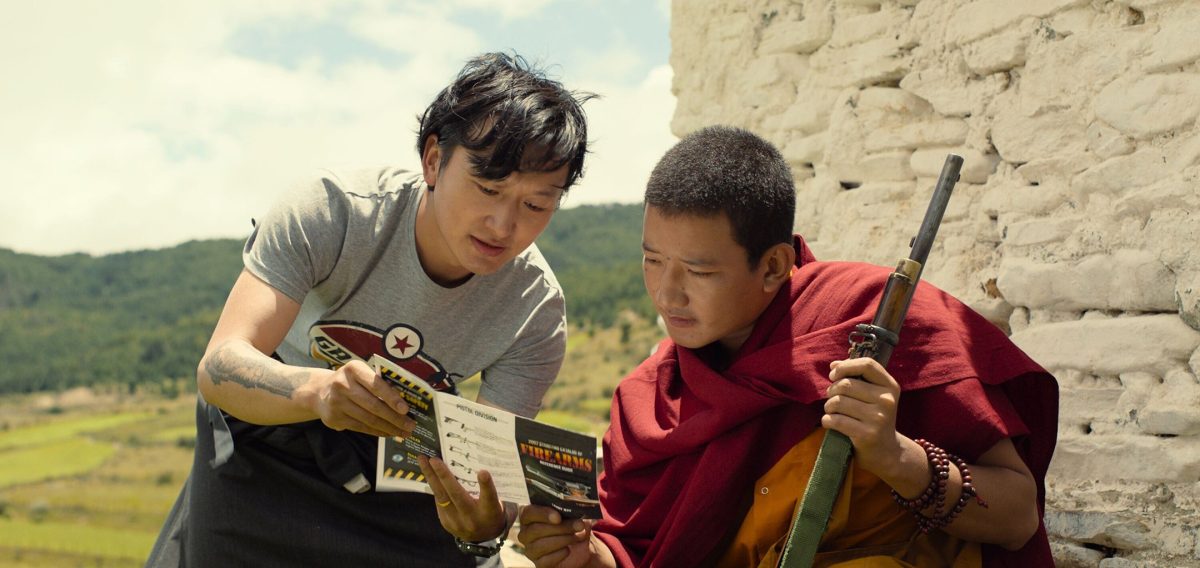
In the initial sequences, Tandin Wangchuk’s Tashi, a young monk, is tasked by his master, a senior Lama, to arrange for two guns – two guns in a country where anti-gun laws are among the strictest in the world. Tashi wanders all around the village as he tries to fulfil the wishes of his master. As democracy makes its way to the landlocked country, so does television and the internet. Tashi sits at a shop, crowded to the brim as villagers sit on the floor silently. All are fixated on the television set. Tashi asks for ‘black water,’ and a small girl hands him a Cola.
Everybody talks in hush tones as they watch Daniel Craig perform death-defying stunts as James Bond. Thus, western pop culture has crawled to a remote village in Bhutan. His search for guns leads him to finally acquire an antique rifle from an old villager. The Remington rifle was being sold to Tashi merely for a betel nut. However, the gun brought by foreigners to Bhutan a long time back can fetch thousands of dollars in the outside world, which often fetishizes tools of violence.
The Antique Gun also attracts Ron Coleman, an American gun collector who hires Benji. The Bhutanese urban youth is comfortable with speaking English and thus works as a translator, mediator, and even fixer for him. Soon, cultural contradictions arise as Ron faces the fact that American love for guns and promises of bundles of money simply do not matter in Bhutan.
Scenes with a confused Ron and a worried Benji provide for hilarious moments as they try to negotiate with Tashi for the antique. Be it Ron being gifted a giant red phallus statue or Tashi carrying a rifle over his shoulders like a sack of potatoes, the movie does a wonderful job of mixing reflective moments with subtle humour.
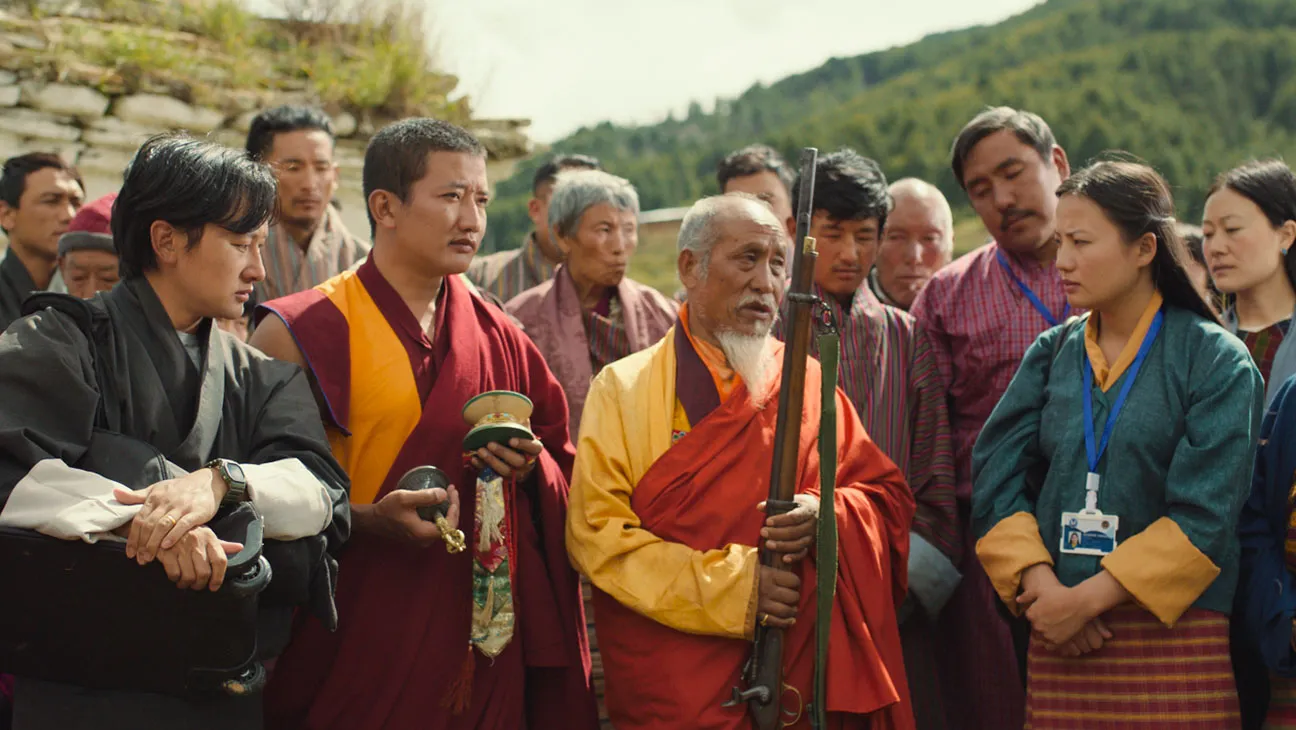
The movie also features a diverse cast, as many natives of Ura village, with no prior acting experience, make their way to the screen. As the Bhutanese film industry is still in its nascent stages, Pawo makes do with a limited budget and a lack of seasoned actors. In fact, the use of locals renders the movie a realistic touch both in terms of cultural depictions and the importance of rituals in everyday life.
Also Related: The 25 Best Films of 2023
There are no theatrical moments, but calm pondering as village elders see their friends indulge in debates encouraged by officials. “Why are you teaching us to be so rude?” asks a grandmother to Yangden as villagers scream for their support of fictional red and blue parties. Does politics always need some form of aggression from its participants? Can Bhutan really cope with elections? Is modernism limited to the advent of electoral processes? Surprisingly, “The Monk and The Gun” asks such questions with much poignancy.
Through rolling hills and lush green meadows, the audience moves with the film’s narrative, guided by a gentle hand and an editing rhythm that renders the experience almost meditative. The phrase “Every Frame a Painting” genuinely applies here. Jigme Tenzing’s remarkable command over light and composition teases out the mystical character of the land. Wide shots of streams cutting across hills, winding roads curling toward the village, ancient stupas, worn interiors of rural monasteries, and even the harsh, fragmented colours of urban spaces all find their place in his visual tapestry.
The film’s third act shifts gears, transforming into a surprisingly thrilling ride as Ron and Benji are chased by the police under suspicion of gun running. The plot thickens further with shady negotiations and the sudden arrival of AK-47s into the picture. Meanwhile, Tashi scrambles to secure the two guns before the full moon deadline, pushing the audience toward the moment when we finally learn why a Buddhist monk needs weapons in the first place. The suspense pays off. The gun emerges not only as a crucial narrative engine but also as a striking visual metaphor that anchors the film’s message.
Ultimately, it is revealed that people chose the colour yellow in overwhelming numbers as voters connected the colour with their king, who had now abdicated. Maybe the Bhutanese were doing just fine with their much-adored king, and the process of elections has opened a Pandora’s box. What makes “The Monk and The Gun” a powerful watch is that it is based on real events, at least in terms of the politics of the country during the time. People stood up for preserving tradition and their king, even as their country transitioned to a democracy – a rare sight in the modern world.
Despite its unmistakably cynical undercurrents, the film’s ending tugs at the heart, as the lives and experiences of its characters converge in a village-wide ritual where tradition and Buddhist philosophy take centre stage. The result is a heartfelt, deeply moving reflection on the political and sociological forces that shape a nation. For a film industry as young as Bhutan’s, this is an astonishingly assured step forward. If this is where the journey begins, we may soon be speaking of Bhutan not just as a land of stunning landscapes, but as a home to cinematic classics as well.


![The Swallows Of Kabul [2019]: Cannes Review](https://www.highonfilms.com/wp-content/uploads/2019/05/The-Swallows-Of-Kabul-Cannes-High-On-Films-768x415.jpeg)
![Maaran [2022]: ‘Hotstar’ Review – Maddeningly Horrible!](https://www.highonfilms.com/wp-content/uploads/2022/03/Maaran_-768x512.jpg)