
The 2026 Travessias Brazilian Film Festival, hosted by Seattle’s Northwest Film Forum, offered more than a curated sample of recent Brazilian cinema. Its four-film program — “Manas,” “Motel Destino,” “Criadas,” and “O Último Episódio” — collectively sketched a portrait of a nation negotiating violence, identity, desire, and memory. If taken together, these works suggest that contemporary Brazilian cinema is less interested in escapism than in confrontation. Rather than exporting spectacle, they export tension, a cinema attuned to friction, to the weight of structures pressing against intimate lives, and to the quiet endurance required to inhabit them.
Three of the four films gravitate toward forms of social pressure that shape bodies and relationships. Whether through urban precarity, domestic hierarchies, or erotic entanglement, these narratives explore spaces where intimacy intersects with structural imbalance. In “Manas” (M. Brennand, 2025), arguably the strongest of the selection, social violence is neither abstract nor rhetorical; it permeates gesture, silence, and environment. The film situates its characters within systems that feel at once intimate and inescapable, revealing how inequality persists not as spectacle but as atmosphere. Its restraint becomes its force, refusing melodrama in favor of slow suffocation, an approach that trusts the viewer to sit with discomfort rather than consume it.
Similarly, “Motel Destino” (K. Ainouz, 2024) stages desire within confinement, transforming a roadside motel into a laboratory of power and vulnerability. Here, sexuality is inseparable from economics and masculinity; eroticism becomes negotiation, proximity becomes threat. “Criadas” (C. Rodrigues, 2025), in turn, sharpens the lens on labor and gender, exposing the quiet endurance embedded in domestic structures that outlast individual rebellion. Across these works, the body becomes both battlefield and archive, inscribed with race, class, expectation, and inherited constraint.
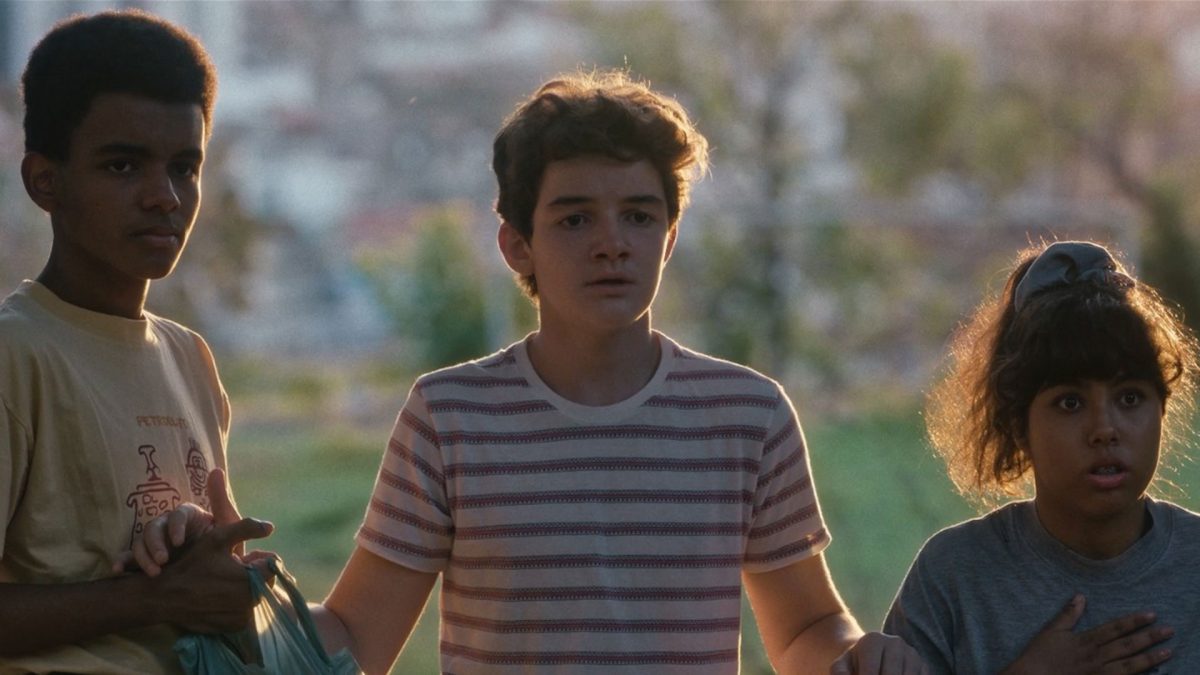
What deepens the coherence of the program, however, is not only thematic convergence but a shared formal sensibility. Each film embraces a language of containment: controlled framing, measured pacing, and an emphasis on spatial tension. Interiors dominate. Corridors narrow. Domestic spaces become charged with invisible hierarchies. Even moments of apparent stillness are fraught with implication. Meaning accrues through duration rather than declaration, through accumulated glances and withheld release. This aesthetic discipline reflects a broader tendency within contemporary Brazilian cinema that articulates social fracture through mise-en-scène rather than slogan, through embodied presence rather than rhetorical excess.
Also Read: Manas (2025) ‘Travessias’ Movie Review: Childhood Crossed by Silence and the Structural Horror Beneath a Natural Paradise
Against this constellation of urgency, “O Último Episódio” (M. Martins, 2025) feels almost like a tonal interruption. Focused on the transition from childhood into maturity, the film leans into nostalgia and emotional recollection. Its departure from the sharper social engagement of the other selections is noticeable. At times, its embrace of saudade risks drifting into romanticized recollection, softening the program’s political edge. Yet this contrast may be precisely what gives the curation its dimensionality. Nostalgia here reads less as denial and more as counterpoint, a reminder that memory, too, is a terrain shaped by social conditions. If the other films confront structural strain head-on, “O Último Episódio” suggests the psychic residue such strain leaves behind.

The program reveals an evident attentiveness to dialogue rather than uniformity. The selection does not attempt to define Brazilian cinema through a single ideological lens, nor does it flatten it into easily exportable narratives of crisis. Instead, it foregrounds filmmakers working within distinct aesthetic registers who nevertheless share a commitment to rigor and social awareness. The goodwill behind this curatorial gesture is palpable: these are not films chosen for market familiarity or festival buzz alone, but for their sustained engagement with form and lived reality.
At the same time, the very necessity of a festival like Travessias underscores a structural imbalance in global circulation. Despite critical recognition and festival premieres, many contemporary Brazilian films continue to struggle for consistent international distribution. Their visibility often depends on temporary platforms rather than durable access. In this sense, Travessias operates as both celebration and intervention, a space that compensates, however briefly, for the asymmetries of the global art-house market. The festival becomes not merely a showcase but an act of cultural mediation, bridging audiences that mainstream distribution channels have yet to fully connect.
What ultimately emerges from the festival is not a unified thesis but a mosaic of pressures and responses. Brazilian cinema today appears deeply committed to situating its characters within structures that constrain and define them, whether those structures are refracted through desire, labor, violence, or memory. It does not present a singular Brazil, but a country in transit, crossing between confrontation and recollection, urgency and introspection, local specificity and global marginalization. In bringing these works into sustained dialogue, Travessias affirms that contemporary Brazilian cinema is neither peripheral nor monolithic; it is formally disciplined, politically alert, and restless in its search for new ways to render lived experience visible.


![The Rib [2019]: ‘NYAFF’ Review – An Important Chinese Film](https://www.highonfilms.com/wp-content/uploads/2019/07/The-Rib-highonfilms-768x432.jpg)


![This Shaking Keeps Me Steady [2019] ‘LIFF’ Review: The Bottomless Pit of Reality](https://www.highonfilms.com/wp-content/uploads/2019/06/tskms-1_1_orig-768x432.jpg)

![Fortuna [2018]: ‘Locarno’ Review](https://www.highonfilms.com/wp-content/uploads/2018/08/FORTUNA_LOCARNO_HOF_1-768x537.jpg)