
You may not be aware of Juliano Mer-Khamis, a self-proclaimed “100% Palestinian and 100% Jewish” actor and political activist whose life, identity, and philosophy form the crux of Michael Dahan’s film, “Yes, Repeat No.” And suppose you go into the film expecting a straightforward biography, Dahan’s approach will probably frustrate you if you aren’t already frustrated with his conceptual meta-investigation or a narrative that does not justify why it is about Juliano in the first place.
That said, there are a lot of merits here that warrant consideration. For one, the film’s approach not to present a formulated stance on the Israeli-Palestinian conflict but to foreshadow and establish a link about anti-war sentiments, all the while backing it under the layered siege of stands from both sides, works if you really dig its verbose structure. Second, the confusing and confounding conceptual film, perceived out of Juliano’s work, gives it a free-flowing structure that requests something from everyone – the actor, director (who shows up intermittently), and the audience – engaging you firsthand in a frustrating but ambitious experiment.
Talking about the structure, “Yes, Repeat No” opens with a basic introduction of Juliano Mer-Khamis with three actors namedly – Karim Saleh (Israeli Juliano), Mousa Hussein Kraish (Arab Juliano), and Adam Meir (Public Juliano) first contesting against each other before being thrust upon a rotating soundstage to play versions, or fragments of Juliano’s personality.
The preliminary reading of the film’s screenplay is closely cut together with Juliano’s own ideologies, with the base of the conflict to be established with the reading of “The Little Drummer Girl,” the 1984 film that also marked Juliano’s debut, and features scenarios where the conflict is addressed via a temporal displacement of identity.
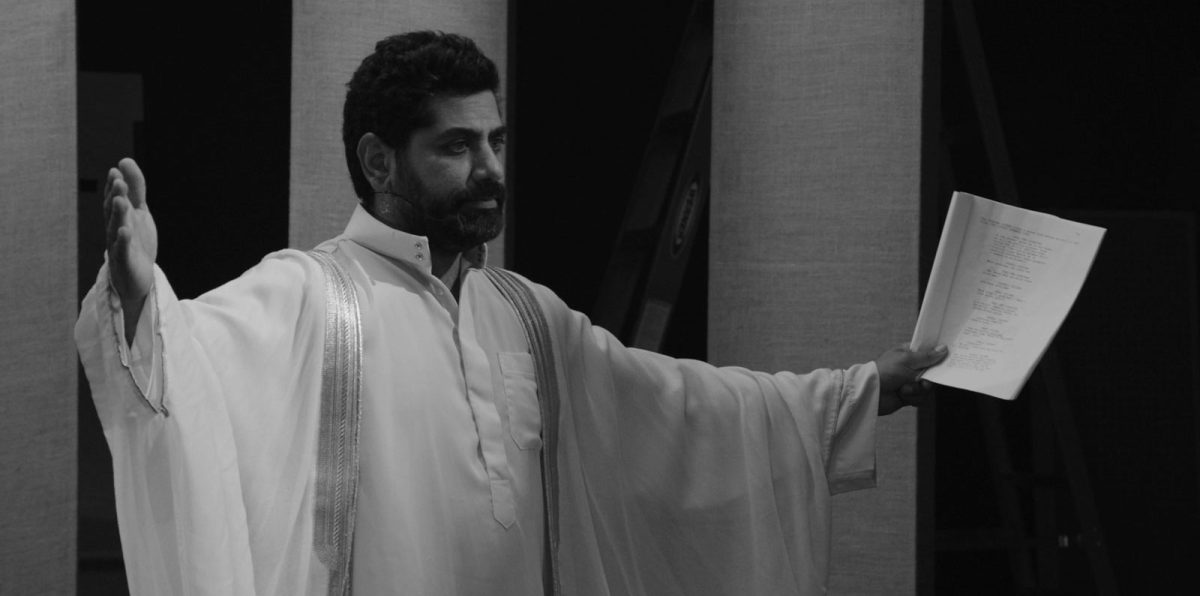
The visuals, which are a combination of monochrome imagery, closely cut by black screens to let the heady dialogue-driven sequences feel a little less heavy and frustrating, create a sense of delving into the collective memory and the lapses they have based on who and where it is directed to. The three actors are instructed by Salome Azizi’s director, who is like a placeholder that creates the triggers in the discussion. Things often get heated up between the characters, and consequently, the actors, with the visuals then shifting to color as Dahan steps in to moderate the reality in the fiction-within-fiction and reality-within-fiction scenario.
The high-concept idea of “Yes, Repeat No” can be extremely draining for viewers because the idea of a concept film with the subject being a placeholder for more important themes screams of self-indulgence. Dahan is completely aware of that. Which is why he also makes it a point to keep visiting a revisiting parts of Juliano’s psyche or his persona, aligning with the autobiographical nature of this film.
That said, the constantly talky nature of the film does not allow you to settle. Since the narrative works in a constant jumbling of ideas, the conversations often escalate and superimpose one another as the film grows more and more distant. The ticking metronome is used as a score to punctuate the intensity with which the three actors approach the dialogue, but it sometimes overpowers the conversation itself.
It also doesn’t help that the actors who are often seen as representations of America, Israel, and Palestine are not very good; the range of emotions that is needed out of their characters, or with their diction, eventually creates less of an impact than intended. Salomé Azizi’s performance is the only standout here, with her commanding the screen every time it’s her turn to speak.
Overall, “Yes, Repeat No” is definitely an experiment that is worth checking out. However, it might not serve as a clutter-breaker as it intends to be.





![Boy and the World [2015]](https://www.highonfilms.com/wp-content/uploads/2016/01/O-Menino-e-o-Mundo1.jpg)