
Certain films settle into memory with a quiet steadiness, and 5 Centimeters per Second (2007) belongs to that rare category. The experience of watching it feels gradual and immersive, as though the narrative gently aligns itself with the viewer’s own reflections. Under the direction of Makoto Shinkai, the film develops as a careful exploration of distance, yet the idea of distance expands far beyond geography.
The story certainly presents physical separation through trains, relocations, and changing cities, but its deeper concern lies in the emotional spaces that quietly emerge between two people over time. When Takaki and Akari begin as children, they share a sense of closeness shaped by letters, shared routines, and a mutual sensitivity. As circumstances shift and time advances, their connection evolves in subtle ways.
The film shows how growth and relocation reshape communication, how new environments influence perception, and how memory begins to function as both anchor and filter. The emotional space between them grows gradually, and that growth feels organic rather than dramatic. Shinkai frames this process through images of snowfall, railway crossings, and cherry blossoms, allowing the natural world to mirror internal change.
The film, therefore, portrays love as an experience that remains meaningful even as it transforms, and it approaches this transformation with clarity, patience, and visual grace. In “5 Centimeters per Second,” the narrative unfolds across three carefully arranged chapters, which allows the viewer to understand how a relationship matures and transforms across different phases of life.
The first chapter situates Takaki and Akari in childhood, where their connection is shaped by shared experiences and a mutual sensitivity that feels natural and unforced. Their communication through letters becomes especially significant because it preserves intimacy even when physical distance enters their lives.
The film takes time to show how written words sustain emotional presence, and in doing so, it illustrates how affection can travel across space while remaining delicate. As the characters grow older, their environments change, and with these changes come new responsibilities and expectations.
Academic transitions, family relocations, and emerging ambitions gradually reshape their daily rhythms. The film presents this evolution with patience, allowing the viewer to observe how circumstances influence emotional continuity. The widening distance between them appears as a consequence of time’s steady movement and the distinct paths that life gradually offers to each individual.
“5 Centimeters per Second” particularly invites reflection on how relationships exist within broader social and personal contexts. It shows that intimacy develops within specific moments, and when those moments pass, the form of connection adjusts accordingly. Through this explanatory progression, the structure itself becomes a means of understanding how affection interacts with growth, memory, and the onward flow of life. The title itself refers to the speed at which cherry blossom petals fall, and this image provides a conceptual lens for the entire narrative. The descent of a petal happens gently, yet its movement continues steadily toward the ground.
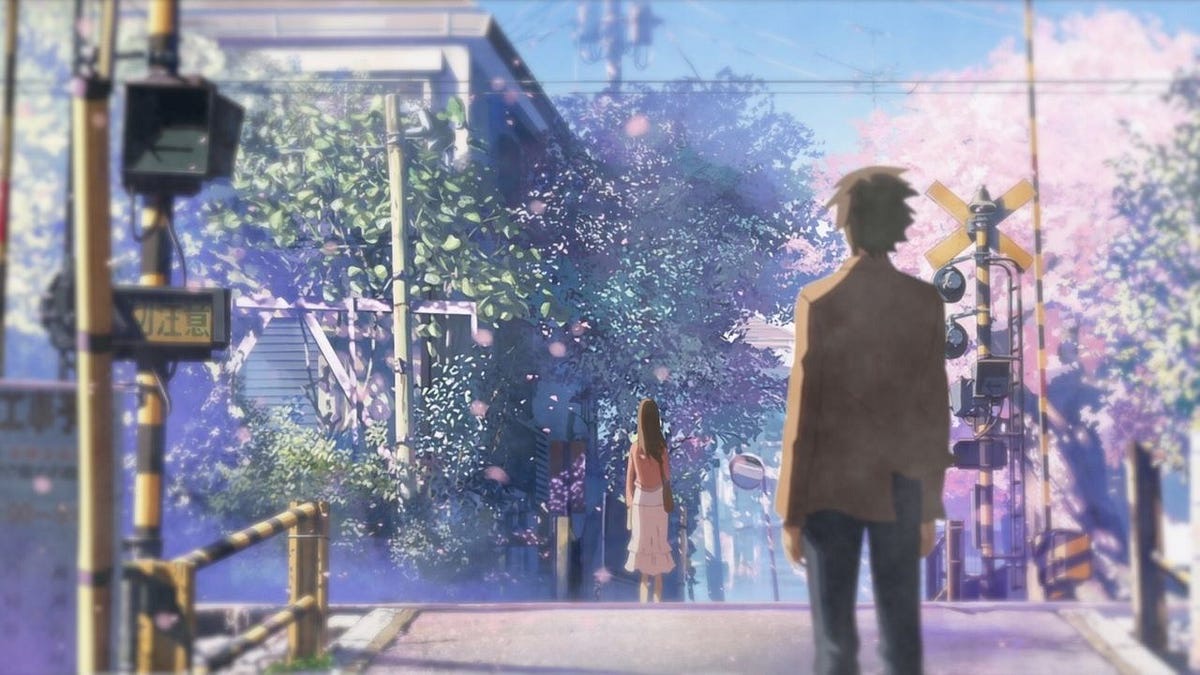
In the first chapter of “5 Centimeters per Second,” the snowbound train journey forms the emotional and narrative center of the segment, and its pacing plays a crucial role in shaping the viewer’s experience. The sequence unfolds gradually, allowing the audience to inhabit the passage of time alongside Takaki. Each delay of the train extends the sense of anticipation, and this prolonged waiting generates a tangible awareness of duration.
The viewer begins to understand how deeply Takaki values this reunion because every passing minute carries emotional weight. The snowstorm intensifies the atmosphere, surrounding the journey with stillness and uncertainty, while also heightening the significance of the effort he makes to reach Akari.
When the two children finally meet beneath the winter sky, the scene carries a quiet emotional clarity. Their reunion focuses on their shared presence in that moment. The kiss they share emerges as a gentle acknowledgment of feeling, shaped by innocence and vulnerability. It communicates affection without attempting to define its future.
In the second chapter, the narrative perspective shifts toward Kanae, and this shift expands the emotional scope of the story in a significant way. Until this point, the film has centered largely on the bond between Takaki and Akari, reliving the memory of their childhood connection. When Kanae enters the narrative foreground, the film invites the viewer to observe Takaki from the outside rather than from within his own recollections.
Through Kanae’s perspective, his inwardness becomes more visible. She admires him, spends time with him, and gradually develops feelings that deepen with familiarity. At the same time, she senses that his emotional world remains oriented toward a past that continues to shape his present. The film presents longing as an experience that can move in different directions simultaneously. Kanae’s growing awareness of her own feelings and her recognition of Takaki’s emotional distance create a gentle tension that remains grounded in realism.
By the time the narrative reaches its third chapter, the characters stand firmly within adulthood, and the atmosphere surrounding them reflects this transition with clarity. The expansive natural landscapes that once framed childhood gradually give way to structured urban environments. The city appears through office interiors, apartment rooms, railway crossings, and illuminated streets at night.
These spaces carry a sense of order and routine, suggesting lives shaped by professional commitments and daily responsibilities. Within this environment, Takaki functions competently as an adult. He works, commutes, and participates in the rhythms of metropolitan life. At the same time, the film reveals that his interior world still carries a deep attachment to earlier memories.
This chapter explores how time influences emotional continuity. We find how certain experiences remain embedded within a person’s consciousness. Takaki’s recollections of Akari surface gently, often triggered by familiar sights or seasonal changes. These memories coexist with his present reality, creating a layered sense of temporality.
The narrative suggests that emotional growth integrates formative attachments into the ongoing structure of identity. So, the film presents time as a force that moves steadily forward while also preserving fragments of the past within the individual. The cityscape, with its constant motion and intersecting railway lines, becomes a visual metaphor for lives that progress along distinct routes.
What becomes especially compelling in “5 Centimeters per Second” is the way it approaches love as an experience whose value does not depend upon permanence or culmination in lifelong union. The film presents affection as something that can remain deeply meaningful even when two individuals eventually travel in different directions. We find the film exploring how certain connections shape the inner landscape of a person.
An early attachment can influence how someone understands intimacy, longing, and memory for years afterward. In this sense, the film suggests that relationships function as formative experiences. They contribute to emotional growth, refine sensitivity, and create reference points through which later experiences are interpreted.
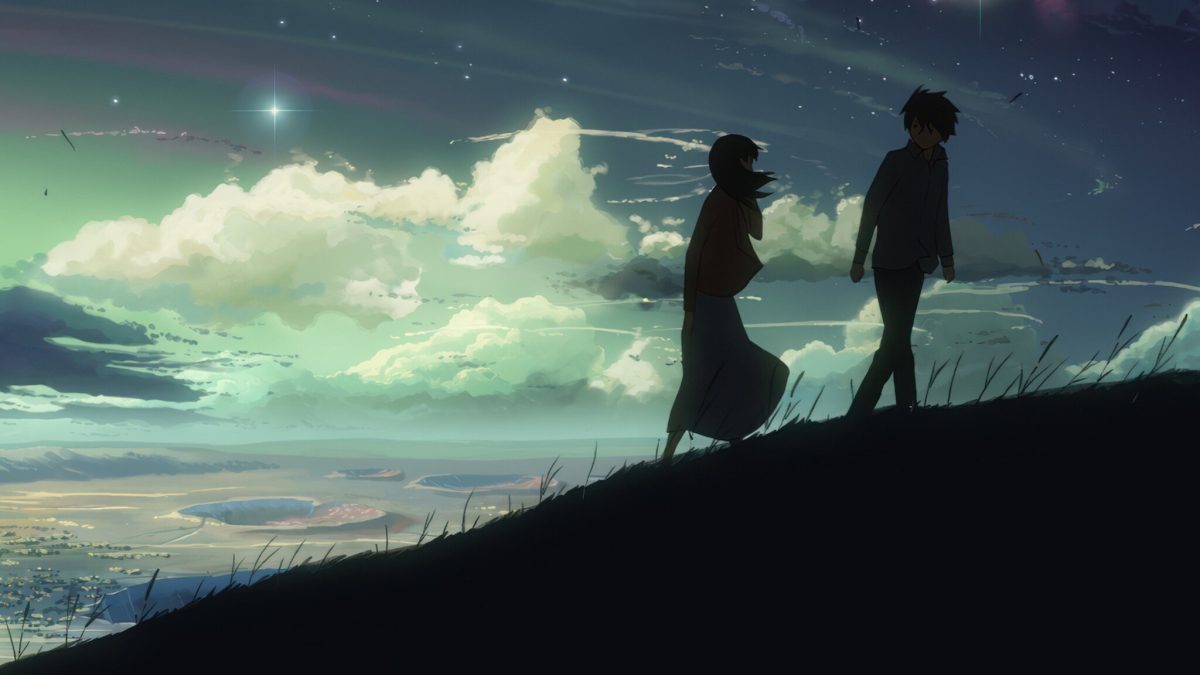
The bond between Takaki and Akari illustrates this idea with clarity. Their childhood closeness leaves a lasting imprint on Takaki’s emotional life. As he moves into adolescence and adulthood, that imprint continues to inform his perception of connection. The film depicts this continuity with subtlety. It shows how memory coexists with present reality and how earlier affection becomes part of one’s evolving identity. This approach frames love as an integral component of personal development. Even when circumstances shift and communication fades, the emotional knowledge gained from that relationship remains active within the individual.
The soundtrack structures how the viewer experiences memory, duration, and emotional continuity. The most significant musical presence in the film is the recurring use of the song “One More Time, One More Chance” by Masayoshi Yamazaki. This song appears in fragments throughout the narrative and then returns in full during the final montage, and its placement is deliberate.
Earlier in the film, instrumental variations and restrained background scoring accompany moments of longing or anticipation. These softer musical cues allow space for reflection, particularly during scenes of waiting, such as Takaki’s extended train journey through the snow. The quiet piano-led compositions during these sequences mirror the emotional stillness of the characters, and the slow tempo reinforces the sense that time itself has become palpable.
The film avoids villainy entirely; there is no betrayal, no grand misunderstanding engineered for dramatic payoff. There’s only the mundane realities of relocation, career, and emotional inertia, and in that sense, it feels closer to lived experience. Because it acknowledges that most separations are caused by gradual drift. One becomes aware of how modern communication – letters, emails, text messages – both bridges and accentuates distance, creating the illusion of connection while exposing its fragility. Shinkai seems attentive to the paradox that technology can transmit words instantly yet cannot synchronize emotional timing.
One might see the film as a lament for lost love, another as an acceptance of growth, and another as a study in emotional stasis, and none of these interpretations cancel the others. The cherry blossom petal, descending at five centimeters per second, becomes a reminder that movement can be imperceptibly slow yet irrevocable, and that awareness can arrive long after the moment has passed.
What becomes particularly meaningful in “5 Centimeters per Second” is the balanced way in which it treats love as an experience that carries depth while also existing within the natural movement of time. The film presents love as something that can hold profound emotional significance in a person’s life. Through Takaki and Akari’s journey, the narrative illustrates how a relationship can shape identity, influence perception, and remain vivid in memory even when daily life moves forward along separate paths. In this way, the film frames transience as part of love’s structure.





![Swallowed [2022]: ‘Fantasia’ Review: The Kind Of Messy Queer Horror We Need](https://www.highonfilms.com/wp-content/uploads/2022/07/Swallowed-768x405.jpg)
![Aladdin [2019] Review: Just Magical Enough](https://www.highonfilms.com/wp-content/uploads/2019/06/Aladdin-Highonfilms1-768x326.jpg)
