
There’s never been a rock documentary (or “rockumentary”) quite like “Epic: Elvis Presley in Concert” before, both in terms of raw talent and construction. A standard concert film is crafted based on an established setup of cameras designed to map a performance (or more often than not, several performances edited together) into a single piece of digestible media that emulates what it might be like to see the artist in performance.
“Epic: Elvis Presley in Concert” was an act of discovery from filmmaker Baz Luhrmann, who created the biggest blockbuster of his career with 2022’s “Elvis,” a film that received the endorsement and cooperation of the Presley estate. His latest project is a hybrid of concert footage, behind-the-scenes content, interviews, montages, and ancillary media intended to show the story of how Elvis Presley graduated from the renegade rock’n’roll star of the ‘50s to one of the most foundational legends in American popular culture.
“Epic: Elvis Presley in Concert” offers a speed run on how “The King” became the biggest event in music as a result of the growing prominence of new media and his ability to cross racial lines. While he offered a style of gospel, soul, and blues music that originated with Black artists, Elvis became a towering figure of pre-counterculturalism who also happened to be a juggernaut.
Much of the affinity for Elvis, however, came from how singular a live performer he was, and how his purity as an artist was reflected by the manipulations he endured at the hands of his manager, Colonel Tom Parker. It’s important context to have, but Luhrmann isn’t interested in the origins of Elvis, as he covered that well enough in the biopic. Instead, “Epic: Elvis Presley in Concert” deconstructs how the coda to Elvis’ career became a new era that both condemned him to an all-consuming performance schedule while bringing unprecedented joy to those lucky enough to be in attendance.
It was after returning from his service in the Korean War that Elvis became a movie star, as Parker had him appear in dozens of disposable, cheap films that used his radiant charisma to justify their half-hearted excuses for narratives. It was a process that was dispiriting for Elvis, who had deeply admired the work of Marlon Brando in “On the Waterfront.”
Although “Epic: Elvis Presley in Concert” does not skimp on how taxing this was on Elvis personally, it uses the footage as an important means of establishing its aesthetic realism. The digital reconstruction used to bring the archive footage of Elvis (80% of which had never been seen before) is almost jaw-droppingly intimate, and offers a far deeper look at the man than any of the films did in both a figurative and literal sense.
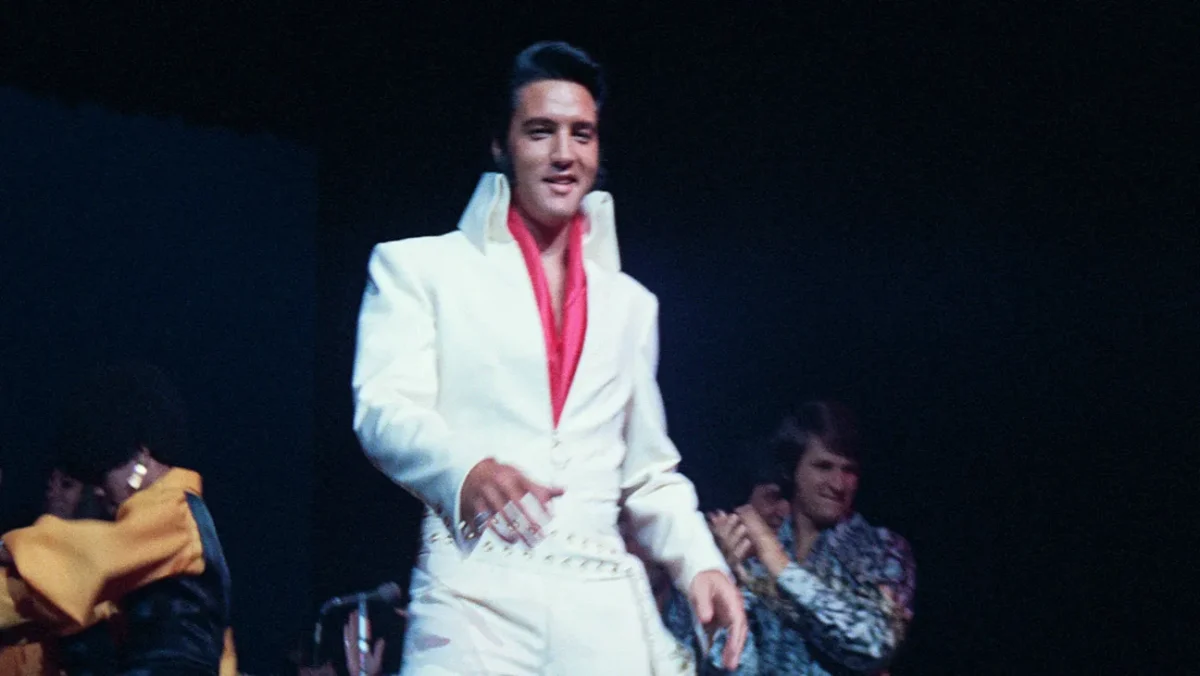
As the title would suggest, “Epic: Elvis Presley in Concert” is primarily concerned with Elvis’ residence in Las Vegas, where he performed over 1,000 shows between 1969 and 1977. The shows offered a mix of familiar hits, but the challenge was the extent to which Elvis could give himself over to the crowd. Every concert was a physical accomplishment that required no shortage of passion, disarming charm, and performative characterization.
Elvis became a character who never failed to deliver a one-liner, flirt with audience members, or revisit his lyrics on the fly to fit with the heat of the moment. A running commentary, which was compiled of various press conferences Elvis gave during the decade, includes many insights about the man, chief among them that he could no longer differentiate himself from the larger-than-life performer who was bathed in applause and light every night.
Similar to the “Elvis” film, Luhrmann’s latest begins with an overstimulating flash of sharply edited, kinetic montages that show just how quickly his star persona was established, and what a deep impact that it had on an uneven cultural landscape in the early days of the Cold War. Elvis had his controversies, of which Luhrmann explored more critically in this film than he did in the biopic, but he was an equalizing force that unified an audience in sheer admiration.
“Epic: Elvis Presley in Concert” charts a “rise and fall” story for which there is no “fall,” as Elvis’ Vegas performances grew so elaborate and transformative that there was never a dip in enthusiasm. The brilliance is that Luhrmann was able to construct the semblance of a single show through his selection of specific songs, yet mapped the passage of time through the development of a more whimsical, wistful, and occasionally sentimental version of Elvis, who both blissfully believed he might actually travel the world and remained completely committed to serving his fans.
Luhramann is able to pack dozens of songs within the film without ever feeling overstuffed, and they’re perfectly matched with the more esoteric points he’s making. The slightly off-putting “Edge of Reality” highlights the disparity felt by Elvis in rekindling the work of his younger self whilst becoming a husband, veteran, and more socially conscious citizen.
While there’s attention paid to more obscure numbers, Luhramann understands that Elvis succeeded by giving the audience what they wanted and delivers the best possible version of every hit. The most memorable sequence is a performance of “Little Sister” that is intermixed with a cover of “Get Back” by the Beatles, who became superstars right before Elvis’ Vegas era. It’s as if Elvis established that he was a phenomenon first, beat the Beatles with their own music, then returned to offer an even more ardent performance that showed his style still represented the future.
The crowd footage is essential in creating an experience in which standard Elvis is seen for the symbol he was in the moment, and not a figment of nostalgia. It’s critical to Luhrmann that “Epic: Elvis Presley in Concert” offers a definitive view of the artist in his time, and why popular culture is yet to find a figure so singular that there could ever be a modern equivalent. A standard rating would feel like a disservice to a film that is so reliant on the genius of an incomparable icon whose work has already stood the test of time, but Luhrmann is the perfect arbiter to make “Epic: Elvis Presley in Concert” as perfect a “rockumentary” as it could be.







![Only Murders In The Building [2021] Review: Cherish this Fresh blend of Investigative Drama and Comedy](https://www.highonfilms.com/wp-content/uploads/2021/10/Only-Murders-In-The-Building-2021-768x432.jpg)