There’s a particular kind of film that hands you a catastrophe with no hope in sight and expects you to sit through it. Dara Van Dusen’s debut feature,” A Prayer for the Dying,” is that kind of film. Based on Stewart O’Nan’s 1999 novel and adapted with the unflinching focus of someone who has something specific to say, the film drops us into 1870 Friendship, Wisconsin – a name that functions less as geography and more as bitter irony.
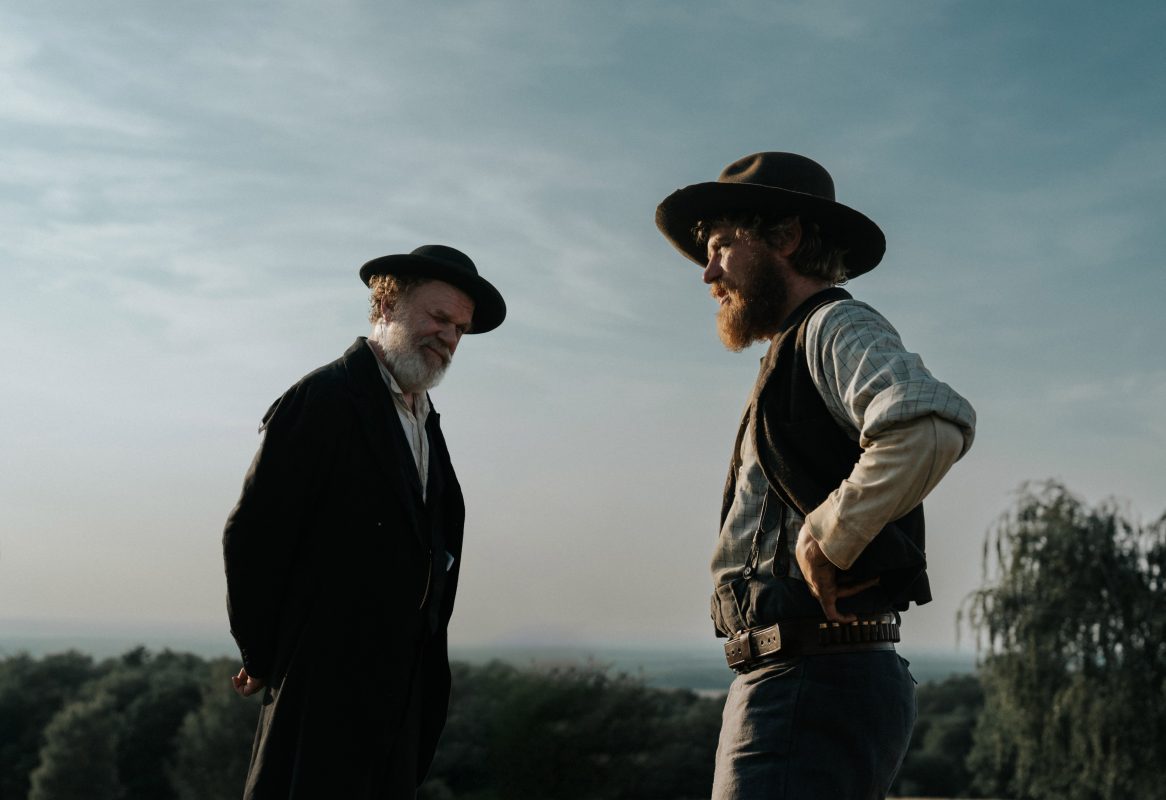
The settlers here are Scandinavian, still raw from the Civil War, and now being gutted by a diphtheria outbreak. The man in the center of all this is Jacob Hansen, played by Johnny Flynn in a performance of tremendous, contained anguish. He has taken on, somewhat absurdly, the roles of sheriff and pastor simultaneously.
The film is not a thriller, even if it moves like one occasionally with its linear camera movement. It’s not quite a Western, though it gives off the scent of one. What it actually is is a character study of a man whose entire identity is a coping mechanism, and what happens when the thing he was coping with finally catches up with him.
That’s the whole conflict the film tries to deal with. Because you feel, watching Jacob go from family to pulpit to crime scene, that he has stitched these roles of a sheriff and a pastor together. As if to play an authority out of duty. But the weight of something buried sits right behind his eyes throughout.
Jacob knows about diphtheria before anyone else does. When he finds out from the doctor, he also receives the instruction to keep quiet about it. And you watch him struggling to make that decision in real time, and you understand it completely. The film borrows its unsettling nature from its style and makes its home inside the small town. We see a whole town slowly dealing with its own disappearance, but through the decisions of a single man. A man who has built himself so carefully, this double-role fortress of usefulness and authority, and a clear PTSD from the civil war that never ended in his head.
The film shows this with an unusual rigidity. The camera tends to travel only in straight lines, horizontal or vertical, with an almost mechanical restraint. There’s no drift, no wander. Initially, this reads as stylization, but as the film develops, it starts to feel like Jacob’s psychology made visual: a man who can only think in fixed roles and straight lines, who cannot see the periphery of any situation he’s in. The cinematography by Kate McCullough is genuinely stunning in that regard, sun-bleached and blood-tinted, and it never lets you rest.
Where the film gets complicated and a little exhausting is in how completely it surrenders to Jacob’s interiority. The plague is real. People are dying around him in grotesque, graphic ways. His wife, Marta, played by Kristine Kujath Thorp with a quiet desperation that deserved more screen time, understands what is happening far more clearly than her husband and keeps saying so. But the film doesn’t seem particularly interested in Marta’s clarity. Or in the settlers dying in the background. Or in much of anything outside Jacob’s collapsing sense of himself.
You can understand this choice, that the film is fundamentally about one man’s struggle to fight against the end of the world. That’s a valid and even underrated idea. Hollywood is known for writing authority figures that go against all odds to save their family, community, and sometimes even the world.
It feels very fresh in that regard. But there’s a cost. The suffering of the town becomes a backdrop. The grief being represented on screen is filtered through someone who is too far gone inside his own mythology to fully witness it. John C. Reilly, playing the town doctor Guterson, brings some of the film’s most grounded presence precisely because he’s allowed to look outward.
By the end, Jacob’s and the film’s reality stop being one. We see glimpses of what we already suspect is happening, along with a version of how he imagines it. It seems that he has saved the town. That the biblical accounting has come, yes, but that he faced it well. It reads as the mind’s last mercy to itself.
A man who could neither shepherd nor protect anyone constructs a version of the story where he did both, just so he can let go. It’s a devastating idea. Whether the film entirely sells it is another question. Because the symbolism piles up so heavily that at some point you stop asking what it means and start wondering if the film knows either.
Two roles, priest and sheriff. Are they opposites? Is Van Dusen saying that a man split between competing identities will serve neither well? Or is Jacob’s failure more personal and less philosophical? A man who took on the armor of duty to avoid the vulnerability of actually being present for the people he claimed to love? The film gestures at both readings and commits to neither, which is either richness or evasion, depending on how generous you’re feeling.