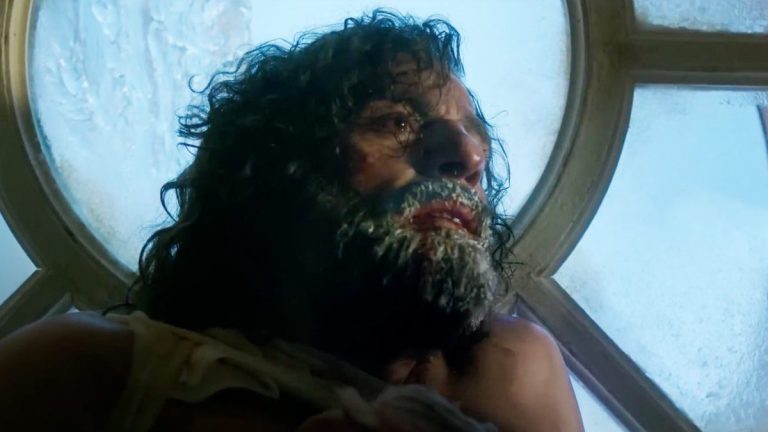
It’s widely understood that we as a species have come to understand less about the vast ecosystems of our own oceans than we have about the limitless reaches of outer space. During his tenure at Pixar, Andrew Stanton has examined both extremes through the boundless possibilities of animation.
And while the inherent limitations that come with a transition to live-action cinema certainly haven’t stopped Stanton from exploring those boundaries on a different plane of reality, the results of those past experiences—namely, his infamously disastrous but ultimately innocuous live-action debut “John Carter”—have certainly slowed down any further excursions towards the frontiers of a corporeal existence that can be felt between our fingers.
Yes, these further expansions into the realm of seismic live-action worldbuilding have slowed. Still, they haven’t stopped altogether, as “In the Blink of an Eye” constitutes Stanton’s long-awaited passion project that melds those oceanic origins with the space-age travels of tomorrow, and everything in between.
But while Stanton’s triptych narrative purports to distill the ever-ominous presence of time into a concise exploration of just about everything that defines the human experience, the resulting mishmash of hollow milestone moments instead filter that experience into a vacuous black hole that swallows every speck of introspection without a single guiding light to inspire us as we look to the sky for a grasp at fleeting wonderment.
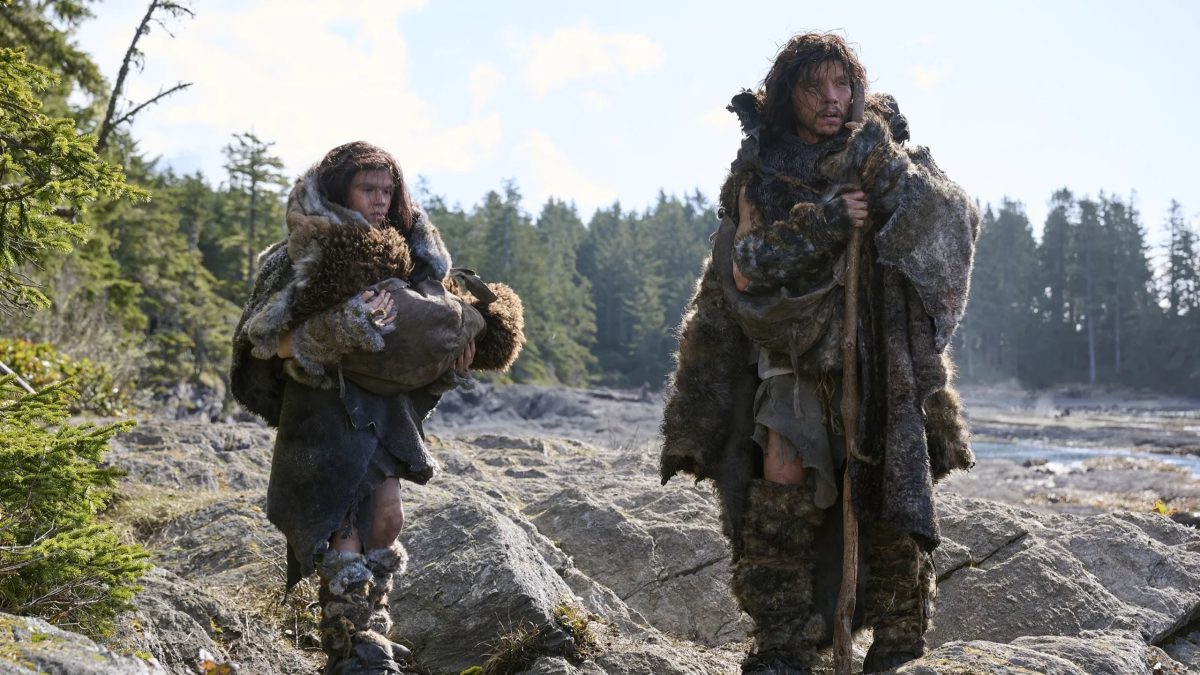
“Fleeting” is certainly the operative word in a film that jumps between its three timelines with the frequency of a coked-out kangaroo, as Stanton begins his era-spanning treatise on human purpose—as one so often does—with the early days of homo neanderthalensis. Beginning with a family at the cusp of the neanderthal era, circa 4,500 BCE, “In the Blink of an Eye” opens on the modest foraging lives of Thorn (Jorge Vargas) and his cave-dwelling nuclear clan.
Wordlessly making their way through the tribulations of raising a family in an age before Google or Mr. Rogers—well, “wordlessly” insofar as the guttural grunts spoken between them go untranslated—Thorn and his family find in their modest means of survival little more than the fuel for a future anthropologist’s academic research.

Her name is Claire (Rashida Jones), and between intermittently successful college hookups with Greg from statistics (Daveed Diggs) in 2025, she’s building her field work on the examination of what we assume to be Thorn’s fossilized remains. All this comes before her own mother’s ailing physical condition forces Claire to put her studies aside, a development that dovetails into the galaxy-spanning exploits of Coakley (Kate McKinnon, for some reason), a lone pilot guiding a centuries-long trek in the year 2400-something to populate a distant planet with human embryos—assuming the depleting oxygen caused by her suddenly sickened plant supply doesn’t end the mission first.
From the very start, Stanton’s transitions between his three narrative threads are shown to at least have some basis in logic, not only for the cheekiness of these interweaving moments—the hum of Claire’s vibrator segues into an introduction of Coakley awoken by the daily alarm on her ship—but also in a more thematically connective sense. Despite the tennis-style back-and-forth between these insulated timelines, the parallel setbacks their subjects endure all exist on the same temporal field—namely, the realization, reckoning, and subsequent acceptance of an impending death and perseverance in its aftermath.
It would probably make for a rather devastating three-point gut-punch if not for the fact that the deaths in question are often too peripheral in a narrative that already spreads itself beyond the necessary scope to foreground the central figures with any semblance of care for the finer details that would ostensibly bring such an ambitiously mapped project down to an interpersonal scale.
We barely know enough (or anything) about Claire before we’re besieged with her academic sacrifice to care for her dying mother (itself a dynamic Stanton spotlights for all of half a scene), nor does Coakley’s mechanical interplay with the ship’s AI system ROSCO (voiced by *checks notes* Rhona Rees) add up to anything before we’re made to feel any semblance of loss when the ship’s dwindling oxygen supply forces some tough decisions to be made for the good of their species-saving mission.
That McKinnon, best-known for sketch comedy, is left to bounce off of nothing but the antiseptically quaint, cardboard cutout-style walls of an empty spaceship is emblematic of the greater executional disincentive that plagues an entire film so stringently tied to tired structural parallels with no lively bodies to traverse them, but the greatest issue facing the film is how aimless Colby Day’s script is in what those structural equivalents are supposed to achieve outside the most surface-level articulations of the ephemerality of human experience.
Millennia come and go between the moment Thorn first sparks a flame and the moment Kepler-B is seeded with the fruits of a new generation. But for us, the viewers, Stanton shoves all this experiential vastness into a pre-credit runtime just shy of 90 minutes. What’s worse is when time begins to fly with each individual narrative, as if whole swaths of character development—primarily involving entirely new characters—are incorporated with the grace of Stanton accidentally and repeatedly sitting on the mouse in the editing room.
What may then signal an intentional sense of transience promised in its title instead leaves “In the Blink of an Eye” turning every one of its misguided, comatose epiphanies into an experience whose brevity is only defined by how long you’re left to think about it, despite Stanton’s stilted pacing certainly leaving you under the impression that you’ve been sitting in your chair watching nothing but sickly plants growing for eons.
Life is short, and “In the Blink of an Eye” argues that an eternity is worth nothing compared to the moments that echo through lifetimes and beyond. Those moments, in fact, are our eternity. But for all that insisted ideation, Stanton fails to make the here and now matter for even those temporary moments that find our own blinking eyes set towards his vacant odyssey.