
In 2003, writer-director Billy Ray made “Shattered Glass,” a quiet, procedural drama about the downfall of Stephen Glass, the wunderkind journalist at The New Republic who wrote over thirty fictitious articles for the magazine while passing them off as true. At the time, the film went very under the radar, receiving mild critical praise but almost no box office attention whatsoever.
It was viewed mostly as a cautionary tale on the principles of print journalism, the dark rabbit hole of fabrication, and the self-destruction of a bright young man. Over two decades later, however, the film stands for far more than most traditional newsroom dramas ever aspired to. It foreshadows, with uncomfortable precision, the crisis over truth-telling that defines our society today.
The New Republic was a cleverly written, serious, and lively magazine hoping to take part in the cultural zeitgeist of the 1990s. It deemed itself the in-flight magazine for Air Force One, and a bright young writer like Glass was brought in for his creativity and knack for journalistic storytelling. He was beloved. Colleagues adored him. Editors protected him. He was the kind of charming, eager presence that a newsroom adopts almost instinctively, the person who fills a room with warmth and makes everyone around him feel like the most important person in it.
It was Glass’s 1998 piece, “Hack Heaven,” about a fifteen-year-old hacker who had overridden a tech company’s network only to be later hired on as a consultant, that caught the attention of Forbes Digital, which outed him as a fraud. The whole story was fabricated. So, too, were many others. Thirty-six of his forty-one articles at the magazine contained invented material.
What makes Ray’s film stand out is that it refuses to focus on shock and sensationalism. There is no dramatic courtroom moment, no explosive confrontation played for maximum cinematic effect. Instead, the film uses dramatic tension and slow, careful build-up to reveal the mechanics of deception. It’s interested in showing how a lie sustains itself, how institutions protect the people they have invested in, and how the truth, when it finally arrives, feels less like a revelation than a slow, painful deflation. Ray trusts his audience enough to let that deflation do the emotional work.
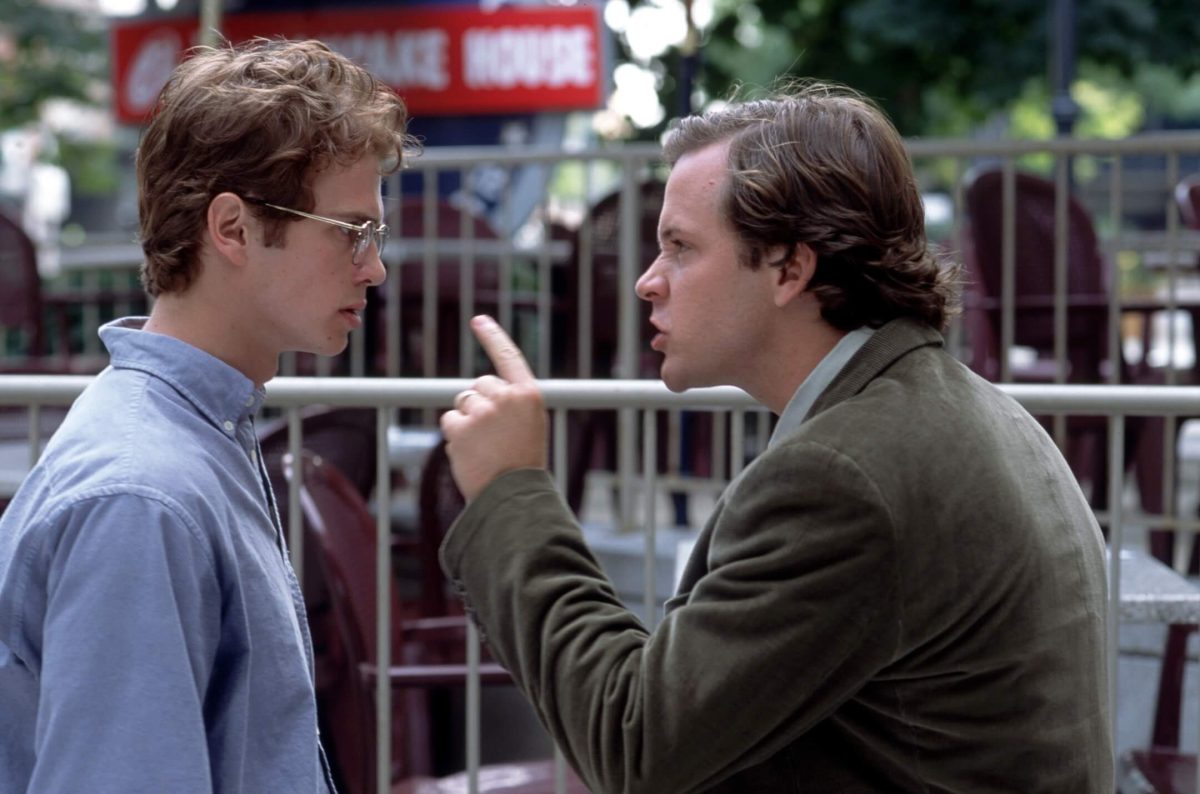
The film is anchored entirely by its two lead performances, and they are both exceptional in ways that feel rooted in genuine psychological observation rather than performance. Hayden Christensen plays Glass as needy and ingratiating, winning over his colleagues through flattery, attentiveness, and tactics as disarmingly small as supplying the office with cupcakes. It is a performance built on surfaces, which is entirely the point. Glass is all surface.

Christensen communicates the terror underneath the charm with tremendous subtlety, the way his eyes dart when a question catches him slightly off guard, the way his smile recalibrates in real time as he works out which version of himself is needed in any given moment. It is one of the most underrated performances of that era of American cinema, and the film’s relative obscurity has meant it has never received the full appreciation it deserves.
Opposite him is Peter Sarsgaard as Charles Lane, the New Republic editor who was taken in by Glass’s lies and ultimately bore the responsibility of firing him. Sarsgaard’s characteristic quiet intensity serves him extraordinarily well here. He does not play Lane as a hero. He plays him as a man doing a painful, unpopular job with the particular loneliness that comes from being right in a room full of people who wish you weren’t.
Glass had defenders on the magazine’s staff, passionate ones, and the initial instinct of the senior leadership had been to back Glass. Lane had to resist that instinct, absorb the social cost of doing so, and hold his ground. Sarsgaard communicates all of that without ever overstating it. There is a scene where Lane sits alone after the confrontation has played out, and the expression on his face is not triumph. It is exhaustion. That is the detail that makes the performance linger.
The tension between Christensen and Sarsgaard builds across the film with the patience of great dramatic writing. Their dynamic is not one of outright antagonism. It is something more unsettling than that. It is the dynamic of a man who senses something is wrong before he can prove it, and another man who senses that he is being seen and responds by doubling down on the performance.
Every scene they share has a quality of two people communicating in a register slightly below the words they are actually saying. Christensen escalates. Sarsgaard stays still. The stillness, ultimately, wins. It is the kind of tension that rewards close attention and makes the film feel far more like a thriller than its understated marketing ever suggested.
At the time of its premiere, “Shattered Glass” felt like an indie film with a foreboding message about the degree to which the pillars of American journalism could be trusted to police themselves. The New Republic was small but highly influential. Then, in 2003, the same year the film was released, another media ethics scandal broke out, this one involving the nation’s premier newspaper.
The New York Times revealed that Jayson Blair, one of its own reporters, had fabricated and plagiarized across dozens of stories. The parallels were too close to ignore, and for a moment, the journalism world appeared to reckon seriously with its own vulnerabilities. That reckoning, it turned out, was incomplete.
Nearly twenty-five years after “Shattered Glass,” the anxiety around where we get our news and how much we can trust the media we consume has not diminished. It has metastasized. The phrase fake news, which should carry specific, serious weight given the documented history of what Glass and Blair actually did, has been so thoroughly weaponized as a tool of political bad faith that it has largely lost its diagnostic function. It is now deployed more often to sow doubt about legitimate reporting than to identify actual malfeasance.
The irony would be funny if the consequences were not so serious. Glass fabricated stories to make himself look good and to give readers what they wanted to believe was true. The modern information ecosystem has simply industrialized the same impulse, removed the individual fraud from the equation, and replaced him with entire platforms, algorithms, and media ecosystems designed around the same basic transaction.
What “Shattered Glass” understood, and what makes it feel so strikingly relevant today, is that the crisis it depicts is not primarily about bad actors. It is about the structures that enable them. Glass was not operating in a vacuum. He was operating inside an institution that rewarded the qualities he had in abundance: charm, productivity, the ability to generate compelling copy on deadline, and was therefore structurally reluctant to examine the foundation beneath those qualities. The New
Republic’s tragedy is not that it employed a liar. It is that it built a culture in which a liar could thrive for years before anyone with power felt sufficiently motivated to look closely. That observation applies to newsrooms, to social media companies, to political parties, and to nearly every other institution currently grappling with the consequences of optimizing for engagement over accuracy.
Billy Ray made a film that, in 2003, looked like a contained story about a specific scandal in a specific magazine. What he actually made was a portrait of how institutions fail themselves, and how the people inside them rationalize that failure until the moment they can no longer afford to. It is a film about the cost of looking away. Watching it in 2025, it is difficult not to feel that we are all still paying that cost, and that the invoice keeps growing.



![Trenque Lauquen [2022] ‘Venice’ Review: A Curious Mystery That Paints A Fragmented Portrait of a Woman](https://www.highonfilms.com/wp-content/uploads/2022/09/Trenque-Lauquen-2022-Venice-Review-768x432.jpeg)
![Eighth Grade [2018] – A Captivating and Heartfelt Portrait of Modern Teenage Life](https://www.highonfilms.com/wp-content/uploads/2018/09/Eight-Grade-2018-768x432.jpg)

![Sun in the Last Days of the Shogunate [1957] Review – Blending Madcap Comedy and Social Commentary](https://www.highonfilms.com/wp-content/uploads/2020/07/Sun-in-the-Last-Days-of-the-Shogunate-1957-768x432.jpg)
