The girl who lives on the “wrong side of the tracks,” the rebel, the high schooler misfit with immense courage to imagine a life beyond Sacramento, is a poignant commentary on what happens when girls dream of New York; when girls refuse to conform to the intangible limits imposed on them. Perhaps the most vivid manifestation of this refusal is the constant friction with her mother, who, time and again, reminds Lady Bird to live within her means. After all, what would have happened if Esther had not won that fashion magazine contest and come to New York from the dull suburbs of Boston? We would not have The Bell Jar.
I am always reminded of The Bell Jar when I think about Lady Bird’s angst. The simplest of desires turns into a tug of war between existing and living. Lady Bird is confounded as to why she cannot carve out an identity for herself. Is it the lack of her cultural capital or the inherent guilt of cherishing a dream when her family is living on the margins? Lady Bird’s childlike fantasies of living in a fairytale mansion, ditching the squalor of her own neighbourhood, are depicted pretty early in the movie.
It is when she imagines out loud what it is to live in a palatial residence where life is not enclosed by cluttered spaces. For the likes of Lady Bird and Esther, liberty comes with access to culture and perhaps the right social circle. We see how both are drawn to parties and drinks, cool people like Jenna Walton, like moths to fire– Gatsby’s guests, only to burn down at the end.
When I first watched “Lady Bird,” I was in awe of her fiery attitude, which brought back my own teenage years. The tenacity to keep one’s head up in a sea of negatives. Yet Greta Gerwig never sugarcoats this journey of battling odds to fulfil aspirations. She portrays the entire spectrum of unimaginable horrors that Lady Bird confronts in living with people who are constantly on their toes to survive. Honest, hardworking people who never dreamed of taking the road less travelled. In this journey, Sacramento is quite a fascinating context. Would things be so different if she belonged to San Francisco?
Why is Lady Bird driven by her angst? Is it a coping mechanism to come out of her mother’s control? Is it a resistance to not let her mother decide for her? Why does she need to be apologetic for getting through a top-tier college that she has fought so hard for? She constantly makes the point of asserting her identity, even if it means letting go of certain bonds.

What strikes about Lady Bird is her love for literature and the arts. She has a slight fancy, which she carefully harbours towards the aesthetics of life– reading in bed, something that only “rich people do.” It instantly brings to mind the rumblings of Esther Greenwood: “Look what can happen in this country, they’d say.
A girl lives in some out-of-the-way town for nineteen years, so poor she can’t afford a magazine, and then she gets a scholarship to college and wins a prize here and a prize there and ends up steering New York like her own private car.” If we run a parallel between Esther and Lady Bird, we understand the cost of dreaming big. Lady Bird works two jobs, learns responsibility, gets her driving license, and yet is constantly guilt-trapped for her ambitions. It is as if her feet are sucked in by wet sand as waves of adversities crash at her.
The beauty of this character lies in her strength that cannot be eclipsed by the lack of imagination surrounding her. It is also the sublime tenderness of this person dealing with heartbreaks and loss of hope with her chin up. We have seen her as a cushion of support and love for people, even when she herself has experienced it hardly ever, and mostly never with her mother’s unending bickering about perfection and reminders of monetary crisis.
Also Read: The Drive across “Mother-ing Up” & “Daughter-ing Down”: The Multitudinous Complexities of the Mother-Daughter Relationship in Lady Bird (2017)
But this dismal life was never to be with Jenna Walton, Lady Bird’s classmate and queen bee, who could waltz through her mischief in a mini skirt and flawless skin. We know why Lady Bird has the constant compulsion to fit into Jenna’s group, to exaggerate, to lie, and deceive. The group belongs to a relatively well-off family.
A cohort that is neither rebuked by their parents for the struggles of raising them, nor have to be embarrassed about their address. But this gang also has one crucial thing missing– the ferocity to dream big. Lady Bird, irrespective of her class constraints, is never afraid to walk on a few eggshells to ditch the suburban, shabby life to have a taste of “the way the eye of a tornado must feel, moving dully along in the middle of the surrounding hullabaloo.” But, at what cost?
The quagmire of challenges that pulls her down is mostly attributed to the economic class she was born into. Marion, her mother, who mostly appears in her blue uniform, makes it clearly evident that she works double shifts to put food on the table. To her, life is within the hospital corridors smelling of isopropyl alcohol. Lady Bird’s father loses his job quite early in the film. The adopted Miguel and Shelly are mostly engaged in a soul-sucking desk job at a departmental store that cannot have much scope for creativity or a career.
Defying the mundane, we have a character who has given herself a name and the identity of a bird in a skirt. Things go haywire every time she dreams of escaping Sacramento. Her mother has planned a city college for her. We know how mothers, with all their pragmatic, well-meaning intentions, have stifled the artistic sensibilities of women keen on holding onto their aspirations. “She was always on to me to learn shorthand after college, so I’d have a practical skill as well as a college degree.”
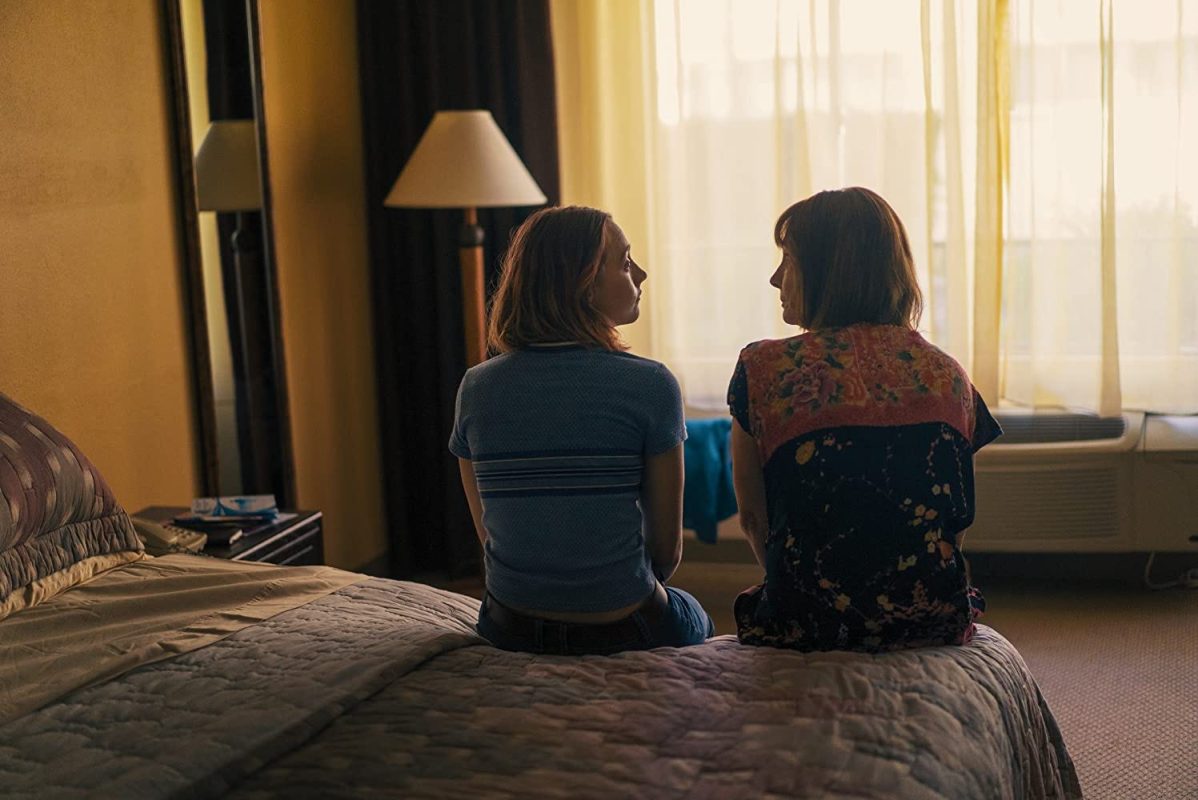
Esther confesses to us how her own mother was never much of a help. With Lady Bird, her mother stringently opposes the relocation to New York and refuses to speak as an act of protest. Certainly, it boils down to the question of aspiring beyond means. But Lady Bird refuses to be weighed by the means or the lack of them.
Lady Bird has a performative streak, and whether we like it or not, she gets things done. She wants “to live through something.” Her desire to experience culture, freedom, and fashion in New York is the driving force– the energy that Esther nurtured when she dreamed about authoring books and studying all over Europe. But while Esther landed up in an asylum, Lady Bird turned to religion as a solace.
Towards the end, Lady Bird’s return to spirituality is not a moment of paranoia, but extreme clarity. It is a case when, for the first time, Lady Bird is herself, free from the constant inner battles to prove her merit and individuality. She reconciles with her identity, Christine McPherson, and accepts that suburban life was perhaps not so much of a bell jar, a vacuum that allows no air to breathe in. This too is a price she paid after crossing hurdles and coming to New York, estranged from her mother and desperate to taste a life which, till that point, had only allured her from a distance.
Sadly, there is no prosaic relief for Lady Bird except for the bit of beauty she finds in the neighbourhoods of Sacramento: The sun filtering through trees and turning the lanes into a dazzling yellow. Lady Bird has no nostalgia to bask in for a while, pushing aside the price she has paid for her independence in New York. To me, Lady Bird cannot be pigeonholed into the concept of an angsty teenager.
She has a direction: to live a life that her mother has not planned for her. She associates herself with people who have never heard of Sacramento. This gutsy yet fragile Lady Bird represents women across the world who, too, had to fight tooth and nail to climb the social ladder, to move out of their hometown, and experience life in all its splendid glory!
“Look what can happen in this country, they’d say. A girl lives in some out-of-the-way town for nineteen years, so poor she can’t afford a magazine, and then she gets a scholarship to college and wins a prize here and a prize there and ends up steering New York like her own private car.”



![I Am Cuba [1964]: When Propaganda becomes Poetic](https://www.highonfilms.com/wp-content/uploads/2021/06/i-am-cuba-thumb-768x477.jpg)