We all remember that tragic clip of Sir Ian McKellen on the production of “The Hobbit,” breaking down to near-tears at the mental toll of sitting alone in a vomit-green room, forced to regurgitate Tolkien dialogue opposite absolutely nobody—a sobering commentary on the dismal state of blockbuster cinema embodied by the upsetting image of a true thespian of the art form reduced to burying his forehead into his hands in an act of complete resignation.
It’s enough to make a grown man (or wizard, as it were) cry, even just as an outside observer. McKellen has since been given many a forgotten Bill Condon thriller to help dull the pain and regain some slight creative footing, but it was clear by this point that the Shakespearean performer needed something more substantive to reawaken that theatrical twinkle in his eye. As it turns out, what he needed was Steven Soderbergh and his utter disdain for the mere concept of a month spent without a camera glued to his face.
Thus, “The Christophers,” Soderbergh’s second film of 2025—he already released two other films last year, but the first, like this one, was a push-off from the previous calendar—is born, and McKellen is afforded a chance to stretch those dormant muscles and remind us of the fire that, for decades, lit so many stages and screens alike. The seasoned veteran is, of course, not alone in his efforts, and his pairing with one of British cinema’s most dynamic younger talents makes for an elastic sparring session on the very values we place on reputations and legacies in the ever-volatile realm of art consumption.
That talent belongs to Michaela Coel, who plays Lori Butler, herself a talented artist in her own right whose longstanding desensitization to the art world and the elitist bashing it represents has left her in a fruitful creative state relegated solely to the cramped rented studio she calls home. Scraping by, Lori is suddenly approached by Sallie and Barney Sklar (Jessica Gunning and James Corden) with a business proposition.
Their father, Julian Sklar (McKellen), is a famed painter whose curmudgeonly exile is topped by the lingering mystery of a series of unfinished paintings called The Christophers, and if Lori can forge their completion under Julian’s nose while pretending to be his new assistant, the trio is looking at a hefty fortune once the old toad croaks. Julian is—as many named Julians are—at best an antisocial recluse and at worst an elitist asshole, and the exhausting but strangely not all that reluctant enlistment of his new assistant hints at more than a few sketchy regrets hidden away behind layers and layers of thick, oily paint.
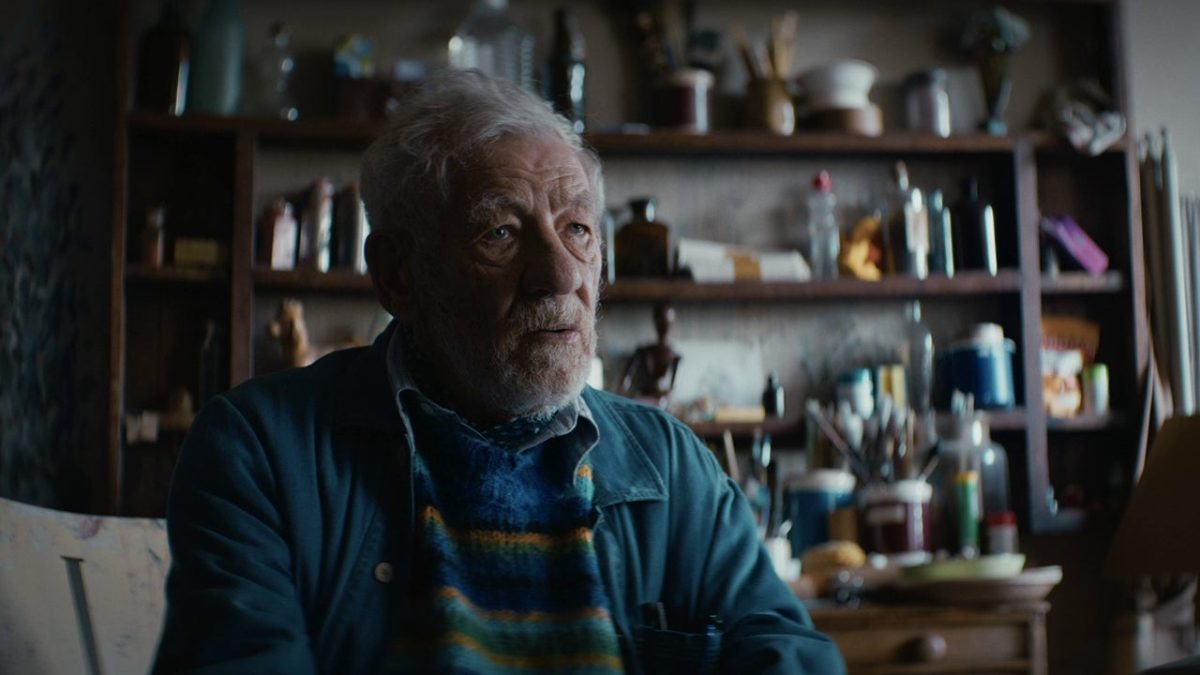
Much like his previous Best Film in Years “Black Bag,” “The Christophers” sees Soderbergh eschewing the mildly intriguing but drainingly overzealous formal experimentation that bogged down the likes of “Presence” and “Kimi” in favour of a more streamlined, narrative-focused endeavour that benefits the sort of steadiness of hand that has allowed him to maintain such a prolific output. Unlike “Black Bag” and its slick, proto-Fincher espionage tactics, however, Soderbergh’s camera is here much more frenetic, as if the lens itself can’t help but reverberate at the deadly timbre of McKellen’s aged fury and still-sharpened wit.
As has been sufficiently hinted by this point in the review, the man formerly known as Magneto is extraordinary under such intimate constraints, turning the stained, creaky walls of Julian’s flat into sound-absorbing pads whose sole purpose seems to be to soak in the shockwaves heard in the cracking insistence that booms from his sardonic vocals.
As expected, beneath that “hanging a photo of myself flipping off the camera in my hallway” attitude lies a much more fragile resentment and subsequent self-loathing that the actor balances—sometimes within the scope of a single seated closeup—with the sort of tragic ease that reminds us, more than the outbursts themselves, how much this sort of role means to him, and how much it means to us that he’s been afforded the reins to make it his own.
Coel, it should be said, is no slouch to the task of standing in McKellen’s shadow, as her own relative stoicism is a more effective absorbing tool for his monologuing than those tattered walls. The duo’s verbal boxing match is closer in execution to a series of simple bob-and-weave maneuvers, as Julian’s calculated jabs are met with Lori’s more concerted efforts to dodge the dummy punches and wait out her opportunity for the knockout blow.
(All this is played out over a melancholy theme that sounds suspiciously close to a John Williams tune from “Valley of the Dolls”). Through it all, Coel’s poise masks its own shattered interior that, in unison with McKellen’s, reveals this argumentative sport to be just as personal as it is a matter of simple love of the game.
Ed Solomon—whose screenwriting track record is otherwise mostly a nightmare comprising the likes of “Now You See Me” and the original “Super Mario Bros.”—pens a tightly character-driven, theatre-ready script that, surprisingly, doesn’t inspire Soderbergh to employ his usual self-challenging trickery in an attempt to prove the film’s cinematic viability.
Rather, Soderbergh finds in “The Christophers” the inspiration to get far closer to his subjects than he has with any of his contrived handheld iPhone shooting employed as of late. Itself a treatise on the lingering laments of our own dormant motivations, “The Christophers” learns as much from an empty canvas as it does from the subtle contortions of an artist’s face as they gaze silently upon it.