In 1964, a little-known band—end of sarcasm—called “The Beatles” released “A Hard Day’s Night,” often regarded as an early visual album, following the Liverpool icons through fame, everyday life, and moments of playful chaos. Of course, history is never that straightforward. Some argue that Serge Gainsbourg’s Histoire de Melody Nelson deserves that title instead—a concept album centered on an illicit relationship between a middle-aged man and a teenage girl, brought to life visually through its artwork and imagery featuring Gainsbourg’s then-partner Jane Birkin.
Whichever side you side with, the idea continued to evolve. Sometimes it functioned as a companion piece to a film, like Tommy or Purple Rain. Other times, it leaned into something far more ambitious—like Michael Jackson’s “Moonwalker,” a strange and fascinating blend of music videos and narrative, featuring my favorite track of his, “Smooth Criminal,” which featured the now-iconic gravity-defying lean. And then there’s Pink Floyd’s “Pink Floyd The Wall,” a work so singular it’s been imitated countless times (the less we talk about that Nostalgia Critic attempt, the better), but rarely, if ever, matched.
By the time Prince and Michael Jackson were redefining the relationship between music and image, a seismic shift was already underway. On August 1, 1981, MTV launched and changed the landscape of music forever. Suddenly, visuals weren’t just an addition. They became essential when promoting these musical acts. Artists began pushing creative boundaries, crafting videos that ranged from bizarre to extravagant to minimalist. Some stuck to promoting individual singles, but others took it further by creating a visual counterpart for entire albums. What once felt like a novelty gradually became a trend, setting the stage for what we now recognize as the modern visual album.
I have some of the most random memories stored in my brain. I can forget what I read a few hours ago or what I ate a couple of days back, yet I still vividly remember standing in a gas station mini market, watching the video for “One More Time” on a tiny 18” TV. Seriously, maybe I should take Sherlock Holmes’ advice and start purging useless information.
But I digress.
Daft Punk has always been synonymous with striking visuals. Whether it’s the minimalist yet unforgettable “Around the World” video directed by none other than Michel Gondry, or the borderline nightmare fuel of “Technologic” with that unsettling robot, you could always count on two things: they wouldn’t show their faces, and they’d pair great music with equally memorable imagery. So it’s no surprise that in 2003 they released a full visual companion to their landmark album Discovery—titled “Interstella 5555 The 5tory of the 5ecret 5tar 5ystem”, or like the cool kids (looking at you Netflix) like to call it “Interstella 5555”.
“Discovery” marked a clear shift from the duo’s earlier house-driven sound into something more eclectic. Not necessarily avant-garde, but definitely more expansive—blending genres while maintaining a certain simplicity. As Thomas Bangalter described it, “the album explores song structures, musical forms, and childhood nostalgia, a contrast to the raw electronic punch of Homework.”
You can feel that evolution immediately. Where the former album, “Da Funk,” invites head-bobbing and B-Boys to breakdance in the streets, “One More Time” pulls you onto the dancefloor with something more euphoric and immersive. There’s also a stronger sense of narrative baked into the music itself, with lyrics and structures that very much demand a visual companion.
Now, some bands might have stopped there, I mean, the ambition behind the record was already clear. But Daft Punk built their reputation on not playing it safe. During the early stages of recording, they began developing the idea for a story that would blend sci-fi with commentary on the entertainment industry.
The original plan was to make it live-action, but that idea was quickly scrapped. Instead, they set out to find the right animation style—something that could fully capture the tone and scope of what they had in mind. That search led them to the legendary Leiji Matsumoto, whose work, particularly “Captain Harlock”, has been one of their major influences. Even if the name doesn’t immediately ring a bell, chances are you’ve come across his work in series like “Space Battleship Yamato” and “Galaxy Express 999.” Lastly, Kazuhisa Takenouchi—known for his work on Dragon Ball—was brought on to direct.
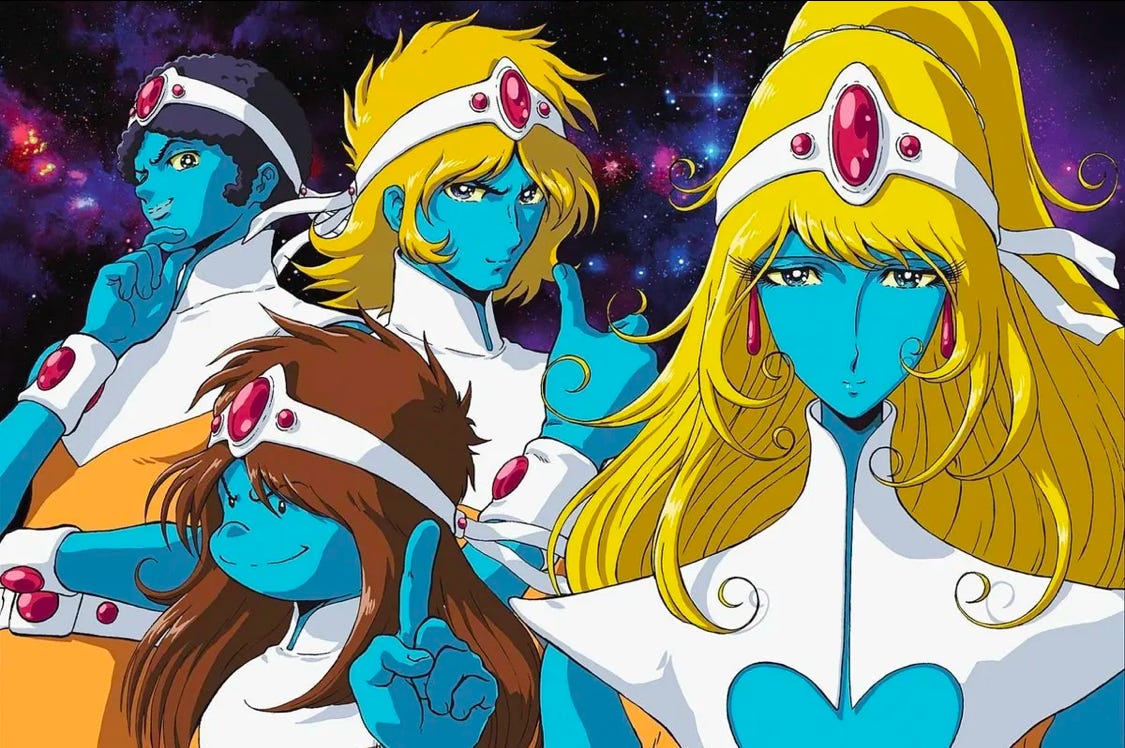
Matsumoto’s imprint is all over the film. The character designs feel instantly recognizable—so much so that if you told me Harlock cameos in the film as the alien hero, I wouldn’t be surprised at all. There are even moments where certain characters resemble characters from his earlier works, like the guitar player who looks a lot like one of his leads in “Yamato”. It gets to the point where you wonder if he’s remixing his own ideas or self-plagiarizing. And yet, despite those similarities, the leads still carve out their own identity.
Choosing anime was absolutely the right call. Japanese animation tends to be more expressive than its Western counterparts, especially when it comes to conveying emotion through gesture and visual nuance. And for a film with not a single spoken dialogue, that expressiveness becomes essential. The characters communicate entirely through movement, expression, and staging—and for the most part, it works beautifully.
At its core, “Interstella 5555 The 5tory of the 5ecret 5tar 5ystem” is very much about the darker side of the entertainment industry. Music is the focus, but the themes easily extend to film, television, and media at large. Stories of artists being exploited by powerful figures aren’t new. Judy Garland immediately came to mind—forced into destructive routines to maintain an image, she ultimately ended up paying a heavy personal price. And while there are plenty of cautionary tales, there are also modern cases like Taylor Swift, who fought to reclaim control over her own work.
Now, I’ve seen people dismiss the film’s premise as too simple or on-the-nose, and I initially went in with that mindset. And at first, it seems very straightforward: we see a band whose music comes from a place of pure love. There’s a genuine passion there—they’re brimming with an infectious joy that seems to lift the spirits of everyone who listens. From what the film shows, they’re not just performers but a central source of happiness for their entire colony. It’s almost as if their presence alone sustains that sense of community. And thinking back, I don’t recall seeing any other musical acts, which only reinforces how vital they are to that world.
Then, of course, the film quickly introduces the sinister music mogul who kidnaps them. It’s an interesting narrative turn, as to my best of understanding, typically, artists are “discovered” through A&R channels, though you do get stories from studio owners doing this work. Either way, that process is twisted into something far more predatory.
It reframes the story as one about exploitation, where powerful individuals prey on young talent for their own gain. As the film unfolds, that idea becomes even darker with the reveal of a literal sacrifice—once the mogul has extracted everything he can, the artists are discarded to feed a larger “machine.” It’s very much a blunt metaphor, but an effective one.
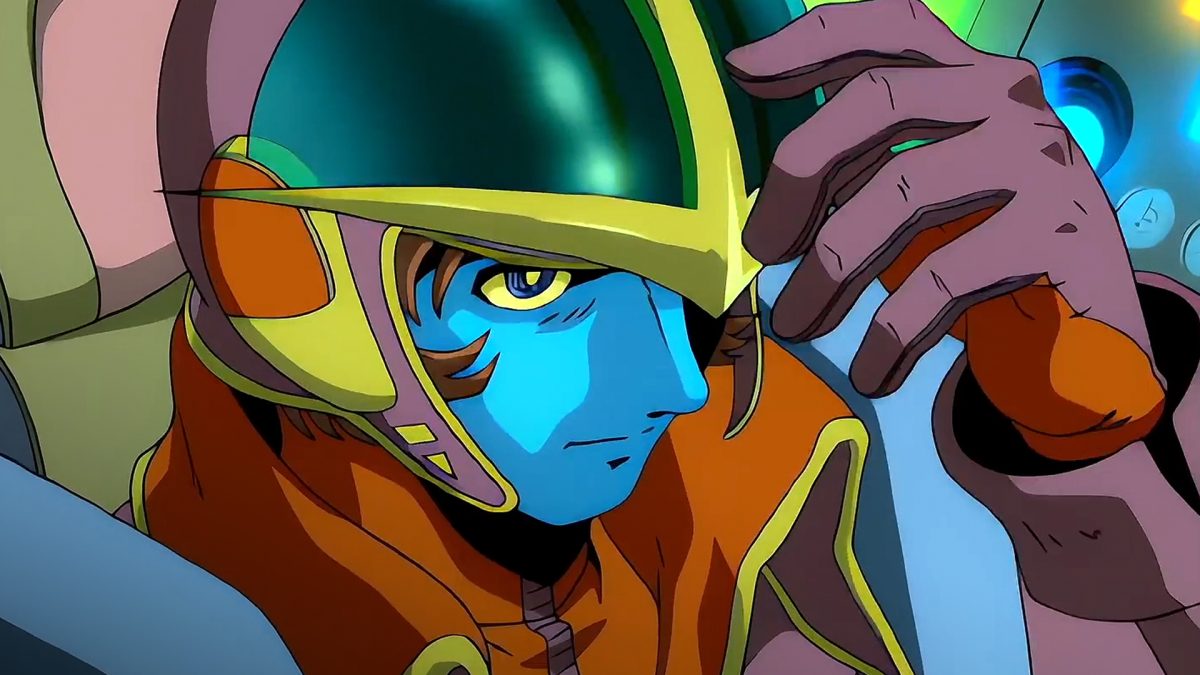
I did find the whole skin color change particularly interesting—I couldn’t help but wonder if there was a racial angle at play. It almost reads as a commentary on how many Black and non-white artists have historically been pushed to reshape or suppress parts of their identity in order to fit a more “marketable” image for wider (read: white) audiences. And the use of “Harder, Better, Faster, Stronger” in that moment feels almost on-the-nose in the best way, directly mirroring what’s happening: a forced transformation into something more efficient, more controlled, and ultimately less human.
Another detail that really stood out to me—subtle but effective—is in their faces. At the beginning, they’re constantly smiling, with this infectious, radiant joy that almost lights up the film even more than its already eye-popping colors. The two elements feel perfectly in sync. But once they become The Crescendolls, that spark is completely vanished.
The smiles fade into something hollow, replaced by a kind of quiet sadness, borderline depressive. They look exhausted, almost lifeless. The device implanted in them turns them into these soulless individuals, stripped of what made them feel human in the first place. From that point on, they’re no longer individuals, but products fuel for a larger machine that slowly, almost imperceptibly, drains whatever life they had left.
There are also these smaller narrative beats that stand out, like the implication of a more personal, exploitative relationship between the villain and one of the band members. It echoes real-world dynamics—figures like Tommy Mottola come to mind—where power imbalances blur professional and personal boundaries. Now, in the case of Tommy, it seems he and Thalia are doing more than great.
And yet, despite all that I’ve said, the film doesn’t fully surrender to cynicism. It could have easily painted the entire industry as irredeemable, but it stops short of that. There are still individuals within the system who see artists as people rather than commodities. In the film, we get the presence of a character who chooses to help, who recognizes their “humanity,” and who adds a necessary counterbalance. It suggests that while the system can be exploitative, it isn’t entirely devoid of compassion. That balance is what keeps the film from feeling purely bleak. Beneath the critique, there’s still a belief—however faint—that things can be better.
Many visual concept albums exist. Many have reached the highest tier, becoming classics and elevating their artists in the process. But, controversially or not, what Daft Punk achieved with “Interstella 5555 The 5tory of the 5ecret 5tar 5ystem” feels like something greater. At its core, it tells a story we’ve seen countless times—the rise, exploitation, and eventual fallout of artists, a narrative echoed in many biopics. Yet where those can sometimes feel repetitive or overly familiar, “Interstella 5555” manages to feel fresh and distinct. It’s a perfect marriage of music and visuals, where one doesn’t simply complement the other, but they end up becoming inseparable.
The decision to strip away dialogue entirely and rely solely on imagery and sound could have easily backfired. It could have confused audiences or resulted in something emotionally hollow. Instead, it does the opposite. The film trusts its audience, allowing meaning to emerge through expression, movement, and musical progression. And within that, there’s a surprising level of nuance with subtle ideas and emotional beats that reveal themselves if you’re willing to engage with it on its own wavelength.