
Those who decry contemporary films for being too “political” would likely have a conniption minutes into “I Love Boosters,” the latest brazenly satirical anti-capitalistic dark comedy from Boots Riley. Riley isn’t interested in playing both sides of any debate, nor does he care about potentially offending those with differing beliefs; “I Love Boosters” assumes that its audience are on board for Marxist thinking and a searing indictment of Americana. The confidence is to the film’s advantage, as Riley doesn’t have to hide behind mixed metaphors in order to get his point across. “I Love Boosters” is a much stronger film than his messy debut, “Sorry to Bother You,” and also one that goes deeper. Although it can be enjoyed for the wild, surrealist humor, “I Love Boosters” has something to say about the dissemination of art that feels like both a message Riley has catered for the current moment and a personal reflection on his journey as a filmmaker.
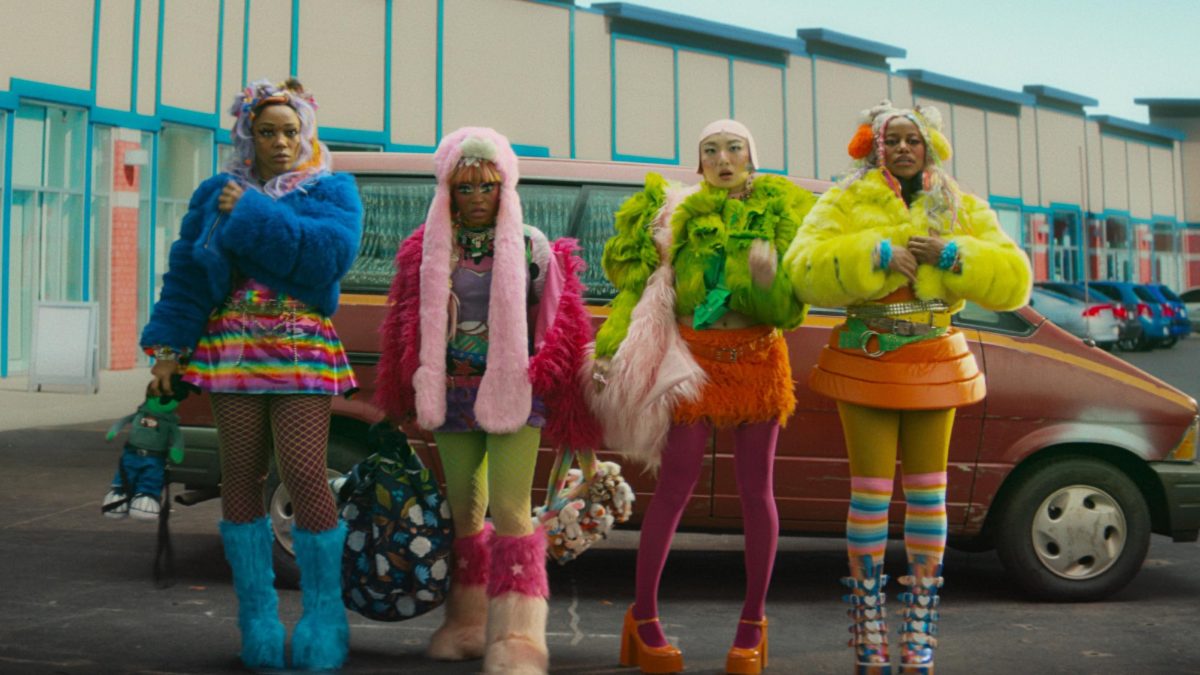
The reality of “I Love Boosters” is not all that removed from current day, as the legitimately fantastical elements aren’t totally incorporated into everyday life. Although there’s enough establishing moments to suggest that the world that exists is in the same complicated state of the last few months, “I Love Boosters” focuses on the shoplifters Corvette (Keke Palmer), Sade (Naomi Ackie), and Mariah (Taylour Paige), who have made a habit out of stealing fashion items and “boosting” them for profit. Their efforts have attracted the rage of the powerful fashion maven Christie Smith (Demi Moore), even though Corvette has a lot of respect for the self-made woman. Their plot to undercut Smith’s ambitious gala is prompted when they acquire a position working at one of her stores, which is managed by a pretentious, virtue-signaling doofus (Will Poulter).
Surrealism is often conflated with the existentialist style of David Lynch or Alejandro Jodorowsky, but “I Love Boosters” is more comparable to “Looney Toons.” There’s a manic, propulsive energy that Riley uses to unpack the hyper-active world, which often includes flashing phrases and sharp cuts to create a disorienting effect; while on one hand this is an unnerving way of showing how distraction-prone the capitalist empire is, it’s also a means of observing how excited Riley is about the wealth of influences he can draw from. That “I Love Boosters” is overstuffed is almost a given for any of Riley’s projects, but there’s surprisingly little fat within the film. Even the subplots that grow too on-the-nose are rarely boring; for better or worse, Riley has a lot of opinions that he wants to express, and finds a way to shoehorn in all types of commentary.

There are instances in which the blatantness of Riley’s approach is also effective as a comedic device. At one point in the third act, a piece of technology used to explore the “natural state” of selected targets offers a few gut-busting laughs about the insidious roots that lie beneath all of American culture and economics. However, it’s when the film becomes sincere where the satire is no longer as sharp-edged, as it asks for the reality of the story itself to be taken seriously. Although an understanding of the complex, gag-a-minute narrative that Riley has meticulously constructed is not necessarily required to have a blast watching “I Love Boosters,” it does prevent the film from grounding its emotional stakes.
Also Read: 25 Impactful And Uplifting Movies About Black People
The confusing touches of sincerity do not affect the performances, as Riley has assembled a fantastic cast of up-and-coming stars, established names in unusual roles, and legends in their comeback roles. Palmer is the perfect lead for a film because she is confident, passionate, and strongly opinionated, but not abrasive in the way that the other members of “The Velvet Game” are. Paige’s performance is much more idiosyncratic and care-free, which makes her the perfect counterpart because of how uncomfortable Corvette has become by Mariah’s approach. Sade is sadly the least-developed character, despite a few great lines, but Ackie’s performance is strong enough to make the friendship between the trio quite effective.
Moore has proven that, after “The Substance,” she is willing to engage in self-satiring roles that play off of her image as an ‘80s sex symbol, and she’s perfectly suited for an aggressive, privileged fashion magnate who is framed as 21st century “girlboss CEO.” The film’s gender politics are surprisingly subdued (with the exception being a subplot involving LaKeith Stanfield’s character), but Smith is positioned as the type of viperous entrepreneur who would thrive in Obama-era America. The biggest transformation of the cast is from Don Cheadle, whose hilarious role can’t be discussed further without spoilers being involved. Suffice to say, it is great to see one of the industry’s best actors back in a new film where he is willing to try an outrageous performance style that is unlike anything else he has done.
There’s not a single bad performance in “I Love Boosters,” but some characters feel cheated of more room to grow. Eiza Gonzalez has an interesting role as Violeta, a co-worker of the three leads at the fashion store, who is actively supporting the interests of a union. Although she grows to be a member of the team, there’s a tension between Violeta and the Velvet Gang that feels unexplored; while there are some brief allusions to racial tension, it’s the rare instance in which Riley doesn’t seem to be saying anything profound. Alternatively, the rival shoplifter Jianhu (Poppy Liu) has an integral role that grows as the film continues, and does a great job at flipping the perspective on what “boosters” can really do. It’s where the film’s optimism is best served; alternatively, Poulter’s performance is gloriously hammy, yet uncanny in its depiction of mid-level management, making him a brilliant scene-stealer.
“I Love Boosters” is high on its own supply, and in many ways, its politics feel lifted from the Biden era. That being said, Riley is pushing himself to take more chances, include more gags, and overwhelm the senses, resulting in a film that never feels compromised. Politics and art have been and will always be linked, and “I Love Boosters” is equally ambitious in both regards.



![Sing Street [2016]: Finding the voice!](https://www.highonfilms.com/wp-content/uploads/2016/07/SING-STREET-768x419.jpg)
![Good Night Good Morning [2010]](https://www.highonfilms.com/wp-content/uploads/2016/10/Good-night-good-morning.jpg)

![Moving On [2019] Review – A Tender Family Drama Reminiscent of Hirokazu Kore-eda’s Works](https://www.highonfilms.com/wp-content/uploads/2021/10/Moving-On-2019-1-768x432.jpg)

