Agradoot’s “Pathey Holo Deri” (1957) emerges from the Uttam-Suchitra melodrama cycle, a body of films that carried the emotional pulse of Bengali cinema through the 1950s. The modernity constructed within these films functioned as far more than a social atmosphere. It moved through gestures, speech, bodies, and interior longing until emotion itself became form. Melodrama here, instead of simply housing desire, shapes desire, giving it rhythm, resistance, and emotional texture. Memory, misrecognition, and gradual self-revelation flow through the narrative structure of “Pathey Holo Deri.” Beneath its romantic framework lies a persistent anxiety surrounding class and identity, with the relationship between its two protagonists carrying the emotional and social tensions of the film forward.
On the surface, the plot follows Jayanta Mukherjee, a modest middle-class doctor who travels to the mountains to practise medicine. There, he meets Mallika Banerjee, the heiress of a millionaire. Their forbidden love compels Jayanta to pursue further studies abroad. He finances his education with the help of Mallika’s maternal heirloom and promises to return. While abroad, he receives false news of Mallika’s marriage and comes back broken-hearted.
Now a successful doctor, he discovers a bedridden Mallika with the help of his new fiancée. Traumatised by what she believes to be his betrayal, Mallika has withdrawn into illness, and his attempt to heal her becomes the emotional core of the film. The obstacle separating the lovers originates from parental authority, a familiar device in melodrama, though the film approaches it with unusual psychological sensitivity, showing how social pressures slowly reshape themselves into guilt, longing, and emotional paralysis
The film begins in the present: Jayanta is attempting to cure Mallika of her mental illness. It then tracks back into the past to the moment he first met her. The introduction of the lover, with a quest to relieve the one he loves, triggers a desire which opens the past as something ghostly, half-remembered. Jayanta’s introduction to Mallika at the nursing home slowly hints at a conscious desire to be near her. The narrative winds through the lovers’ growing intimacy until the moment Mallika’s brother breaks his hand, and Jayanta is called upon to treat him desire finding its way through the detours of duty.
While You’re Here, Also Check: 15 Great Movies About Caste Discrimination, Dalit Resistance, And Ambedkarite Politics In India
The desire essentially crystallises in Jayanta’s personal space. He now wishes to be with the woman he loves, but is uncertain of his possibilities. The extra-personal conflict of class and social status bears down on that desire, leaving its mark in the form of hesitation and retreat. He hesitates and walks away, even when Mallika asks him to stay. When Mallika comes to his chamber to profess her love, Jayanta can no longer deny his own feelings — though the obstacles remain unresolved. The nurse, Mallika’s brother, and even the chief doctor in the chamber all remain, as if in silent conspiracy, allies of the couple’s fragile paradise.
The song ‘E sudhu gaaner din’ haunts this surreal paradise, a space that feels untouchable precisely because we already sense what will happen to it. The paradise appears like a ghost, as we know very well, what will happen to it, in the face of the public conflict. The personal space will shatter down to a state where Mallika will be haunted by it, and Jayanta will be a mere helpless, in the face of desertion. Shot against a theatrical backdrop, the song marks the peak of the couple’s desire for union in personal space. It prepares us for the crisis that must follow, and announces itself — through its very unreality — as something mortal. The magical space’s mortality is exaggerated by how emphatically otherworldly its construction is.
What follows is the slow generation of crisis: Mallika’s grandfather forbids their love. It’s the moment at which Jayanta’s unconscious desire to become a successful doctor, to study abroad, resurfaces. A desire he had considered impossible, one he had not fully acknowledged even to himself, now moves into the foreground. We, as viewers, become aware of this desire before he does; what remains in suspense is how its revelation will affect the lovers’ union.
The changed desire leads the couple to a decision that pivots the narrative back into the present, dissociating from the haunted story-world of the past. Jayanta resolves to go abroad and succeed — not only to socially legitimise his love, but to fulfil the ambition that the crisis has brought to the surface. Mallika offers her mother’s heirloom as a wedding gift, to pay for his education, saying simply: “We are already married, since we already love.” This private, non-social marriage — a union of pure interiority propels the narrative directly toward the assault of the extra-personal.
While abroad, unaware of Mallika’s grandfather’s scheming, Jayanta receives and believes the false news of her marriage. On his return, a coincidence leads him back to her. This coincidence is far from unmotivated. In melodramatic terms, it is a structural necessity. It creates the space for Jayanta to discover the task that awaits him: he finds that Mallika never married, that she ran away from home for him, and has been waiting. He understands that it is now his responsibility to free her from trauma.
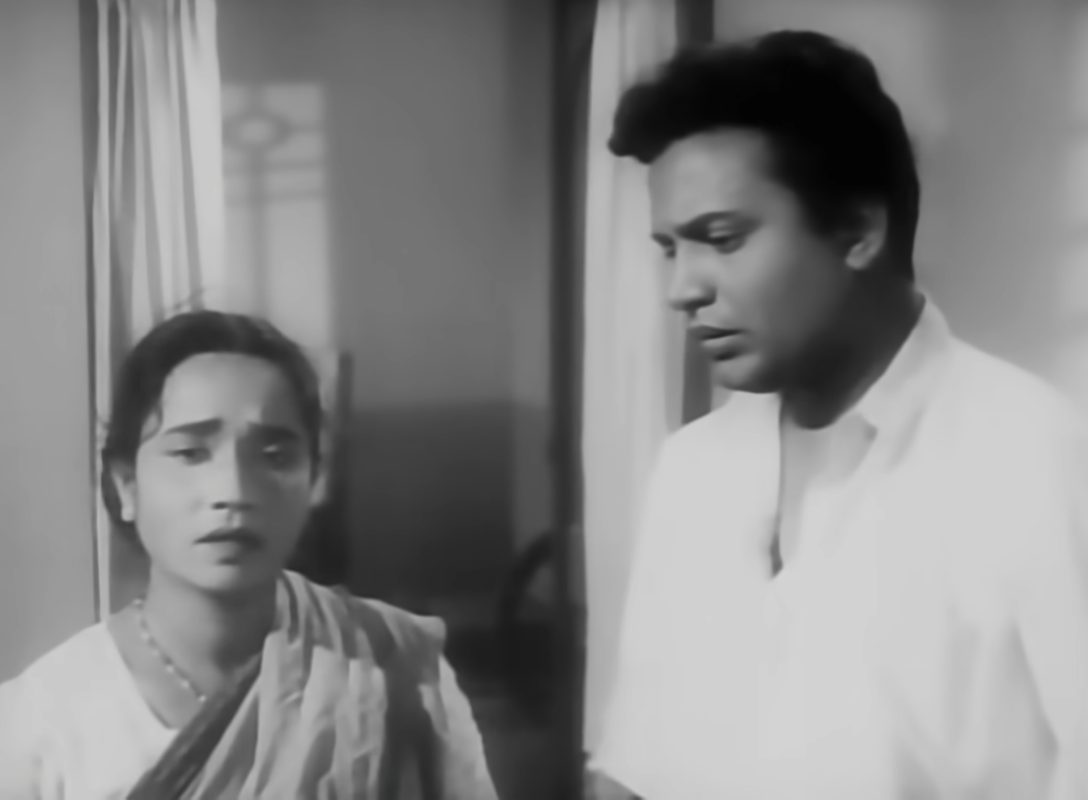
His self-revelation at this moment is crucial. For the first time, his two primary desires converge: to be Mallika’s lover and to be a successful doctor. In seeing her again, he is simultaneously both. This moment, when he sees Mallika again, he does not merely love her. He also feels responsible for healing her. The erotic and the professional merge, and in doing so, they give each other their fullest meaning.
Though the film might appear, on first reading, to be Jayanta’s journey with Mallika as its passive object of desire, the narrative is equally attentive to Mallika’s own desire and her slow, painful process of self-identification. Mallika inhabits an almost entirely masculine world. Raised by her grandfather alongside her brother after her parents’ deaths, she encounters no female figure in her home. Her sense of identity forms against and through the masculine. She accepts the men around her: grandfather, brother, and prospective suitors as her natural allies and reference points.
Mallika is aware of the peculiarity of her world. She says: ‘This is how I must accept my fate.’ She trusts her grandfather and absorbs the feminine into herself only in order to play by his rules, learning to sing, meeting the suitors he selects. Yet the very distance between herself and her grandfather opens a crack in which something else can grow: an attachment to her absent mother. Her mother’s heirloom is her only sustainable connection to the feminine – to herself. In a world where she has no access to her own interiority, the heirloom stands in for a lost self. When she gives it to Jayanta as a wedding gift, she gives him the only thing that is truly hers.
Mallika pursues Jayanta when he remains uncertain. She breaks the myth of class discrimination and takes power into her own hands. And yet she has not achieved autonomy. She still inhabits her family’s extra-personal space, in which she has been trained to subordinate herself. She tells Jayanta, ‘I am nothing without my grandfather’s wealth’. It explains her conditioning toward self-negation.
The dependency on her grandfather’s authority is structural. It cannot simply be wished away. The paradise she discovers after her union with Jayanta is her first taste of selfhood, a self she does not yet fully recognise. She still looks to Jayanta as her saviour, the one who will break her grandfather’s hold over her.
Also Read: Revisiting ‘Manichitrathazhu’ (1993): Caste, Psychiatry, and the Cultural Blind Spots of a Malayalam Classic
When she gives Jayanta her mother’s heirloom, Mallika breaks symbolically from her grandfather’s authority yet remains, in practice, subject to it. She still waits to be taken away and suppresses the new self that has emerged from beneath the pre-existing order. Her ultimate break from the extra-personal space comes when she runs away from home. Mallika, after falsely believing that Jayanta is engaged to another woman, falls into deep emotional distress. She seeks shelter with her nanny, descending, at last, into the maternal space that had always been absent from her life. It is the maternal that redeems her from death.
Towards the end, disturbed and bedridden, Mallika learns of her grandfather’s final betrayal. Significantly, it is not her lover’s apparent betrayal that drives her toward suicide, but her grandfather’s. With this final break, the extra-personal space does not simply lose its power but becomes impersonal, voided of authority. Two letters arrive in this moment: one bearing news of her grandfather’s betrayal, the other from her nanny. The juxtaposition is precise: the collapse of the patriarchal space coincides exactly with the arrival of the maternal voice. In the space between the two letters, Mallika meets herself, a self that is, for the first time, entirely her own.
Just as she is about to consume the poison, Jayanta arrives to stop her. Jayanta does not arrive as her saviour, not in the conventional melodramatic sense. He comes as her equal: her inner masculine, stripped of the extra-personal authority that once defined their difference. The rescue, here, is also a recognition. Jayanta does not rescue Mallika. By the time he returns to her, she has already endured the emotional cost of reclaiming herself
“Pathey Holo Deri” traces Jayanta and Mallika’s parallel lives and holds them in a melodramatic structure that is far more psychologically rigorous than the genre’s popular reputation might suggest. In the film, the lovers’ paradise is always already doomed, but it is in the ruins of that paradise that both its protagonists discover who they are. Melodrama, at its best, offers recognition in “Pathey Holo Deri,” and that recognition is irreversible.