Since the start of Russia’s invasion of Ukraine in early 2022, few films outside the realm of documentaries have examined the scope of this seismic breach of national sovereignty; even fewer, if any, have taken on that perspective from within the aggressor state itself. It’s fitting enough, then, that the first major fictional display of Russia’s very real aggression set within Putin’s bounds would come from a voice wholly familiar with bringing that pervasive corruption to the screen.
Andrey Zvyagintsev hasn’t made a film since 2017’s soul-shattering “Loveless,” and while his absence has been attributable more to a life-threatening bout of COVID-19 than any state-imposed censorship, the Russian director knew well enough that a film like “Minotaur” would probably only see the light of day if production were taken beyond the Kremlin’s reach. With material this timely, Zviyagintsev makes no pretenses about its relevance to his nation’s ongoing crimes, but as always, his means of confronting that national crisis is distilled through a microcosmic expression of grave familial dysfunction.
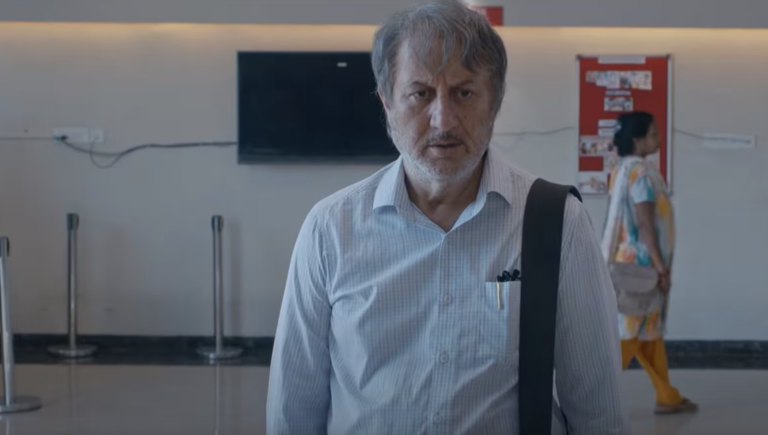
Gleb (Dmitriy Mazurov) feces this crossroad when, in the early months of 2022, he comes to be faced with a devastating dilemma. The CEO of a regional company that’s already facing staffing shortages in the aftermath of the pandemic, Gleb is called into the mayor’s office alongside his business peers to learn that the Russian offensive has forced them all to send a list of workers recommended to be shipped to the front lines. Already distraught by this order, Gleb’s situation isn’t alleviated by his circumstances at home.
Between an increasingly distant wife Galina (Iris Lebedeva) and a hormonally hostile teenage son (Boris Kudrin), Gleb’s luxurious refuge outside of work isn’t all that peaceful with the nagging suspicion that his spouse is having an affair behind his back. Tasking one of his underlings to do some digging on the matter, what Gleb comes to discover weighs heavily on his mind, perhaps more so than the prospect of sending his own unsuspecting workers to die for a crooked cause.
Zvyagintsev has always allowed the sinking disparity of his class commentary to creep through his films with the most innocuous of acceptance that nevertheless acknowledges the cruelty of their casual enablement, and “Minotaur” slips right back into that comfort zone without missing a beat; the sparse isolation of Gleb’s remote, high-end home stings even more against a smooth circular pan around the messy apartment of a nobody with all the power to make his wife happy in ways he hasn’t achieved in ages, if ever at all.
These vast and controlled playgrounds of the wealthy serve equally as the perfect silent representations of the household disarray not so easily swept by the bi-weekly visits of a maid, as Zvyagintsev continues to block his actors with almost Kurosawa-levels of intent that brutally emphasizes the distance they so obviously wish they could have from one another when the suffocation of bourgeois appearances give way to the bedside release of all that pent-up poison flowing between them. Passive-aggressive conversations are had, but genuine thoughts rarely pass through the provincial chill of the stifling air.
It’s an approach we’ve seen from Zvyagintsev time and time again, but a newly recontextualized Russia in the ongoing brutalities against Ukraine gives “Minotaur,” a modern-day retooling of Claude Chabrol’s “The Unfaithful Wife,” so much urgency upon which he pounces with unshakeable focus, refusing to relent on the everyday reality of propagandistic banners celebrating the pointlessly fallen, or an inconvenient problem swept under the rug in return for a few front-line resources made necessary by the government’s inability to foresee the difficulty of the circumstances in which it has thrown its own citizens.
The “Leviathan” filmmaker has always ingrained the corruption of the Russian aristocracy into much smaller depictions of moral rot, and “Minotaur” finds its startling efficacy in how a common marital discord is framed and handled on the side of a man whose sense of follow-through defies any pre-existing depictions of handling infidelity. Gleb, in his quest to discover his wife’s habits, handles himself rather gracelessly, but one completely casual decision he makes in front of his computer screen will likely have your jaw stretched across the floor when confronted with the unmitigated audacity of such offhanded cruelty.
In Greek mythology, the minotaur exacts periodic cruelty upon the sacrificed locals of Athens, only to return to the refuge of its cavernous labyrinth. “Minotaur,” for its own part, stands to address the behemoth brutality of a monstrous figure lurking behind the twisted walls of its own byzantine refuge; for Andrey Zvyagintsev, morality is a maze, and working one’s way to the centre only serves to face them with unconscionable atrocities at the bloody hands of a beast that just barely passes as human.



![Why Are We Creative? [2018]: ‘Venice Film Festival’ Review](https://www.highonfilms.com/wp-content/uploads/2018/09/WAWC_campfire_Animation-768x540.jpg)