
Sompot Chidgasornpongse has served as the assistant director on a few projects directed by Palme d’Or winner Apichatpong Weerasethakul. It shows in his narrative feature, “9 Temples to Heaven,” which recently premiered at Cannes. Much like Joe’s films, it’s a quietly transportive cinema that finds beauty in its relatively long takes and unhurried pace. Still, unlike his work that often leans into magic realism or surrealism, “9 Temples” relies on grounded realism. Although thematically more focused on the Thai spiritual elements, it has tonally more in common with Edward Yang’s films, which can be considered gloomy slice-of-life dramas about a part of Taiwan’s cultural history.
Chidgasornpongse approaches his themes similarly as he follows his characters over a passage of time, reflecting on life and interpersonal relationships. Written by him, the script covers a brief period in a family’s life. The film takes place over a few days of a road trip across some temples in Thailand. The older generation of middle-aged parents believes it would help their aging mother, but the younger generation isn’t entirely on board with that notion. Tor, the 20-something man who joins them with his girlfriend, appears as a clear-cut skeptic, whereas Sakol, the middle-aged patriarch who remains in charge of the trip, appears blindly faithful to their ritualistic gestures.
The script doesn’t pit them against each other to offer a watered-down, conventional confrontation between their belief systems. It shows them trying to find a way to co-exist despite their differences and only occasionally allows the underlying interpersonal friction a room to breathe. That makes the film remarkably lifelike and resonant. Even humor appears organically in situations when people find themselves in the same space. In one such scene, Koon, Tor’s teenage brother, talks about his mental health struggles from a few years before. He reflects on the advice he received from his older relatives, who considered meditation a definitive solution to his concerns.
The director could have easily used it as a means to let Tor blow off some steam and share his point of view. Instead, he finds subtle humor by simply letting the camera remain on Tor’s face, as Tor barely says a word. So, he seems emotionally divorced from such familial obligations. That understated approach remains crucial to the film’s overall impact. It also lets the themes breathe organically rather than being used as fuel for attention-grabbing statements, no matter what kind. That’s why, instead of a simplistic confrontation or a declaration, the film seems like a wholly personal account about these belief systems ingrained in Eastern cultures.
“9 Temples” is not snarky or cynical, even if a character occasionally appears that way. The same goes for characters who believe in the spiritual gumbo about a higher power or in the strength of their ritualistic gestures. The script never endorses any stance. It simply acknowledges their viewpoints as a part of a similar family dynamic. That also makes it a relatable portrait of such families, where rituals often become obligatory and inescapable regardless of your personal beliefs.
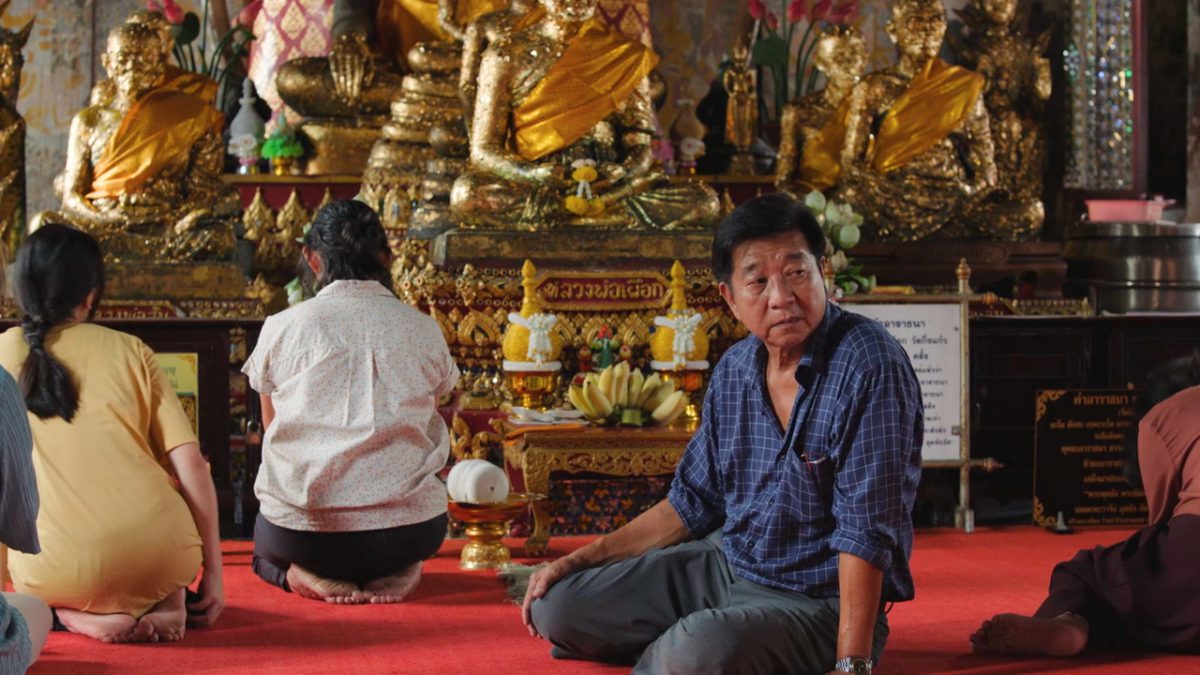
Thematically, “9 Temples” resembles Lulu Wang’s film, “The Farewell,” as it also explores views on faith and mortality through an intergenerational tale over the course of a few days. In both films, the grandmother appears almost as a centrifugal force holding everyone together despite their evident differences. Wang presents their bond through tragic and occasional dark comedic notes, whereas Chidgasornpongse does it through breezy naturalism with a tragic undercurrent. Their bittersweet musings about mortality feel similar because characters avoid speaking about death, an inevitable part of human life.
“9 Temples” explores this perspective about life (predominant in Eastern cultures) with remarkable ease and candor. Nothing feels forced or staged, even if it relies on a cast of mainly non-professional actors, and explores heavier themes of gender constructs and wealth disparity between different generations. It underlines those differences through casual conversations and believable moments that do not draw attention to themselves in a conventional sense.
The director manages it mainly through wide shots, staying relatively (and respectably) distant from the characters. It allows their movements and gestures to be interpreted in a social situation rather than their reactions to be the central focus of those scenes. These choices help especially in situations with dramatically heightened moments, where we can also see others around them getting uncomfortable, annoyed, or afraid of the ones engaged in the argument. That’s why close-ups, used sparingly, make their reactions linger. These subtle choices show the director’s skill at crafting his own world with a fine balance between its grounded style and substance. That’s an impressive feat for a debut feature.
The only reason it feels like a lesser entry in this form of cinema is the lack of fresh insights into the themes of faith and intergenerational disconnect. There’s nothing revelatory about the script to make it truly unforgettable. However, it still finds plenty of charm through its mundane moments to keep us engaged in its ruminations. So, the director deserves every bit of praise for capturing the mood of disconnect and ennui.




![The Happiest Day in the Life of Olli Maki [2016] – The Existential Struggles of a Fighter](https://www.highonfilms.com/wp-content/uploads/2017/01/Olli-Maki-Cover-768x403.jpg)
![Wade [2020] Short Film Review: A Delicate, Detailed Horror Story about Climate Crisis](https://www.highonfilms.com/wp-content/uploads/2020/11/WADE-SHORT-FILM-highonfilms-2-768x577.jpg)
![The Nun [2018]: A Lackluster Spin-off That Sinks Into Its Mediocrity](https://www.highonfilms.com/wp-content/uploads/2018/09/MV5BMTYyNjQzOTAzNl5BMl5BanBnXkFtZTgwNzk4NzgxNjM@._V1_QL50_SX1777_CR001777744_AL_-768x322.jpg)