I remember the 12-year-old me watching “Delhi Belly” for the first time without understanding a single moment, except relishing the “Bhag D.K. Bose” sequence. Eight years later, when I had just entered the community of film buffs, I rewatched it due to constant peer pressure and was completely blown away by it. Subsequently, I watched “Blackmail” and thought this is exactly the kind of cinema I was looking for. Cut to 2026. I’m watching “Brown” before having an interaction with Abhinay Deo, who sort of changed the way I used to look at cinema before.
Honestly, I felt a little pain in my heart while watching the first two episodes. It’s the kind of pain you feel when your favourite filmmakers change their styles — perhaps an emotion strictly restricted within the cinephile’s community. However, as I watched the series till the end and conversed with Abhinay about his craft, it became clear to me that he has not changed at all. Rather, he has evolved. Abhinay made a late entry into OTT. This is what his style is. When something new emerges, he tries to contemplate it before jumping into it. He tries his hand only when he is convinced that he can gain a grip on the thing.
“Brown” is one of the best thrillers I have seen so far. While Abhinay rediscovered himself with the series, you’ll get to watch Karishma Kapoor in an avatar you have never seen her in before. Below is my conversation with Abhinay.
Soumalya: Hey Abhinay, how’re you doing?
Abhinay Deo: Great buddy. How’re you?
Soumalya: Fine, sir! So, shall we start?
Abhinay Deo: Absolutely!
Soumalya: Abhinay, you know I belong to the generation that grew up watching your films. For us “Delhi Belly” (2011) was a moment of revelation. It opened up for us the possibilities that a film could contain in itself. Later films like “Blackmail” (2018) followed it. So, we were quite used to your black humour, through which you used to tell your stories. But here in “Brown” (2018) I noticed you’ve quite explicitly stated what you intend to say, and your signature black comedy has evaporated. This hints towards a shift in your filmmaking style. Did you do it consciously? If yes, then how and why did you do it?
Abhinay Deo: Yes, it was a conscious decision to change the style… because I hate to do the same thing over and over again, whether it is style, whether it’s the kind of stories I tell, whether it’s the genre… I think I have always experimented with different genres. I shot “Delhi Belly” 15–16 years back. After that, I have evolved over time. In that period, after “Delhi Belly,” I have done 5 films and 2 series (including “Brown”) and almost 1250 ad films… so after this much body of work, you end up evolving your craft, methodologies, thought process.
So, I think it is a conscious effort to tell something and give something differently to the audience, and also to challenge myself — that’s what I do in every project, at least I try. And “Brown” is a special experience for me because the last series I did before, “24” (2013), was for television, and with “Brown” I’m about to make my debut in OTT as a director. Another special thing about this series is that it is almost a relaunch of Karishma Kapoor in a very, very different avatar than you have ever seen her before. So, throughout the series, many attempts have been made to break conventional moulds, and I hope they all work.
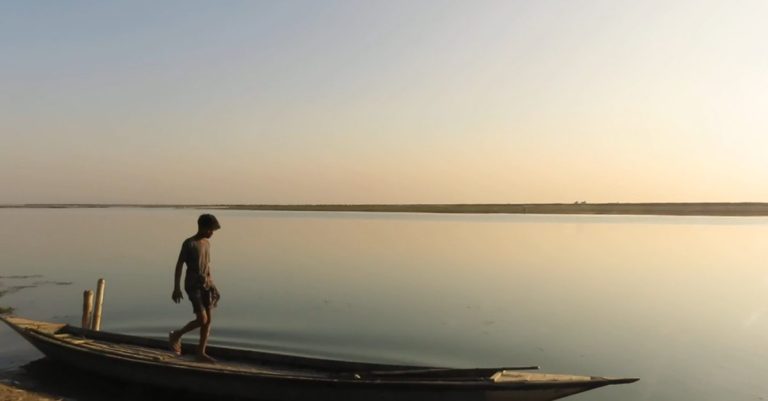
Soumalya: I personally love the way you treat space in your films. The dingy space in “Delhi Belly” where the characters dwell was so unique that it is almost beyond our imagination to think of the same film without having the same space in it. Here in “Brown,” you have used certain subtleties to decorate Kolkata, such as political agitations, boat sequences in the Ganges… these all make Kolkata very lively in the show. Do you treat space in your projects as a character itself?
Abhinay Deo: You hit the nail on the head. For me, it is always the space in which the characters operate… so it is equally important as the characters are. I believe if I do not specify the geopolitical location where the incident is occurring, or if I do not treat the city as a character, then I will be doing an injustice to the film. Whether it is “Delhi Belly,” “Blackmail,” “24” or even “Brown,” I always try to incorporate the politics of the place, the food of the place, the art, the culture, the heritage, the architecture… I mean, being an architect, it plays an important role for me…
Soumalya: You were an architect before coming into films?
Abhinay Deo: Yes. I was an architect, then switched to filmmaking.
Soumalya: It’s interesting, man!
Abhinay Deo: It’s wild (chuckles). You know, studying five years of architecture teaches you a lot about paying attention to details as far as space is concerned. So it’s a very important question that you asked… yes, Kolkata is very much a character in the series. I’m not from Kolkata, but I have always been intrigued by the city… I’m a big foodie, plus I’m an architect and love watching films… so now you can understand from all my perspectives how hard it is to keep Kolkata out of my system. The city has the finest literature and the finest music… so I wonder, when a city has so much to offer, why should I not make it a part of the story?
In this series, if you have watched carefully, you’ll understand I haven’t looked at Kolkata from a tourist’s point of view. Also, I have noticed whenever a show or a film is shot in Kolkata, it opens with Howrah Bridge or Victoria Memorial… I find it an injustice to the place because the monuments don’t make a place; the people make it. I have attempted to rectify that in “Brown.” “Brown” is as much about the Bengalis residing in Kolkata as it is about the Anglo-Indians, the Chinese, the Marwaris, the Biharis… so it’s as much about the people as it is about the crime we are handling in the series. Crime is the spine, but the people make the body, and their moral decay is what the story delves into.
Soumalya: I didn’t know you loved Kolkata so much. If you come to Kolkata soon, let me know. Will you give a Kolkata special biryani treat?
Abhinay Deo: Absolutely… I have always been fascinated by Kolkata.
Soumalya: We all are. I’m also not from Kolkata, but it has always fascinated me.
Abhinay Deo: Really? Since you are Chatterjee, I thought you were from Kolkata.
Soumalya: No, no. I’m from West Bengal but not from Kolkata. I’ve studied there, but was born and brought up in a different place.
Abhinay Deo: Oh! I understand.
Soumalya: Abhinay, could you name a few shows that particularly inspired you to make Brown?
Abhinay Deo: No, I don’t think there is one particular series that inspired. What I try to do while making something is not to get myself influenced by any other work. Since you asked me the question, I can tell you about certain images which were in my mind, but you know, what I try not to do is get carried away by a kind of show or film that is similar to the one I’m making, because then it becomes an integral part of your thought process and you’ll end up making something that is slightly borrowed… that slight borrowing might turn into a bigger borrowing.
I prefer to come up with my own vision. Let me give you an interesting example. You just try to remember Karishma Kapoor’s look in the film. I took a reference from Sandra Bullock’s look in the film “The Unforgivable”. I took a cue from this film and understood how Rita Brown should look in the show. Rita Brown, in the show, starts as an alcoholic, chain-smoker, and a person with baggage who is really down and suffering.
It’s very interesting to note how her character begins in the show, and while she is fighting her own demons, she is fighting other demons made out of society. So it’s a story not about a cop and her targets but about everybody around, and also it’s about how much grey the characters have become without realizing it. That’s the most interesting part about it. So, I might have taken cues from certain references, but I tried to go as original as possible.
Soumalya: I have a pretty complex question for you. You have been making films for a long time now. Things in the meantime have changed a lot. People have changed their habits of watching cinema after OTT. Popular films have changed their characters. These days, much of the commercial cinema carries a political statement with it. A certain section of intellectuals regards these films as texts trying to fabricate history. How do you respond to this changing ecosystem of cinema as a filmmaker?
Abhinay Deo: I’m not surprised to see this change, neither as a filmmaker nor as an ordinary citizen. I personally feel change is the only constant! And if you look at our industry, you’ll notice a wave coming at an interval of every 10–15 years, and the wave kind of changes the shoreline. It just comes, smashes against the shore, and changes the entire landscape. I think at the moment OTT is that wave. Actually, we all know this truth deep down. It changed the viewing patterns, changed the consumption patterns, changed the way we used to look at cinema, and changed the screen size!
It has changed much more than we could ever imagine. All this changed in just one wave… it was like a tsunami, and during COVID, the tsunami got a double boost. So, considering all these things, there are two ways. One is to observe it, look at it, comment on it, and the other is to accept it! I believe in acceptance. I believe that when changes happen, if you fight them, then you are fighting them to eventually lose it to them. I am not saying this from a defeatist point of view. Don’t look at change as a problem.
Try to look at it from an optimistic point of view. Honestly, OTT and this changing landscape you are talking about have only given us many more opportunities. It has definitely made some dents, created some upheavals, but those upheavals are bound to happen because with change comes unrest. Though the unrest settles down slowly, the change becomes the new normal. I personally feel that we should accept it with open arms… and you know I’m not an eternal optimist, but I try to look at things from the best possible optimistic point of view. I’m also one of the last directors to get on to the OTT bandwagon… it has been there for 7–8 years, but I joined lately.
You know why I took time? Because of this change. My formula is to take the change easily. Calmly comprehend it. Wait for the right opportunity. Don’t rush. So I was waiting for the right opportunity. When the new normal had settled down and I got a grip on it, then I tried my hand at it.
Soumalya: So, Last Question! Before we end this, we always ask our guests about their five favorite films, but since we’re called “High on Films,” could you share some movies that you believe represent the cinematic high moments, where you feel cinema truly reached its peak? What films made you feel that way?
Abhinay Deo: Cinematic high moments! Whoa! Shall I recommend Indian cinema only or world cinema?
Soumalya: Anything you want.
Abhinay Deo: That’s a tough one …
Soumalya: Okay. Let me help you a little bit. You can always recommend more than five films (chuckles)!
Abhinay Deo: I can tell from my perspective …
Soumalya: Absolutely!
Abhinay Deo: Okay … will try to do this chronologically. So, let me go back as much as I can. The first peak moment for me came when I saw “Sholay” (1975). I saw it when I was 7 years old, and I had the good fortune of watching it at Minerva. I saw it, and I was stunned because for the first time as a kid, I saw something and understood everything about it. It was extremely well made, it was extremely real, and it was unlike everything that came before and after it. It set a certain standard in my mind. The second peak moment came for me around the same time when I saw “Star Wars” (1977) in Excelsior, Mumbai.
My father took me with him to watch it and said you must watch all this wild stuff, and for the first time I saw a spacecraft in cinema, I saw cars flying, an inter-galactic war, and I was like WHAT THE HELL IS GOING ON HERE because it was all unreal but the person (George Lucas) made it look so real, and it was so big of an influence for me that I wanted to become a filmmaker at that very moment for the first time. Then I saw “Superman” (1978), and I saw a human being flying and flying so convincingly!
It convinced me that in cinema, if you can think it, you can make it — and that was really a liberating thought for a child. The fourth film I’m going to name is probably the one that had the biggest impact on my life. It’s “Anand” (1971). I saw it as a kid, but I lacked the faculty to understand it at that age. I saw it again when I was about 10 or 12. Then I understood it and was so inspired by it because for me it was a film without grandeur, without fancy clothes, nothing dramatic about it… It is a simple human story, and the story makes you laugh and cry at the same time.
It impacted me immensely, and I think Hrishikesh Mukherjee was one of the finest filmmakers who ever lived. I consider him and Bimal Roy as some of the finest filmmakers we have ever had. And interestingly, my parents were in “Anand.” Dr. Prakash and his wife, whom you’ll see in the film, are my parents. And you’ll be surprised to learn that during the last schedule of the film, around 1969, my mother was pregnant and she was carrying me in her tummy, and in that way, I also became a part of Anand…
Soumalya: It’s surreal, man!
Abhinay Deo: It’s surreal! It’s bizarre! And you know my mother later told me by calculating that “Oh shit! Even I didn’t know you were in my tummy at that time!” She came to know only when she had finished the shooting, and I was like what a bizarre coincidence that was! Mind-blowing! Then I don’t remember particularly if a film made an impact on me… definitely there were films that I loved… but the next one I would mention is Raj Kapoor’s “Jagte Raho” (1956).
Then Benigni’s “Life is Beautiful” (1997) impacted me a lot. Later in my life, I saw “Bicycle Thieves” (1948), Tarkovsky and Kurosawa’s films, and all those classics, but the films I mentioned were the ones that really shaped me. And look at the diversity between “Sholay” and “Anand”… (chuckles).
Soumalya: Man, your suggestions are so interesting because they made me rethink something. It could be irrational, but still, most of the time when I ask a filmmaker to mention his favourite films, in my mind, I try to link them with the stuff they make. But in your case, there’s no link between the films you make and the ones that inspired you to make cinema!
Abhinay Deo: Yeah, there’s no link… but I must tell you something. After I became a filmmaker and I had done all those advertisement stuff, the Coen brothers became my inspiration. Then Tarantino, Guy Ritchie, and so many others influenced me. Then some fantastic Korean and Japanese filmmakers have also been my inspiration, and I think those are closer to the work that I do. But if I have to look back and go through the 50 years of my conscious memory, then the peak moments are those I mentioned earlier, and those were the films that pushed me to become a filmmaker, but at the same time, they are unrelated to the stuff I make.
Soumalya: I’m just curious to know, have you seen Roy Andersson’s films? He made a lot of advertisement stuff apart from his features. Since you also work in the advertisement arena… have you seen them?
Abhinay Deo: Yeah, of course. Also, I forgot to mention Wim Wenders’ films, which have been a source of inspiration to me, and I love Joe Pytka’s commercial stuff also. His “Space Jam” (1996) is mad stuff. Then there’s a guy who made “Eternal Sunshine of the Spotless Mind” (2004)… Michel Gondry… he is fantastic. Have you seen Charlie Kaufman’s autobiographical film… the conversation has become really interesting now (chuckles)… and oh! There’s another fantastic film called “Adaptation” (2002)… have you seen it? Was it directed by Kaufman?
Soumalya: No, it was written by Kaufman and directed by Spike Jonze.
Abhinay Deo: Right! Right! Man, this conversation is so amazing that it won’t end here. We can do this for an entire night over a bottle of whiskey!
Soumalya: Of course! Let’s do this sometime soon in Kolkata.
Abhinay Deo: Absolutely! We will and we should!
Soumalya: It was lovely talking to you. I wish you all the best for “Brown” and for all your upcoming projects.
Abhinay Deo: Thank you, Soumalya, and please let me know your thoughts on “Brown.”
Soumalya: Sure, man! Ta-Ta!
Abhinay Deo: Bye!