Satyajit Ray’s Apu Trilogy does not simply translate Bibhutibhushan Bandyopadhyay‘s novels into images. It interrogates it, mourns it, and films the same poverty, the same Bengal, the same boy watching the world open around him, and arrives, almost inevitably, at a different truth. Between the novelist’s 1929 and the filmmaker’s 1955 lies independence, Partition, the collapse of one dream, and the difficult birth of another.
In this article, I will discuss how the women in Apu’s life are the trilogy’s true protagonists. It is these women who initiate his consciousness, absorb his failures, and die at the precise moments his narrative demands they do. In “Pather Panchali,” that woman is Durga; “Aparajito” belongs entirely to Sarbajaya, and the third film is Aparna’s. The first two films portrayed what Apu gained through these women’s guidance and lost through their deaths. “Apur Sansar” confronts him with the truth that the consciousness that makes him human has been constructed from other people’s sacrifices, and that to understand it, one needs to look at the historical canvas of the novel and the film.
Bibhutibhushan Bandyopadhyay’s novel bears the full pressure of its historical moment, the 1930s bearing down on every page. The Great Depression, compounded by British colonial mismanagement, had devastated the Indian economy: commodity prices soared, cottage industries collapsed, and the national struggle intensified. The Dandi March would follow in 1930.
Against this backdrop, Bandyopadhyay sketches his character, Apurba, marching toward modernity with dream-tinted eyes. The novel maps the slow collapse of Brahmin dignity in hunger, a village, suspended in time, until modernity arrives to dismantle it. Apurba is not a singular case but a type: one of thousands of village boys in the colonial period compelled toward the city, separated from nature, and an entire generation made refugees.
Was Bandyopadhyay hopeful about independence? That would be to assume too much. But he knew that nothing indigenous would survive once it came in contact with the modern world. He writes, some years after the novel:
But this memory of mine is not of joy, but of sorrow. This playful realm of unrestrained nature was destroyed by my own hands. I do not know if the forest gods will forgive me.
Ray’s Postcolonial Vision
Ray started making the films more than two decades later. To understand the trilogy, we must inhabit his decade. The 1950s were a trial period of postcolonial aspiration; independence was barely eight years old, still fresh as a wound, and Nehruvian modernization held sway over the imagination of a young nation.
Ray’s Nischindipur is a village that exists with its own romantic logic, and a specific aesthetic amalgamation of Bengali modernism, Brahmo ethics, literary fidelity, and nineteenth-century rationalism. At that time, transformation was the national mandate. Yet the Cold War had fractured the world into opposing camps, turning progress into a form of survival. In India, against the spectacle of feudalism, Nehru’s call to modernity rang out: Chhodo kal ki baatein, kal ki baat purani (forget yesterday’s talk, yesterday has already gone).
The villages were caught between these two worlds. Ray understood this. His films captured what might be called the ‘destabilized equilibrium of the developmental moment’. The village is not yet gone, the city not yet arrived, and in the gap between them, real lives are lost. Now, as we move to the film, we need to talk about one female character before Durga. Indir Thakrun. She is the film’s first woman and the one who first sees Apu.
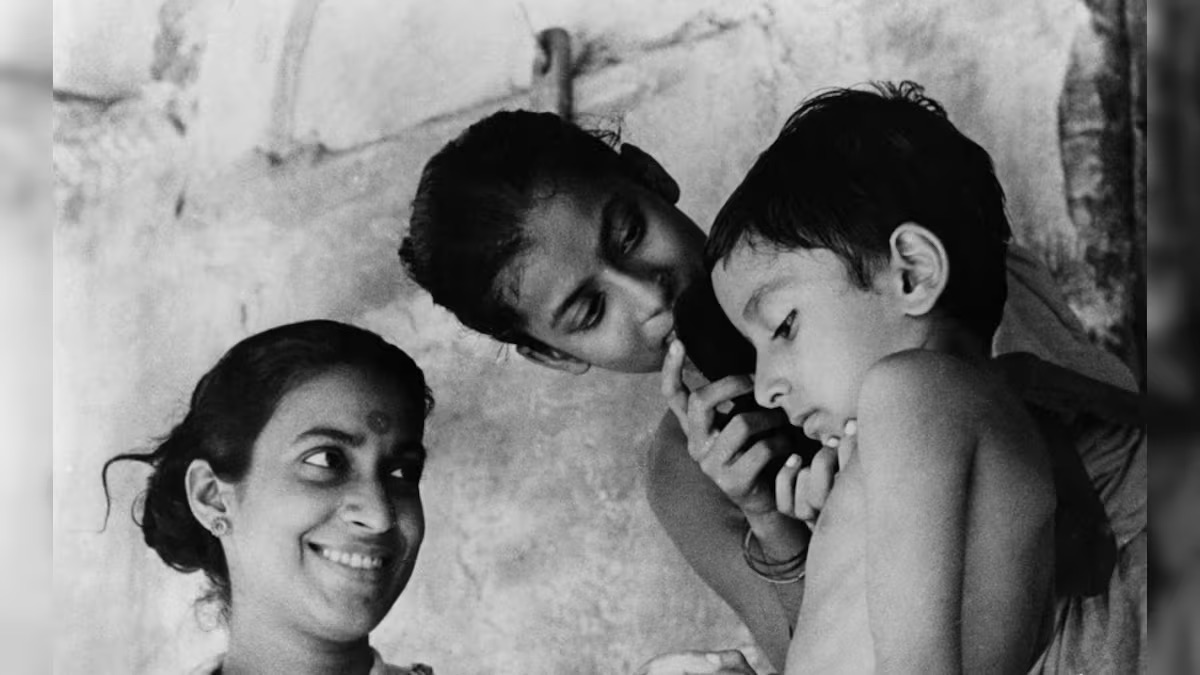
Apu’s consciousness does not begin at his birth. It begins when he opens his eyes. Our first glimpse of him comes from Indir Thakrun’s perspective, an intimate, subjective shot. Through repeated point-of-view cuts, Apu’s face appears less as a presence than as a latent potential. Apu sleeps. The world sees him; he sees nothing. Enclosed within the maternal and the timeless, he is, for now, spared the pain of consciousness. When he finally opens his eyes, Ray cuts to Apu sitting up in bed, the world gazing at him, and he is gazing back.
Indir Thakrun presides over Apu’s pre-conscious world. She is the novel’s first casualty of modernity’s advance. Her death marks the end of an era. Bandyopadhyay writes plainly: With the death of Indir Thakrun, the old era came to an end in the village of Nischindipur. But how she dies and what her death means differ fundamentally between the novel and the film.
Bandyopadhyay, writing in the 1930s when traditional social structures were visibly collapsing, depicts Indir Thakrun’s death with cruelty. She dies alone, in scorching sun, in a stranger’s outhouse, expelled from the community. The death represents the complete breakdown of the joint family system, the bonds that once made old age bearable.
In the film, Indir Thakrun dies gently, in the forest, listening to the laughter of Apu and Durga at play. The camera holds on her face while everything else—including Durga blurs into the background. This formal choice encodes Ray’s interpretation that Indir does not die in social abandonment. Nature reclaims her precisely where modernity cannot follow.
As the film progresses, Apu’s awakening is mediated entirely by Durga. She is his guide into the world, his interpreter of desire. The film’s structure makes this explicit: we see what Apu sees, but Durga has almost always seen it first. She takes him to the train. She teaches him what transgression feels like, stealing fruit from the orchard, hoarding the moments she refuses to share. Durga is older by just enough: enough to know, not so much as to have lost the capacity for wonder.
Durga’s Film
”Pather Panchali” follows Durga’s trajectory from vibrant childhood through social rejection, the accusation of theft, and the broken marriage prospects that the novel details more explicitly, to her death after the dance in the rain. Apu, in this first film, exists to witness, to absorb, to become conscious through her presence and then, devastatingly, through her absence.
When Durga dies, the whole family leaves Nischindipur. The house itself becomes uninhabitable. This literal departure maps a psychological truth: Apu’s life, however far it carries him into education and urbanization, will orbit permanently around what Durga gave him and what her death took away. Every woman who follows Sarbajaya in the second film, Aparna in the third, will be measured, however unconsciously, against this first loss.
In the novel, poverty and illness kill Durga. It is the kind of death that better medicine and a more just society might have prevented. Ray adds something here that the novel did not offer: the image of the train. He places it just before her death, so that the girl who ran through the ‘kaash’ fields toward modernity’s great symbol dies shortly after glimpsing it.
In the novel, the train is pure possibility, but in the film, Durga dies shortly after, following her freedom dance in the rain. On her sickbed, she still asks about the train. The sequence of train, rain, then death, is not accidental. The trilogy’s central argument is that desiring the modern world is a fatal longing. Bandyopadhyay, writing in the 1930s, could still imagine the train as a liberator. Ray, filming in the 1950s, had seen a modernity that extracts human lives as the price.
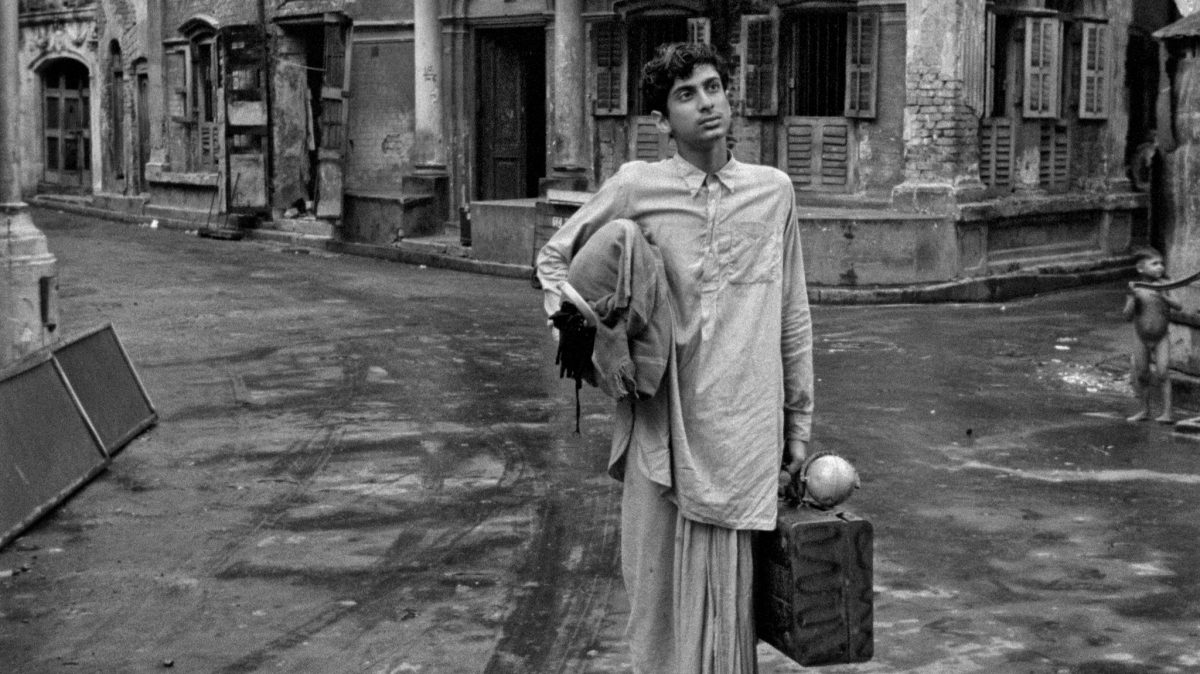
For his next two films, “Aparajito” and “Apur Sansar,” Ray adapted Bandyopadhyay’s sequel novel “Aparajito” by dividing it into two parts. Ray’s decision to split, ending the second film with Sarbajaya’s death, is an interpretive act. The novel’s continuous narrative allows us to move through the mother’s death toward the son’s new life. Ray stops us there. He refuses to let us pass through Sarbajaya’s dying easily. Ray also strips the novel’s other female figures, Leela and Rano Di, leaving Apu surrounded by emptiness. The trilogy becomes legible in this absence. He makes sure that only four women govern Apu’s fate.
Sarbajaya’s sacrifice
In the second film, Sarbajaya’s death reshapes Apu’s life more profoundly than even his father’s. Harihar’s absence in Apu’s life is so complete that his death only produces an economic crisis in Apu’s life. It does not produce the primal wound one might expect from a father’s death. By refusing the priesthood, his father’s profession, Apu enacts a fundamental rebellion, but it costs him nothing emotionally because Harihar never truly claimed him.
After Harihar’s death, Sarbajaya takes Apu to her natal village of Mansapota. With no income, she works as a household servant until she can no longer bear watching him comply with her employers’ demands. She pulls him back to the village. He trains briefly as a priest, seemingly accepting his inheritance, till his academic prowess allows him to study in Calcutta.
From then on, the film explores this mother-son separation through absences: delayed letters, missed visits, and Apu’s growing absorption in a world Sarbajaya cannot enter. As Apu opens toward Calcutta, its books and arguments and freedoms, Sarbajaya contracts, aging rapidly in his absence. When Apu learns of his mother’s death, Bandyopadhyay, in his novel, is explicit. Apu feels free. But in the film, Satyajit Ray does not suppress this truth. But he submits it through one of cinema’s most devastating images, the dimming fireflies, fading like Sarbajaya’s life.
The freedom Apu has been reaching toward arrives with his mother’s death. She is the price. Sarbajaya’s death is systemic. It is produced by an ideology that demands that young men leave their villages to be educated, and that makes progress a transaction in which someone must lose for someone else to win.
In the novel, Bibhutibhushan Bandyopadhyay, writing during the independence struggle, believed in a redemptive narrative. The old generation suffers so that the new can thrive, the village empties so the city can fill with educated reformers. His deaths are meaningful, his suffering is purposeful. Sarbajaya dies so that a better India can be built. Ray, filming after independence, knows this story is not a lie but a partial truth. The educated sons did leave. The mothers did die alone. But the new India was never fully built.
What emerged instead was a class of educated urban men fundamentally disconnected from the rural poverty that produced them, neither fully modern nor any longer traditional. Ray’s Sarbajaya dies the same death as Bandyopadhyay’s; alone, waiting, abandoned. But where Bandyopadhyay sees tragic necessity, Ray sees waste. Ray’s Apu feels the liberation Bandyopadhyay named, ‘the joy of breaking a bond.’ Still, the film also insists on showing us that there is no redemption in the quiet end of a life given entirely to someone else’s future. There is only loss.
Sarbajaya occupies the most painful position in the trilogy. She is the transitional generation. Unlike Indir Thakrun, who belonged entirely to the old world, and unlike Aparna, who will belong to Apu’s modern world, Sarbajaya is caught between. She is traditional enough to believe a mother’s highest calling is to sacrifice for her son. She is modern enough to provide her son with an education. Sarabajaya enables the very modernity that destroys her. The film’s most devastating irony is that Sarbajaya makes every correct choice by modernity’s logic.
She supports Apu’s education, encourages his ambition, gives money she cannot spare, and tells him not to worry about her. She performs selfless motherhood perfectly. And her reward is to die alone, having successfully raised a son who no longer needs her. Ray does not present this as an individual failing on Apu’s part. He presents it as structural, the inevitable outcome of a developmental logic. For Apu to become modern, Sarbajaya must become obsolete. This is not a personal tragedy but a historical process, which is why no amount of individual virtue could have changed it.
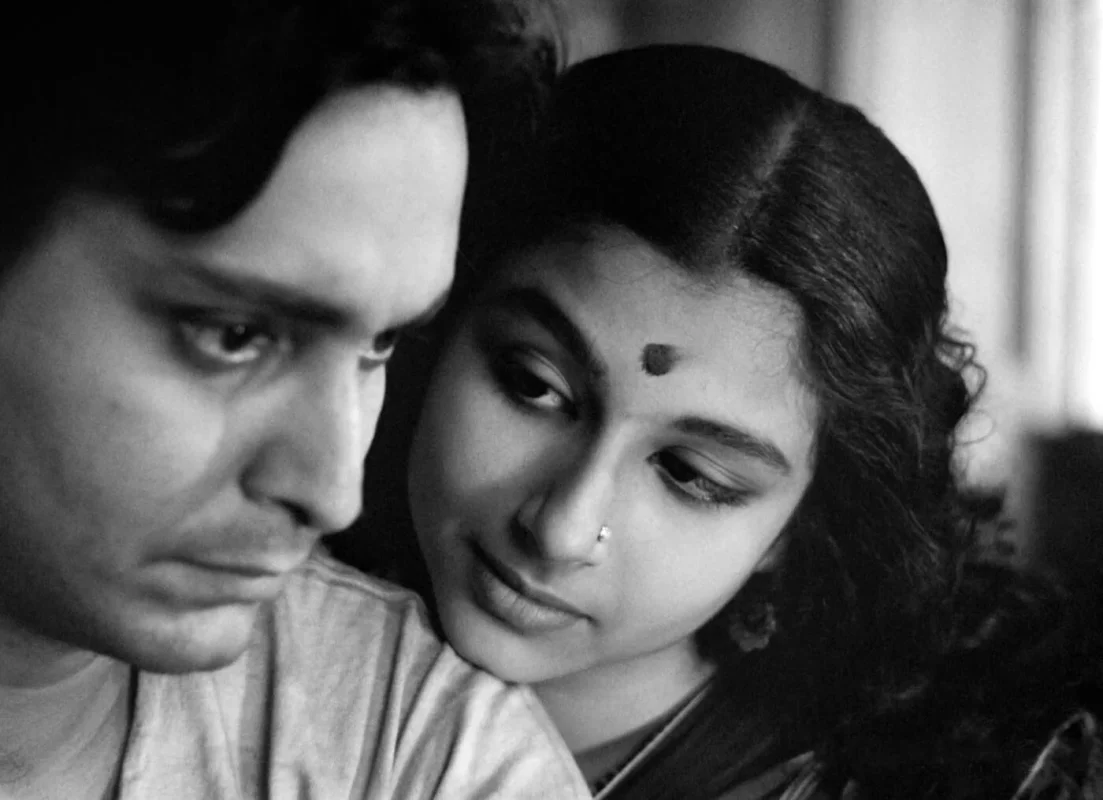
The Modern Couple
In the third film, “Apur Sansar,” when we first encounter Apu, he is writing a novel. When he tells Pulu about it, he is oblivious to his poverty, romantically self-absorbed, and blind to the women sustaining him. He has achieved precisely what Sarbajaya died to give him: freedom from family, village, and obligation. He reads, writes, and dreams. He is the modern subject, apparently self-sufficient. But this freedom is revealed as a delusion.
Then Apu marries Aparna in a whirlwind. When Pulu brings Apu to a wedding ceremony where the groom is discovered to be mad, and the family faces the catastrophe of the bride being called cursed, Apu agrees to marry the stranger, Aparna. In the novel, Apu questions himself: Is this strange girl truly his own? The question carries modernity’s central dilemma. If we are no longer bound by tradition or inherited roles, how do we create intimacy? How does a stranger suddenly become family?
When Aparna moves into Apu’s one-room apartment, she cleans, cooks, and tries to make a home in impossible circumstances. Apu, initially awkward, gradually discovers something unexpected: he loves her. This becomes Ray’s vision of modern love; it is not a romantic destiny or traditional arrangement, but the slow accumulation of shared life. Aparna is, in a way, Apu’s desire for what he has lost, the nurturing presence of the lost motherland. But Ray gives her an interiority that exceeds this projection. She is not simply what Apu needs. She is herself, irreducible to his needs, and it is precisely this quality that makes her death unbearable.
Aparna dies during childbirth. Off-screen. Apu learns of it the same way he learned of Sarbajaya’s death, when it’s too late. Aparna’s death summons all his previous losses, the ones he never knew he had suffered. Indir Thakrun died in the forest while he played; Durga, dying, wished to see the train again; Sarbajaya, dying alone, waited for his return. Now, Aparna gave up her life to bring Apu’s son into the world.
Four women’s deaths differ in cause, but they propel Apu forward, freeing him of all obligation. But this time, Apu cannot accept the freedom. This time, the bond’s breaking brings no joy. Aparna was chosen; their intimacy was created, not inherited or imposed. Thus, it brings devastation. Apu becomes a refugee, not merely uprooted from home, but severed from his connection to the maternal and to the natural world he has been fleeing since childhood. He shivers at a leaf’s touch, the body remembering what consciousness repressed. Nature, which he believed he had transcended, reclaims him through trauma.
After Aparna’s death and Kajal’s birth, Apu disappears. He becomes a wanderer, descending as far as possible from modernity. He replicates the absent-father pattern he inherited. When Pulu finds him and tells him that his son, Kajal, looks like Aparna, Apu’s resistance crumbles. The maternal memory, not paternal guilt, summons him back to fatherhood.
What the trilogy traces is intimacy across three generations. Indir Thakrun never remembered her husband’s face. Harihar and Sarbajaya had a relationship rooted in survival rather than sentiment. But Apu and Aparna were something like equals. And when Apu finally meets Kajal, he meets him as a friend. In the film, Ray demolishes the paternal and replaces it with friendship. The train reappears transformed. Once it symbolized Apu’s longing for elsewhere and marked Durga’s desire and death.
Now it is Kajal’s toy, domesticated and possessed. What was once terror and promise has become a plaything. And this is where the ending of the trilogy diverges sharply from the novels. In the novel, Apu leaves Kajal with Ranudi in Nischindipur and returns to his life as a wanderer. The pattern of departure continues, with Apu still dreaming of freedom. The novel “Aparajito” ends with the line: Age after age, the unconquered mystery of life reveals itself again in what wonderful glory.
Ray both honors and interrogates this sentiment with postcolonial consciousness. He understood that modernity can only advance through the difficult act of carrying what one would rather leave behind. Ray’s Apu becomes the post-colonial parent, who does not abandon Kajal. In the final shot, Apu walks into the future with Kajal on his shoulders, carrying the past rather than abandoning it.