
Director Junta Yamaguchi had remarkably high ambitions for his debut feature, “Beyond the Infinite Two Minutes” (Dorosute no hate de bokura, 2020). He wanted to make a time-loop, time-paradox sci-fi — and do it as a brisk, single-take movie of just about 70 minutes. More impressively, he aimed to keep it as grounded and good-natured as possible, never letting the premise slip into over-seriousness.
Watching the film, you’d hardly guess how tricky those goals were, given how effortlessly fun it feels — full of warmth, camaraderie, and a sense of community that shines through all the temporal chaos. But that ease is precisely the magic of Yamaguchi’s confident direction.
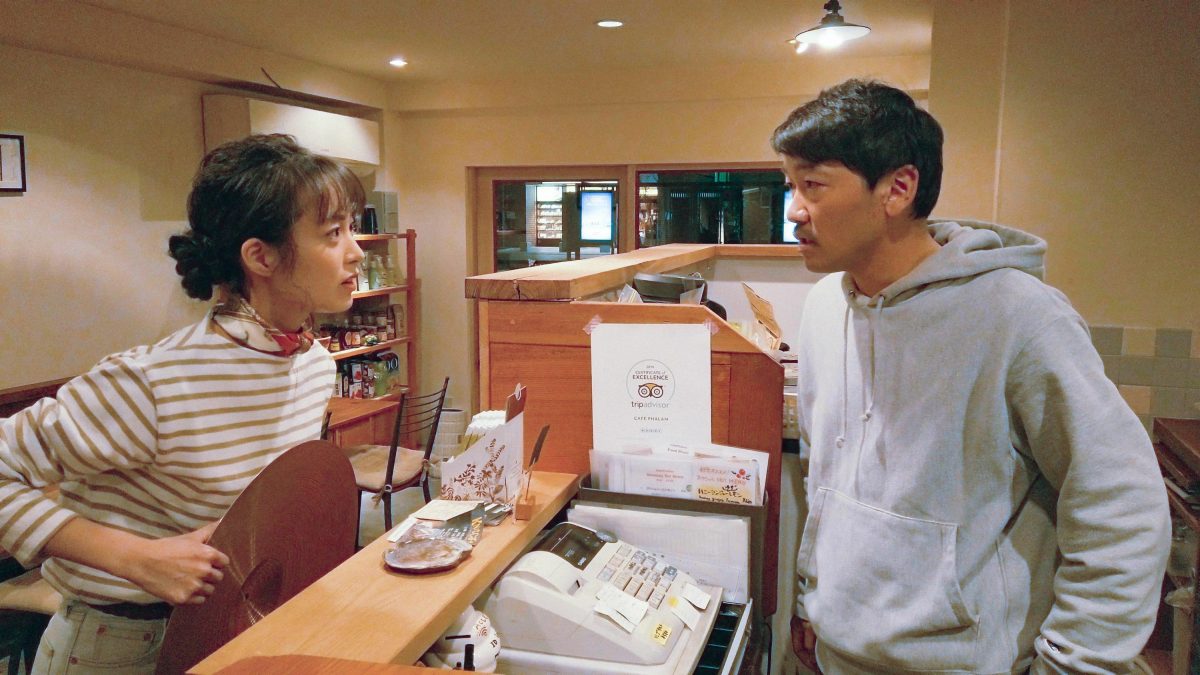
“Beyond the Infinite Two Minutes” takes the most difficult route by laying all its cards on the table within the first ten minutes. The premise, “Kato’s (Kazunari Tosa) monitor and the shop’s TV are linked with a two-minute delay,” is introduced upfront. Within moments, you know exactly what’s going on. It’s a big risk for any storyteller because once the audience catches on, the narrative tension could easily fade.
The viewers are left thinking, “Alright, I know how this works, now show me what else you have got.” But this is where Yamaguchi’s collaboration with screenwriter Makoto Ueda (known for “Summer Time Machine Blues” stage origins) shines. Together, they take that simple premise and turn it into a joyful exercise in imagination and human reaction.
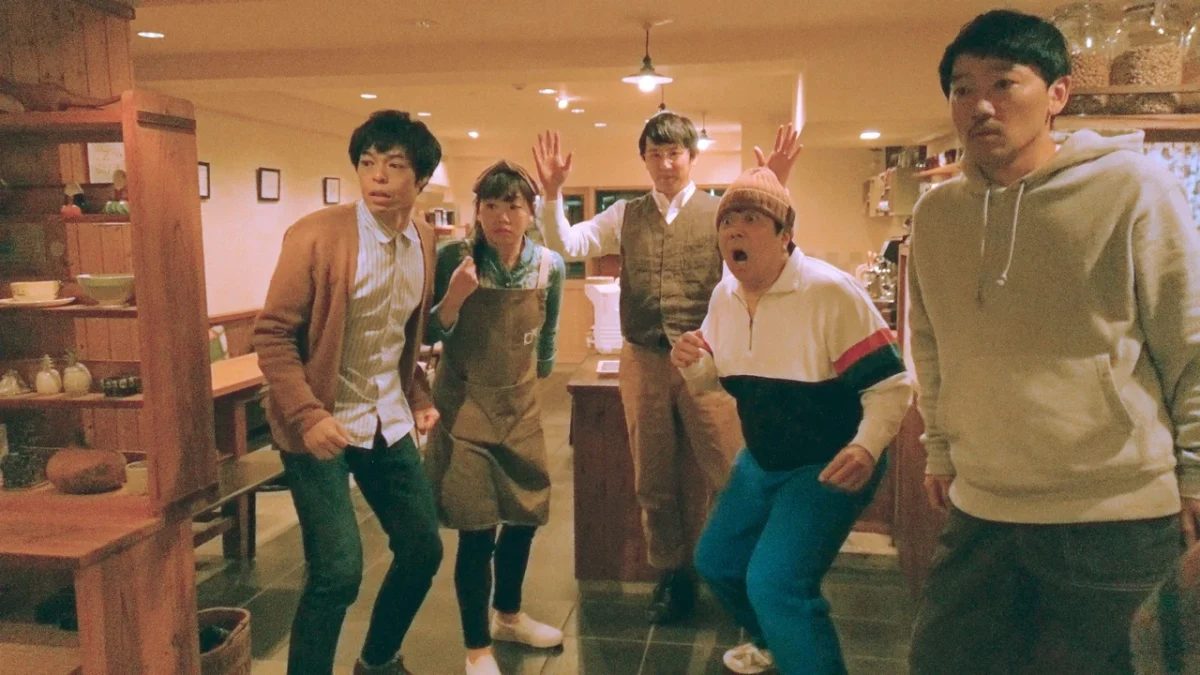
As the movie goes along, it’s not the plot twists doing the talking. Instead, it’s the characters’ traits and their delightfully human responses to the bizarre. The entire film seems built around one cheeky question: “What if a bunch of ordinary, middle-class people suddenly found themselves in a science fiction story?” The characters don’t act like scientists or heroes; they react the way any of us might if something inexplicably weird started happening in our everyday lives.
They fumble, they overthink, they panic, and then they decide to milk it for fun. The so-called “Droste TV” becomes their little science experiment and a local legend all at once. The relatability lies in how absurdly excited they are about something that, in a lesser movie, would be treated with dead seriousness.
The charm beneath all this absurdity is what makes “Beyond the Infinite Two Minutes” so easy to love. Ueda’s writing is always full of cleverness and sincerity, which keeps the tone grounded even when the story threatens to spin out of control.
Ueda has said that part of the inspiration came during the COVID era, when our lives were dominated by screens, video calls, and a strange distortion of time. The two-minute delay feels almost metaphorical in that sense. It is a playful jab at how we experience time and connection through our devices. But the movie never turns philosophical. It is very much content being a small, silly slice of science fiction that feels close to home.
Check Out: 30 Underrated Sci-Fi Movies From Across The Globe
The impressive thing about the storytelling is how much life Yamaguchi squeezes out of the confined setting. The entire story takes place between a tiny café and Kato’s apartment upstairs, and yet it never feels repetitive. The camera glides through spaces, characters run up and down stairs, and the energy keeps flowing without pause.
The “one-shot” gimmick never overwhelms the film. In fact, it is so smooth you barely notice it. And that’s the real triumph. The idea of a one-shot movie usually invites the audience to look for the seams, to see how it’s done. But here, the invisibility of the technique becomes the virtue. It’s a trick that works best when it doesn’t call attention to itself. You believe in this little world completely.
Tonally, “Beyond the Infinite Two Minutes” maintains a tricky balance. It never dips into drama, even when the situation becomes more chaotic. There’s no existential dread, no moral dilemma about time travel, no forced sentimentality. It just keeps the fun rolling. The characters’ biggest concern is not breaking the time loop but making sure they don’t accidentally ruin their future selves’ instructions. In another film, this setup would lead to tragedy or a bittersweet ending, but Yamaguchi is too self-aware for that. He’s making a comedy of curiosity, a movie where the joy of discovery is the story itself.
And then comes the hardest part for any movie like this, i.e., the ending. How do you wrap up a film that thrives purely on momentum and playfulness? The introduction of the goofy “Time Travel Police” could have easily derailed everything. At first glance, it seems like the film might finally go for an emotional punch, that Kato and his neighbor Megumi will forget each other, that the reset will wipe away their shared experience, turning the ending somber and melodramatic. It feels like the setup for a cliché – another movie featuring the tragic consequence of tampering with time. But in that moment, Yamaguchi essentially says, “Not today.”
Instead of melancholia, we get an ending that stays completely true to the movie’s spirit, which is wholesome, goofy, and utterly human. Kato and Megumi talk like ordinary people again. There are no grand declarations and certainly no heartbreak. He says silly things about Nostradamus and how the world should have ended in 2012, a line that perfectly sums up his character: hopelessly anxious, a bit ridiculous, but genuinely lovable. It’s a conclusion that doesn’t elevate the film to something profound. Instead, it keeps it right where it belongs, among the small, charming, and sincere.
Also Read: Did These Films Predict the Future? How Sci-Fi (And Other) Cinema Made Curiously Real Assumptions
For cinephiles, there’s another layer of delight tucked within the film’s seemingly straightforward structure. Just when you think there’s not much to chew on in terms of cinematic homage or meta-commentary, Yamaguchi once again says, “Not today.” The film sneaks in a reference to Fujiko F. Fujio’s short story “Me, Me and Me,” a clear nod to where writer Makoto Ueda drew some of his inspiration. Kato even mentions it in passing, as if the film itself is winking at its influences. It’s a lovely moment of self-awareness that doesn’t feel forced or indulgent.
In that sense, “Beyond the Infinite Two Minutes” also becomes a small love letter to storytelling itself, how one idea, executed with sincerity and playfulness, can create wonder without needing big budgets or heavy visual effects. The movie’s heart lies not in its sci-fi concept but in its warmth, its community, and its sheer joy of performance. Every actor feels like they belong in this little world, and every line feels improvised but meaningful.
Sure, one could criticize the film for being too one-note, too irreverent, too on the nose. The jokes come quickly, the emotional beats are surface-level, and it never aims for complexity. But that would be missing the point entirely. The film never tries to be profound. It’s perfectly okay with being a delightful experiment. It is just a celebration of curiosity and friendship wrapped in the skin of a time-loop comedy. It understands its limits and works beautifully within them.
When the credits roll, you are left with a strange mixture of awe and comfort. Awe at how technically seamless the film is, and comfort at how utterly simple it feels. Yamaguchi made a tender statement that sometimes, ambition doesn’t have to be loud. It can be quiet, contained within a 70-minute movie about a two-minute delay, and still feel infinite. And maybe that is why “Beyond the Infinite Two Minutes” works. It doesn’t aim to blow your mind. It is just there to remind you how good it feels when cinema is made from pure, unfiltered joy. Sometimes, that really isn’t a bad thing at all.



![Bull [2022] Review – A Lean and Mean Gangland Revenge Thriller](https://www.highonfilms.com/wp-content/uploads/2022/04/Bull-2021-768x433.jpg)

