
A “black box” is a nickname for an airplane’s flight recorder, secured in an impenetrable casing so that it can be retrieved after an accident. It’s also a term used in science and engineering to describe any device or system that is clearly functional yet whose actual workings are a mystery. Being opaque to the outside observer, its inner mechanisms can only be deduced while it is in use, through a careful study of the information or “noise” it sends out.
Both definitions come into play in Yann Gozlan’s “Black Box,” (Original title: Boîte noire) one of the best thrillers of recent years. Although reminiscent of both Brian De Palma’s “Blow Out” and Francis Ford Coppola’s “The Conversation,” among other earlier films, it works brilliantly on its own terms as both a white-knuckle suspense film and as a fascinating, intellectually-conceived mystery. It’s over two hours in length, but moves with such force and momentum that it feels more like a twenty-minute workout. It also has the same effect as one: this is one film guaranteed to send the brain working as well as the heart racing.
At the heart of this film is its lead character, an accident inspector and analyst named Mathieu, played with the right amount of smarts and confidence by Pierre Niney. He’s not a rebellious hero figure like John Travolta in “Blow Out” or similar characters played by Warren Beatty in “The Parallax View” and Jane Fonda in “The China Syndrome.” Nor is he a case study in neurosis like Gene Hackman in “The Conversation,” or even a brilliant boffin like James Stewart in “No Highway in the Sky.” He’s simply a highly intelligent and dedicated professional who tries to put his expertise to good use in a time of crisis, such as the one that sets up the whole plot and puts it in motion.
An aeroplane heading from Dubai to Paris has crashed in the French Alps, killing all 316 people aboard. An initial study of the flight recordings seems to confirm early suspicions that it was an act of terrorism, but Mathieu, who has established a reputation in his profession for his especially keen ears and attention to detail, starts to have doubts after giving them a second listen.
Could the recording have somehow been tampered with? Growing more suspicious after his boss disappears without warning, he sets out to analyze the recordings further, testing plausible alternate hypotheses as well as his own, and taxing his abilities to their limits, sending him to the brink of mental and physical collapse.
He also tests the limits of his relationship with his wife and colleagues, as we see how far he is willing to go in his job as fact-finder to get the whole truth. With his concerns being brushed off by those currently put in charge while his superior is still missing, he breaks into his boss’s house and car, hoping to find what he’s looking for. Meanwhile, his domestic life goes through tremendous strain, as his wife was an employee of the airline whose plane crashed, and she gets dismissed from her own job when he uses her work laptop to snoop for information. As they argue, we begin to wonder, could she be involved in this apparent cover-up as well?
The conclusion Mathieu ultimately comes to is that there is another hi-tech “black box” out there, one that is somehow also involved in the accident. The exact nature of this hypothetical technology or even whether or not the hero is correct cannot be disclosed here. To do so would not just spoil the plot but betray the film’s major themes, and this is one of those movies where the pleasures come from finding things out on one’s own.
The movie engages the audience in the problem-solving process and doesn’t skimp on any details, making them essential to the mounting suspense. It also avoids the mistake made by too many other thrillers that set themselves up for an intelligent resolution only to blow it all on crowd-pleasing violence. The climax not only grows logically out of the main mystery but continues the intellectual games of the first half, as Mathieu must follow a torturous maze of GPS coordinates to reach his final destination.
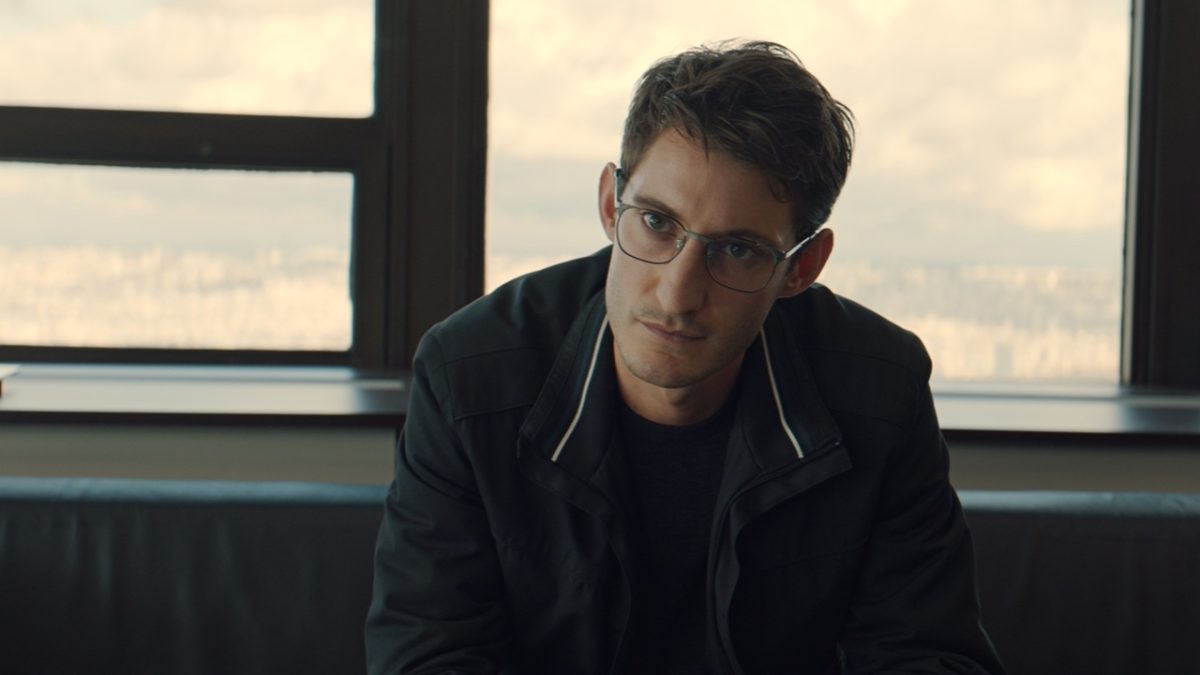
This particular scene is just one of several where the metaphoric “black box” concept comes into play. Throughout the film, Mathieu must make deductions based on the limited information being provided to him from various sources, trying to piece them together properly once he figures out how they’re possibly connected.
It helps that our hero is shown to be a born skeptic who adheres to the scientific method and refuses to indulge in conspiratorial conjectures (“I don’t theorize, I only analyze,” he says at one point), so when he’s forced to accept a conclusion he wishes were not true, we’re ready to believe it as well. Smart thrillers are rare enough; a thriller that works specifically because of the smarts of its lead character is even rarer, and something to be treasured.
It’s only after the film has ended that we realize that the black box of the film’s title is not just a reference to any of the featured gadgets, the impenetrable bureaucracy the hero is up against, or even the mystery itself. It also refers to our inability to fully understand each other, not just complete strangers but even those who we are closest to, both at home and at work, and who we think we know completely. Even more intriguingly, it’s also about how little we understand ourselves until we are finally set up for an internal confrontation. The ultimate black box, the movie seems to be saying, one whose inner workings can never truly be figured out despite our best efforts, is us.
“Black Box” was a major hit in its home country, but strangely enough only seemed to have made a minor stir when released to the festival circuit in the United States and Canada. Plans for an American remake were announced by Netflix in December 2025, but my advice to the curious is to seek out Gozlan’s original film first, and cautiously wait for any follow-ups. It would be a shame if people passed over one of the best thrillers of recent years just because they’re waiting for a version without subtitles.



![Roots [2021]: ‘KVIFF’ Review – A Distinctively Minimalist Portrait of Landscape and its People](https://www.highonfilms.com/wp-content/uploads/2021/08/Roots-2021-768x403.jpg)
![The Girl on the Mountain [2022] Review: Like a compilation of cutscenes instead of a proper film](https://www.highonfilms.com/wp-content/uploads/2022/03/The-Girl-and-the-Mountain-768x320.jpeg)
![Shubh Mangal Saavdhan [2017]: An Elegant and Plausible treatment to accomplish Love](https://www.highonfilms.com/wp-content/uploads/2017/09/shubha_1501590643_725x725.jpg)