
Music documentaries usually follow a genre-specific structure. Some try to reveal every potential detail of a person’s life, including pieces from their formative years, whether as artists or as people. These films aim to offer a comprehensive account of the person’s life, but they can run the risk of being critiqued for their unemotional monotony.
Others capture the beauty in the artist’s definitive concert, offering a taste of their music while sharing how people loved or perceived them in those grand spaces. “Broken English,” directed by Jane Pollard and Iain Forsyth, takes a different approach to tracing such events, prompting us to investigate our own relationship with the artist in question.
The documentary revolves around the life of Marianne Faithfull, an English singer-songwriter and actress, who rose to fame in the 1960s and had a career spanning over six decades. For someone who may not be familiar with Faithfull’s work and her legacy, the film becomes a telling account of how legacies work at large.
The people she collaborated with, male artists in particular, are not merely popular but have been immortalized in pop culture through biopics or soundtrack inclusions. Their public perception remains largely untainted, but for many years, Faithfull wasn’t privy to the same kindness with regard to how she was perceived.
The contemporary media, led and controlled largely by men, pushed the narratives that suited their misogynistic prejudices. They questioned her character for things that male artists didn’t take a hit for. That’s why “Broken English” becomes almost a form of discourse-driven course-correction, which, in an ideal world, wouldn’t have been necessary.
The film’s title refers to Faithfull’s 1979 studio album and an eponymous song, which served a similar purpose in her life, where she used the raw aesthetic of new wave to craft a piece that reshaped her identity in the public eye. She continued that musical reinvention throughout her years of work.
Yet, despite being an intellectual and an artist with a remarkable body of work, the male interviewers and journalists kept asking her about unpleasant moments from her past, which people these days would probably consider rage-baiting. The only difference is that rage and frustration are often expected to be suppressed by women in particular, where the display of such emotions is considered ungainly.
While seeing similar moments on screen, you wonder why these interviewers didn’t think before asking these inflammatory questions, and why she was expected to sit through that ghastly, awkward discomfort. The documentary compels you to think about your own biases and how they may seep into your behavior.
In that vein, it may affect you differently if you’ve grown up, been conditioned, or have reaped the benefits of being a man. The same anger is likely why, even after several years, some of Faithfull’s songs convey the visceral intensity of a seething anger that feels just as searing as it must have felt back then.
Also Read: The 10 Best Shorts from the 2026 Sundance Film Festival
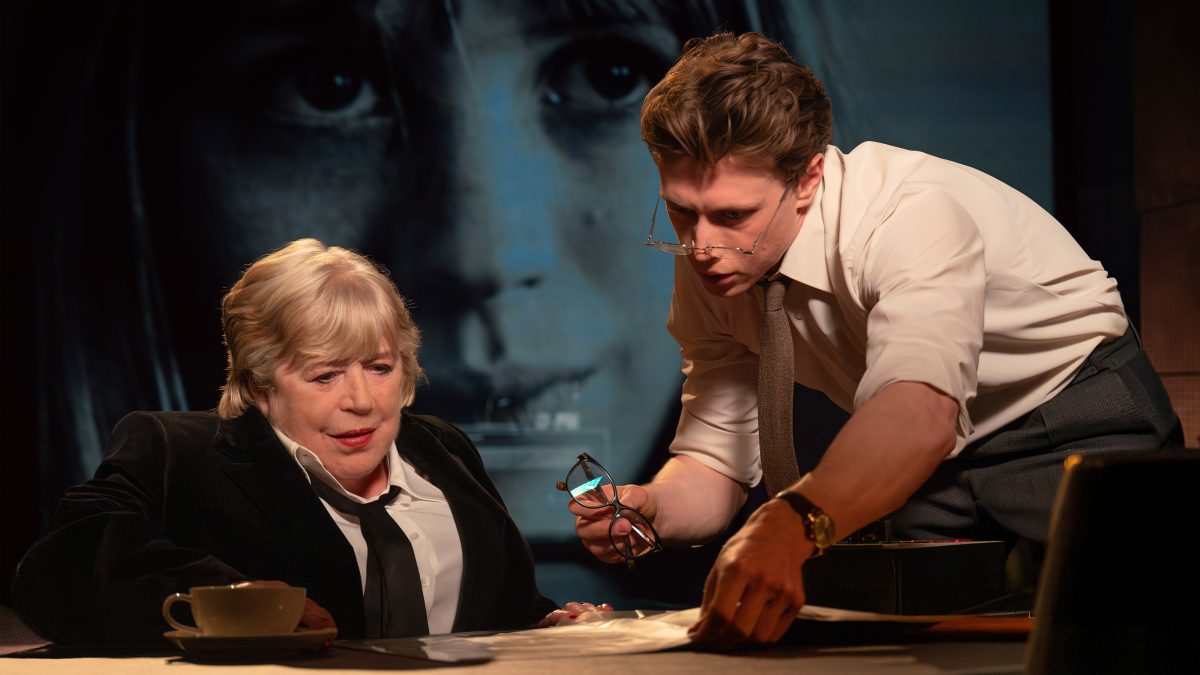
Singer-songwriter Natasha Khan (Bat of Lashes) says something along these lines during the documentary. She appears alongside a few other female artists and media personalities, who reflect on Faithfull’s work, while also analyzing aspects that she shouldn’t be made to relive for the act of recollection. Pollard and Forsyth also introduce actors like Tilda Swinton and George MacKay to offer a behind-the-scenes meta enactment, where Swinton plays an overseer while MacKay plays the record keeper. Zawe Ashton also joins in the role of a media archivist, while Sophia Di Martino plays the researcher.
The meta element adds a much-needed dimension, which, as aforementioned, compels us to introspect. At one moment, Swinton’s character tells MacKay’s, “What we’re after are simply memories. What we’re hoping for is resonance.” It distills the essence of what the film manages to capture while also offering a window into the process of capturing an influential portrait at Faithfull’s.
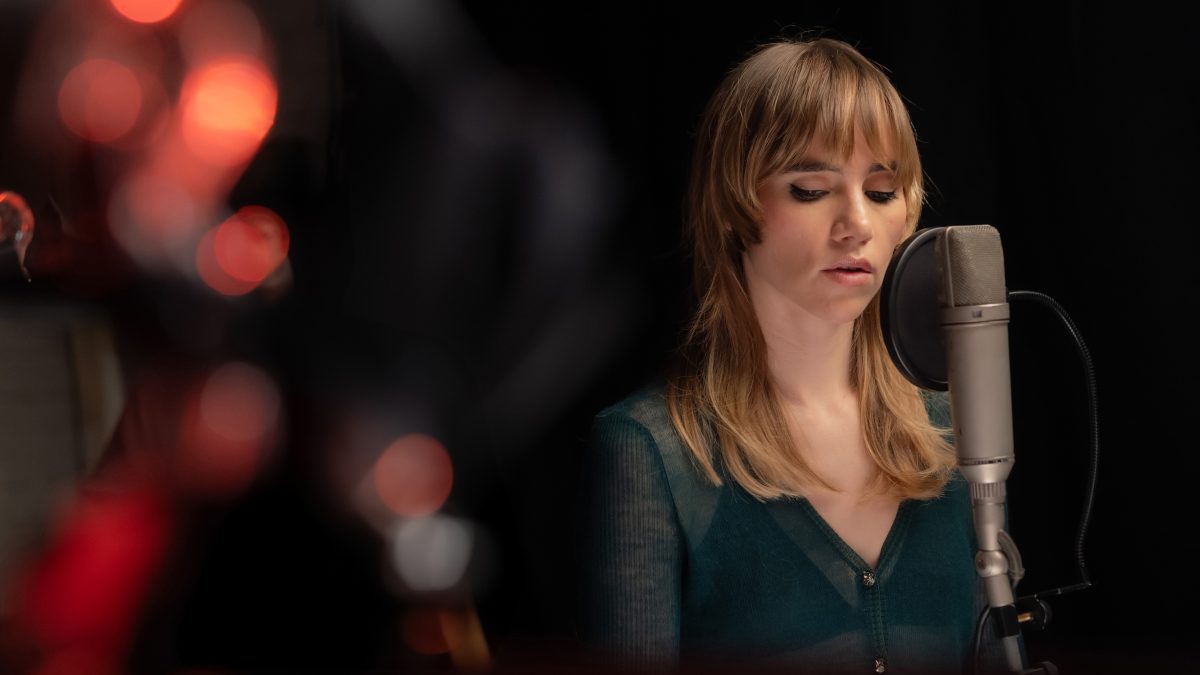
With MacKay’s character serving almost as a psychoanalyst and Swinton’s as a narrator, we receive another layer of interpretation about the nature of memories and truth, leaving us with a resonance of its insights and their reinterpretation. The film also makes us wonder how it all would be interpreted and retold in the age of polished artificial intelligence.
With a stunning mix of archival footage and her recollections about those events, the film gives Faithfull the reins to share her unfiltered opinions about her own past. Luke Thompson’s precise editing becomes instrumental in bringing together all the stylistically distinct pieces. Moreover, Daniel Landin’s cinematography captures the emotion, maintaining dramatic tension while patiently and empathetically capturing the emotional shifts in Faithfull’s expressions.
Through their collective input, we witness Faithfull speaking candidly about the value of anger, the romanticized notion of a tragic celebrity, and the music and acting projects that offered her an unconstrained emotional canvas, among other things. Pollard and Forsyth faithfully convey her candor, devoid of the embarrassing gaze of yesteryear’s opinion-makers, while offering an experience that is soulful, evocative, and cerebral, leaving with far more than an insight into the life of this rock icon.





![Nirmal Pathak Ki Ghar Wapsi [2022] Review: The Tale of a Man’s Homecoming Is Shoddy & Pretentious](https://www.highonfilms.com/wp-content/uploads/2022/06/nirmal-pathak-ki-ghar-wapsi-768x427.jpg)
![Julieta [2016] : The silence of guilt](https://www.highonfilms.com/wp-content/uploads/2016/09/Julieta2.jpg)