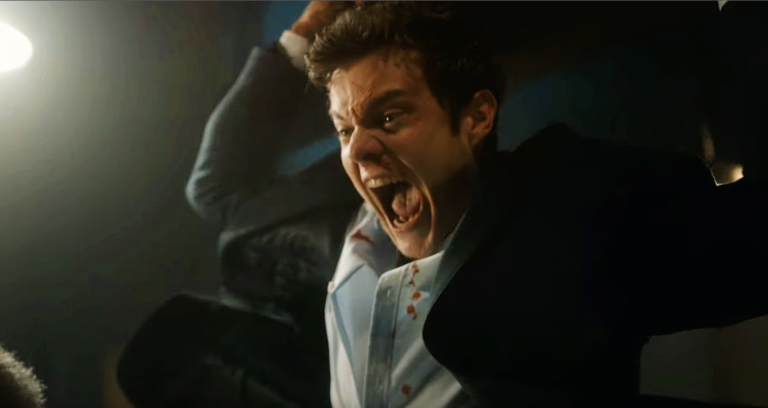
The 1997 Russian cult classic “Brother” (“Brat”) opens with a scene in which the main character, Danila Bagrov, stumbles across a film set. Within this first frame, the movie announces itself as referential to cinema. What follows is a stark, stripped-down crime story about a recently discharged soldier who travels to St. Petersburg to reconnect with his brother. He shortly finds himself entangled in the city’s underworld of criminals. This film is definitely a favorite of mine. If there is one movie that feels underrated, it is this one. And it is great to put on in the background of parties.
Directed by Aleksei Balabanov, this film carries the weight of a country that’s holding onto remnants. I love all of the shots in the various decaying apartment buildings. The cinematography is sublime. The film’s aesthetics are stripped down, but it is not self-consciously minimalist. There are times when it feels like a documentary, even when you can tell the shots have been composed. The texture of this film is tactile. You can feel the dampness of Danila’s jacket.
One aspect that sets this film apart is that it is not stylized in the glossy way most American crime films were in the 90s. At the center of it all is Sergei Bodrov Jr. as Danila Bodrov, a notably quiet performance. He doesn’t perform menace, but he exists within it. When he shoots in this film, it doesn’t feel like some kind of transformation. It feels like a routine. This isn’t a character that is outwardly grappling with his thoughts the way that Travis Bickle in “Taxi Driver” was.

Bodrov’s stillness and overall nonchalant attitude become the film’s emotional anchor. He doesn’t trick the audience into complicity. Instead, he pulls the audience into a space where violence is normalized, one could even say banal. You begin to understand him without necessarily approving of him, which is perhaps more dangerous.
There’s a moment early on when Danila arrives in St. Petersburg to visit his brother, Viktor. The reunion isn’t warm. It feels transactional. Viktor is already entangled in criminal work, and he sees Danila less as family and more as an asset. That dynamic, brother as a tool, brother as a burden, can feel very relatable, and it becomes the film’s emotional core. The blood is there, but it’s thin. It is conditional. It is easily manipulated. Just like can be seen in real life.
Balabanov is nostalgic about the notion of brotherhood. He presents it as another unstable structure in a collapsing society. Viktor exploits Danila’s loyalty. Danila, in turn, seems to tolerate the exploitation with a kind of detached patience. It’s less about forgiveness and more about a made-up hierarchy. The emotional vacancy between these characters is almost more disturbing than the violence that surrounds them. The cinematography of the film reinforces this constant emptiness. Danila sits in a kitchen with crumbling wallpaper behind him. There are little objects placed in the background of these shots. Everybody is constantly smoking, drinking alcohol, and speaking in flat tones.
Also Read: Reconciling the Virtues of Moral Duty and Battlefield Heroics in Movies About War
Music plays a significant role in this film, particularly the inclusion of rock bands that underscore Danila’s internal rhythm. The songs amplify his alienation. In the same way that this film opens with a film crew, some sequences are referential to the soundtrack. Danila listens with headphones on, separate from the room, separate from conversation. It’s one of the few times he appears absorbed in something non-chaotic. But even that absorption feels isolating. The soundtrack becomes a private refuge in a public wasteland. There is a sequence that takes place at a music shop selling CDs, about ten minutes into the film, and it feels like a time capsule.
When I think of this movie, I think of the journey of this character. I think of the way the environment is depicted. How gritty it feels. The streets aren’t neon-lit the way crime films in that decade often were. There is this sense that everything here is temporary, including alliances. The city itself feels like it’s waiting to become something else. The Soviet Union is gone, but whatever is replacing it hasn’t been solidified yet. That “in between” state seeps into every frame. What I appreciate most is that the film never glamorizes the criminal world. It presents it as mundane. Petty arguments over money. Cheap apartments doubling as hideouts. Deals are conducted over a cup of tea. It’s not portrayed like a cinematic fantasy that is filled with explosions, but instead it is seen as work.
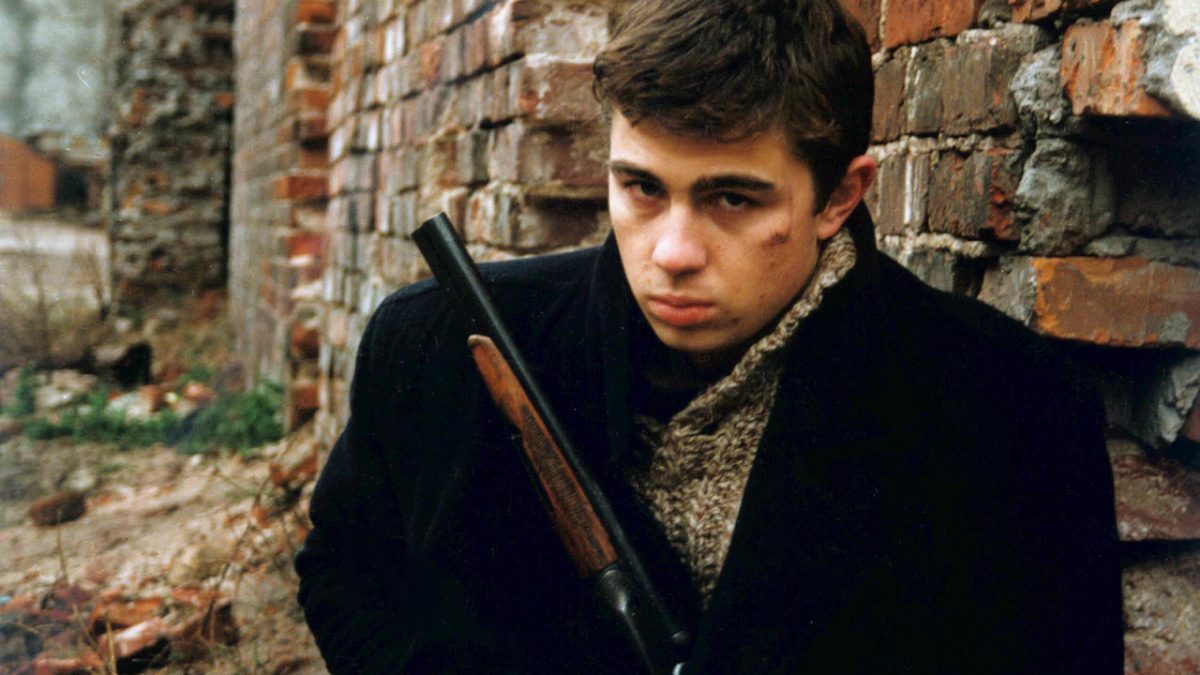
One of the most unforgettable moments in “Brother” comes near the end, in a scene that takes place in a cramped apartment stairwell. This moment perfectly conveys the film’s stripped-down version of violence. The space is narrow, barely lit, and once again, there is wallpaper that is peeling. Danila ascends slowly, almost casually; his face is unreadable, giving no sign of any nerves or excitement. When the gunfire erupts, it is abrupt and blasts loudly in the confined corridor, with shots ricocheting off concrete.
Danila doesn’t say a catch phrase. There is no heroic pose. This doesn’t feel like a comic book moment. The building itself absorbs the violence as if it were routine. This sort of thing happens here all the time. With this sequence taking place inside an ordinary residential space, rather than a stylized battleground, it makes the brutality feel disturbingly mundane, capturing the film’s unsympathetic view of morality in collapse.
“Brother” is a great film to revisit, and it feels like a snapshot of a country that is redefining itself through confusion. The character of Danila has become something of a cultural icon. The film’s cult status makes sense. It is endlessly rewatchable and not because it’s flashy, but because it feels alive. It feels like you’re spending time in a raw place with real people who are still figuring out who they are. But it doesn’t feel like it’s dated. Every time I put this on, whether intentionally or in the background of a gathering, it magnetizes whoever looks at the screen.