After delivering a blockbuster score for the first Dhurandhar (2025), composer Shashwat Sachdev is back with the sequel’s soundtrack. And this time, he took a riskier, darker route. The album for Aditya Dhar’s spy thriller Dhurandhar: The Revenge (2026) is leaner, meaner, and packed with nostalgia. It blends modern beats with classic melodies from the 1970s, 80s, and 90s. The result is a sonic experience that critics say is “gritty and experimental”. Here’s your complete guide to the album, its hit songs, and everything you need to know.
The Development: A “Slow Poison” Album With a Tight Runtime
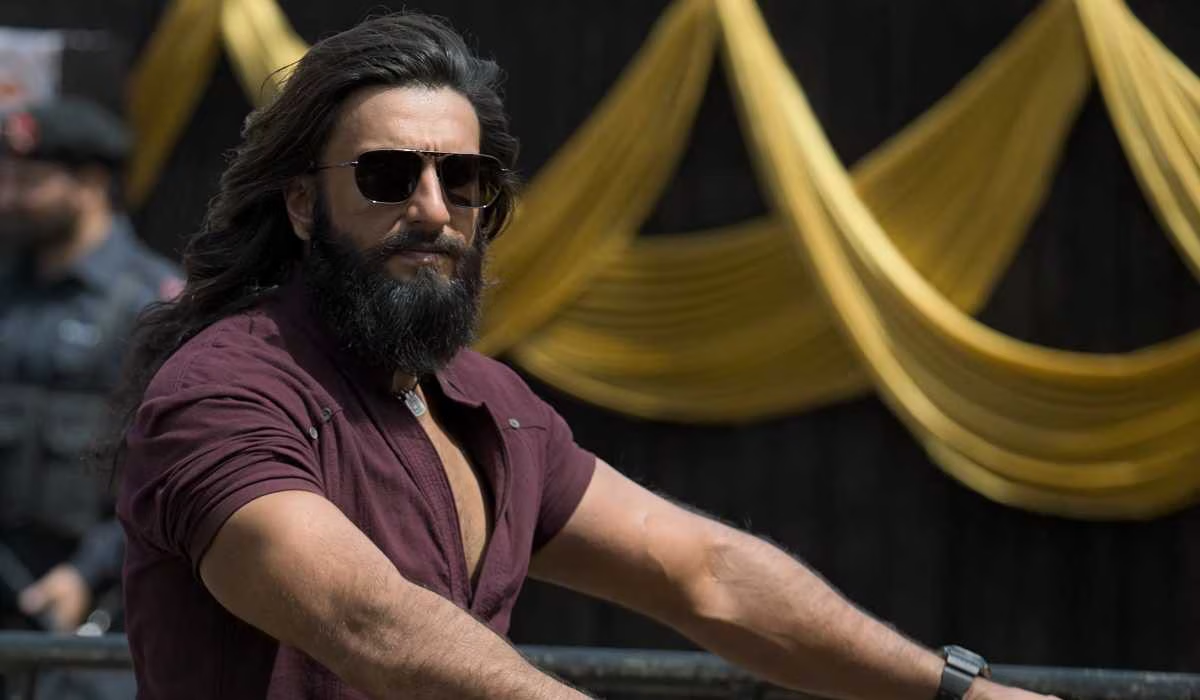
The Dhurandhar: The Revenge soundtrack was composed by Shashwat Sachdev, marking his third collaboration with director Aditya Dhar after Uri: The Surgical Strike (2019) and Dhurandhar (2025). Unlike typical Bollywood albums that stretch for over an hour, the core standard edition of the soundtrack is just 19 minutes and 18 seconds long, consisting of only five songs.
Sachdev deliberately avoided filler tracks. “There’s no item number wedged in for the weekend crowd,” noted a Mint review, calling the album “grittier, darker and heavier than the first”. The creative process was intense. Director Aditya Dhar revealed that Sachdev created the 14 original songs for the sequel in just 11 days, with the full background score taking shape alongside it.
The Music Rights Deal: T-Series Replaces Saregama
The music rights for Dhurandhar: The Revenge were acquired by T-Series for a reported ₹27 crore, replacing Saregama who held the rights for the first film. This figure was nearly double what Saregama had paid for the prequel. Initial reports in Variety had claimed the deal was worth ₹50–60 crore, but T-Series issued a fact-check clarifying the actual amount was ₹27 crore.
Release and Singles: From Teaser to Extended Album
The promotional campaign for the Dhurandhar: The Revenge soundtrack built anticipation over several weeks:
-
Teaser Feature: The film’s teaser featured the Western track “Aaahh Men! ” by American rapper Doja Cat. The song also appears in the film itself.
-
First Single: The first single “Aari Aari” was released on 12 March 2026, coinciding with director Aditya Dhar’s 43rd birthday.
-
Second Single: “Main Aur Tu“, sung by Jasmine Sandlas with a rap verse by Reble, was released on 17 March 2026.
-
Standard Album: Released on 17 March 2026 with five songs.
-
Extended Edition: An extended album with twelve additional songs was released on 24 March 2026, bringing the total length to 1 hour, 4 minutes and 17 seconds.
Full Tracklist: Standard and Extended Editions
The core soundtrack consists of five songs. Here is the standard edition tracklist:
| No. | Title | Singer(s) | Length |
|---|---|---|---|
| 1. | “Aari Aari“ | Navtej Singh Rehal (Bombay Rockers), Shashwat Sachdev, Khan Saab, Jasmine Sandlas, Sudhir Yaduvanshi, Reble, Token | 3:30 |
| 2. | “Main Aur Tu“ | Jasmine Sandlas, Reble, Shashwat Sachdev | 3:30 |
| 3. | “Jaan Se Guzarte Hain” (Remake) | Khan Saab, Shashwat Sachdev | 5:31 |
| 4. | “Aakhri Ishq“ | Jubin Nautiyal | 4:21 |
| 5. | “Wild Ride“ | Ellisar, Shashwat Sachdev | 2:52 |
The Extended Edition Adds 11 More Songs
The extended edition includes several notable numbers.
| No. | Title | Singer(s)/Details |
|---|---|---|
| 6. | “Vaari Jaavan“ | Jyoti Nooran, Reble |
| 7. | “Phir Se“ | Arijit Singh (features at the end of the film) |
| 8. | “Didi (Sher-e-Baloch)“ | Remix of Khaled’s iconic 1990s Arabic hit ‘Didi’ |
| 9. | “Destiny – Mann Atkeya“ | Remix of Nusrat Fateh Ali Khan’s 1992 classic |
| 10. | “Rang De Lal (Oye Oye)“ | Remix of “Tirchi Topiwale” from Tridev (1989) |
| 11. | “Jaiye Sajana“ | Jasmine Sandlas, Satinder Sartaaj |
| 12. | “Tere Ishq Ne“ | Jyoti Nooran |
| 13. | “Hum Pyar Karne Wale“ | Remix of song from Dil (1990) |
| 14. | “Kanhaiyya“ | Jubin Nautiyal |
| 15. | “Bekasi“ | Remix of “Kabhi Bekasi Ne Maara” from Alag Alag (1985) |
| 16. | “Tamma Tamma“ | Remake of the iconic track from Thanedaar (1990) |
| 17. | “Baari Barsi“ | Surjit Bindrakhia |
Additional Film Features: The film also features snippets of several other classics, including “Jumma Chumma De De” (Hum, 1991), “Mujhe Zindagi Ne Mara” (Angaaray, 1986), “Baazigar O Baazigar” (Baazigar, 1993), and Boney M.’s 1978 disco hit “Rasputin” during one of the final scenes.
Catch the Vibe: Standout Songs From the Album
-
Aari Aari: This high-energy Punjabi anthem marks the comeback of Danish-Indian band Bombay Rockers to Bollywood after 6 years. Lead vocalist Navtej Singh Rehal reprised his iconic chant from the 2003 original, and the song went on to hold the No. 1 spot on the Mirchi Top 20 charts.
-
Didi (Sher-e-Baloch): A recreation of Algerian singer Khaled’s iconic 1990s hit, this song is used in a grand entry sequence for Ranveer Singh’s character in Balochistan, Pakistan. It features vocals by Moroccan singer Nabil El Houri and Kuwaiti rap duo Sons of Yusuf, and serves as a follow-up to “FA9LA” from the first film.
-
Tamma Tamma: A faithful remake of the iconic dance number from the 1990 film Thanedaar. This track plays during a shocking assassination sequence involving Sanjay Dutt’s character.
-
Rang De Lal (Oye Oye): A high-energy remix of “Tirchi Topiwale” from Tridev (1989), which itself sampled Gloria Estefan’s “Rhythm Is Gonna Get You.” The vocals of Amit Kumar and Sapna Mukherjee were retained from the original track.
-
Jaan Se Guzarte Hain: A poignant remake of the 1977 Nusrat Fateh Ali Khan classic “Dil Pe Zakham Khate Hain,” this song is considered a standout for its emotional depth.
-
Wild Ride: Sung by Lebanese-American singer Ellisar, this track brings a global flavor to the album, showcasing Shashwat Sachdev’s aim to create a truly international soundscape.
Critical Reception: A Mixed Bag of Praise and Comparison
The soundtrack received generally positive reviews, though many critics compared it unfavorably to the prequel’s landmark album.
-
Bollywood Hungama stated: “the film’s music may not be as legendary as the first part, but it has its own charm and is well incorporated,” praising songs like “Aari Aari” and “Jaan Se Guzarte Hain”.
-
News18 praised the soundtrack’s “effective role in enhancing the film’s overall impact,” particularly lauding the incorporation of old, familiar songs within the narrative.
-
The Week noted that while the soundtrack was “just a notch below the former one,” it still praised Shashwat Sachdev’s musical score and the inclusion of retro iconic tracks.
-
Mint gave a more enthusiastic review, calling the album “grittier, darker and heavier than the first — and every single song earns it”.
-
The Hindu felt that while the repurposed old songs like “Rasputin” and “Tamma Tamma” were “fun in spots,” they felt “more slapped than iconic”.
Aditya Dhar himself praised Sachdev’s work, taking to social media to call him the “unseen hero” of the franchise.
Chart Performance: A Global Success
The Dhurandhar: The Revenge soundtrack achieved significant chart success, demonstrating its international appeal:
-
The album made history with 11 out of 14 tracks charting simultaneously on Spotify’s Global Top 200, following the prequel’s feat of being the first Hindi film album to have its entire soundtrack on the chart.
-
“Aari Aari” held the No. 1 spot on the Mirchi Top 20 charts.
-
The album reached No. 8 on the US Billboard World Albums chart and No. 17 on the US Soundtrack Albums chart.
-
It also charted in Canada (No. 66), New Zealand (No. 24), and the UK (No. 43 on Soundtrack Albums).
Shashwat Sachdev’s work on the soundtrack cemented his reputation as one of Bollywood’s most innovative and globally-minded composers.
Courtesy: Wikipedia