Why is a middle-aged woman learning English treated as unnecessary, even laughable, while a young man failing exams is heroic? Directed by Gauri Shinde, “English Vinglish” (2012) is a Bollywood film that gently explores how globalization shapes everyday life and self-worth in the 21st century.
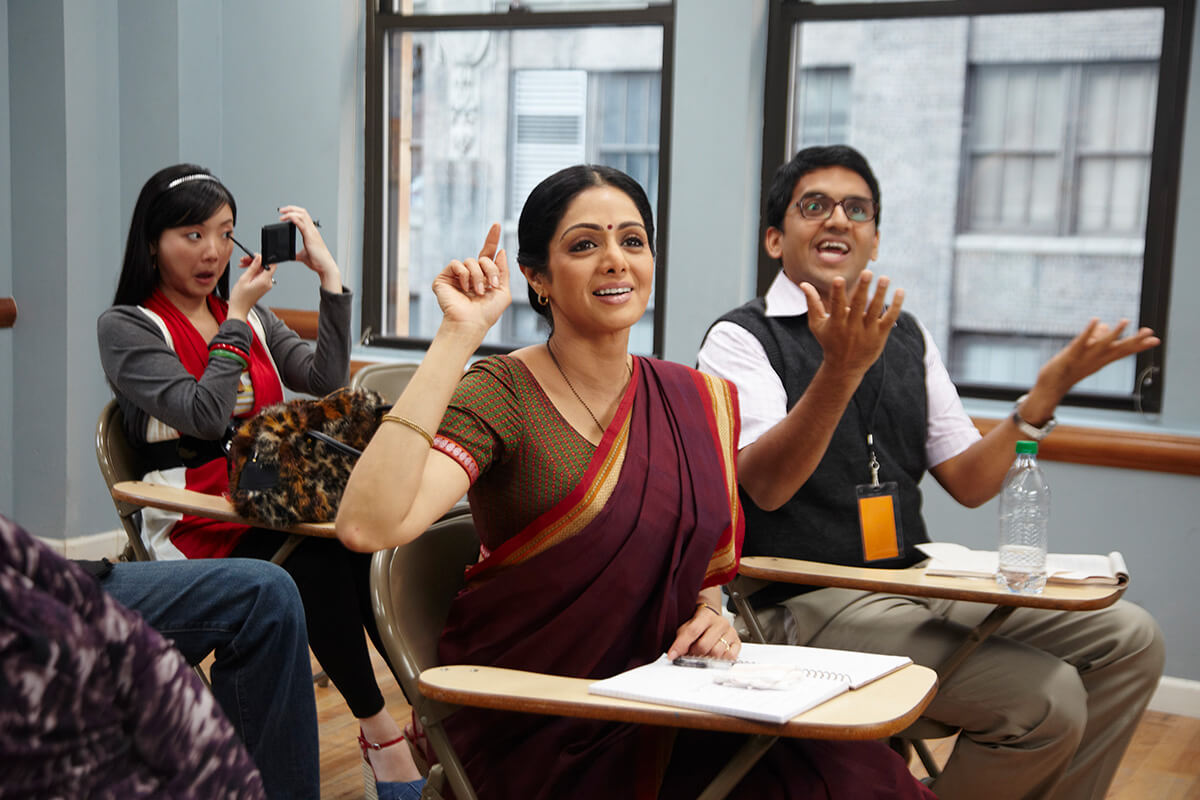
The film’s protagonist, Shashi Godbole (played by Sridevi), is a housewife in Pune who feels alienated from her own family due to her inability to speak English. In an era obsessed with speed, productivity, and early success, “English Vinglish” engenders a question about whether learning itself—slow, imperfect, and deeply human—still has value.
This linguistic inadequacy is not a personal shortcoming, but rather a result of Shashi’s hesitant yet transformational educational journey. It marks the character’s social exclusion, gendered humiliation, and age-based dismissal, confronting a major question that cinema historically avoided. Why is learning late in life so rarely treated as meaningful or worthy of celebration?
Why cinema avoids adult education stories
Catering to the needs of the modern generation, contemporary cinema tends to avoid stories that focus on adult education. These days, stories are expected to move quickly, deliver clear transformation arcs, and offer easily consumable victories. Adult education is marked by uneven progress, regression, and emotional complexity as adults appear to be rigid when it comes to learning. These qualities change the cinema’s demand to keep up with the audience’s demands of narrative momentum.
The adult education stories also carry different outcomes. The youth-centric aspiration of getting boys educated symbolizes return on investment, having promising careers, and growth. Adult learners, especially women, disrupt this logic. Their education does not necessarily end up in new careers or social mobility, therefore making their outcomes harder to monetize and dramatize.
In “English Vinglish,” Shashi is mocked for being a housewife and for her lack of fluency in English, which society treats as a measure of intelligence and self-worth rather than a practical necessity. On the other hand, “12th Fail” (2023) follows a young man, Manoj, who repeatedly attempts the UPSC exams to earn a prestigious government role. Towards the end, during his interview, one member of the board reacts dismissively to his background and struggles, but the other interviewers are impressed by his genuine answers and give precedence to knowledge and character over superficial expectations.
However, both films celebrate different genders’ “restart” spirit and their determination to keep going despite every failure and ridicule from society, even if it means their own family. Shashi studies, practices, fails, and tries again without assurance that fluency will ever fully arrive. It signifies that adult education insists on labour without a guarantee of perfection. The film refuses to turn this labour into spectacle or comedy and does not give audiences a chance to believe failure as a source of entertainment.

Cinema rarely allows such resolutions. In Shashi’s final speech in “English Vinglish,” she speaks fluent English while retaining her accent, a choice that underscores the film’s refusal to equate self-worth with linguistic perfection. Rather than presenting mastery through flawless grammar or polished vulnerability, the scene finds dignity in confidence, sincerity, and self-assertion.
Shashi Godbole and lifelong learning theory
UNESCO and an educational theorist, Peter Jarvis, articulated lifelong learning as an idea that education continues at all phases of life. It is a continuous learning process and is not confined to childhood or early adulthood. Other than “English Vinglish,” several Hollywood films have demonstrated this learning pattern.
For example, “The Intern” (2015) shows a 70-year-old widower becoming a senior intern after retirement at an online fashion startup. “Educating Rita” (1983) talks about a working-class woman who decides to pursue her higher education through private means, which was not endeavored by anyone from her background before.
Learning at any stage of life is an experiential process through which individuals interpret the world, negotiate identity, and remake across different times. It is not about learning skills but gaining the meaning of the world, shaping their life experiences, and developing emotional engagement. Shashi’s learning aspirations do not arise from any economic ambition but rather are a reflection of this lifelong learning theory. She does not want to earn for her family, does not seek a promotion, and aims for any social mobility in the conventional sense.
Also Check: 50 Best Hindi Films of the 21st Century
Shashi’s learning of English is a liberation for her so that her access to dignity in front of her family and society, who belittled her, could be overcome with dignity. It is the language through which she hopes to enunciate herself in spaces where she has been rendered invisible. For Shashi, learning English becomes a means of reclaiming voice, not climbing a ladder.
Based on Peter Jarvis’s ideas, lifelong learning is closely tied to the formation of identity. Shashi’s decision to learn English becomes a source of solace because it marks a process of “becoming,” not a hurried attempt to catch up or conform. Each new word she learned used in real life in certain situations, such as ordering coffee, deeply embodied a practice of self-affirmation. She wanted to “fix” what lacked in her, which does not imply that she was behind “modernity”; rather, she was differently positioned on the learning curve during her adulthood.
Gendered ageism: When women learn late
The reluctance of cinema to celebrate adult education becomes even more pronounced when the learner is a woman. Where men are allowed to grow old in authority and with intellectual legitimacy as they age, women are culturally deemed to have diminished brain value as they grow old. Their brainpower might have gone rusty once youth and beauty are gone, framed not as accumulation but as a loss.
The majority of the films produced portray middle-aged, married women as “settled” subjects, who have fixed roles of caregiving, emotional labor, and sometimes, quiet endurance. As they grow older, their cinematic representation is only limited in contrast to the redirection of growth, ambition, and intellectual curiosity towards younger characters.
Shashi’s decision to learn English breaks two deeply entrenched patriarchal beliefs. First, the idea of a woman’s growth stopping at middle age or marriage is absolutely rubbish. In the South Asian cinematic context, marriage is mainly taken as narrative closure rather than a beginning. Positioning narrative after marriage and exploring selfhood remains unfinished as if intellectual expansion is a youthful privilege.
Second, the film manifests that education for married women is a selfish approach if it is not to serve others. Shashi’s family does not openly forbid her to learn English, but keeps trivializing her intent. The subtle discouragement substantiates the broader cultural pattern in which women’s self-improvement is tolerated but not supported. Learning for self-respect, confidence, or even for a sense of fulfillment is often imperceptibly despised.
The cinema hesitates to extol late learning in women because it destabilizes gendered hierarchies of dependency. A woman who learns late in life will be empowered, according to the common notion that becomes harder to dismiss by men. She not only acquires skills, but she also learns to renegotiate power. This shift is deeply unsettling for cinematic narratives, as male development might be challenged if reliance on women’s emotional availability is glorified.
“English Vinglish” evidently paints gendered ageism by refusing to portray Shashi’s learning as a rebellion against men or family. The everyday dismissals embedded in jokes astutely depict how gendered ageism operates in real life, making this film’s critiques quiet and devastating. There is no villain or hero, and no rebellion against family. Cinema’s avoidance of such stories is not accidental.
Narratives like these introduce uncertainty because they present late-learning women as a return to balance, not as a disturbance. In doing so, the process strengthens relational life instead of pulling it apart. When middle-aged women are shown on a learning path, they move beyond the narrow role of household manager and open up questions about what else they might become. It is perhaps for this reason that adult-education narratives remain rare on the big screen, suggesting that mainstream cinema has yet to fully embrace stories as quietly radical and confrontational as “English Vinglish.”





![On Body And Soul [2017]: ‘Mumbai Film Festival’ Review](https://www.highonfilms.com/wp-content/uploads/2017/11/on-body-and-soul-a-testrol-es-lelekrol.20170817122456-768x325.jpg)