At this point, virtually any firm anti-AI sentiment, especially in the realm of the arts, should be welcomed with open arms, not least of all such a sentiment coming from the likes of Gore Verbinski. Not only has the long-absent, one-time blockbuster filmmaker stood as a bastion for purposefully effects-driven directing—particularly now, when Hollywood is up to its eye sockets in CGI without the focus or motivation to see them as a tool rather than an end in itself—but the man has outright expressed a direct worry that the encroachment of AI in cinema “risks” (a polite way of saying “virtually guarantees”) diluting the very human essence that lets this art form touch us all so viscerally.
This extra-textual context should be enough to have us all rooting for the success of “Good Luck, Have Fun, Don’t Die,” Verbinski’s first film in nearly a decade, before even accounting for the fact that the cheekily titled sci-fi romp finds the director taking his concerns and putting his money where his mouth is. For Verbinski, it’s not enough to complain about the vacuity of unthinking, self-perpetuating algorithms sucking the soul out of moviemaking before our very eyes. He has to show us the horrors that lie ahead.
…In vague, shockingly out-of-date terms, anyway.

Yes, it’s an unfortunate reality that while Verbinski’s first film since 2017’s “A Cure for Wellness” carries some of the same ambitions that have defined the director as an unsung champion of textured for-hire filmmaking, in “Good Luck,” those ambitions come about less in terms of grimy economy of effects and more in terms of his continued hunger for a film that feels as though it never ends.
In fairness, this particular Verbinski-ism is taken right into the text as “Good Luck” goes the “Terminator” route with a soldier sent from the future to avert the AI-driven hellscape that awaits us all. His name is… well, this one has no name, but he’s played by Sam Rockwell, which should give you a decent enough indication of the sort of snarky, exasperated attitude this semi-fashionable, tech-addled hermit brings to the function. If anyone feels the endlessness of this runtime, it’s probably the man who’s appeared at a local diner on the same night some 117 times to recruit a smattering of patrons to act as his entourage as he embarks on a quest to save the world.
Also Check: 50 Most Anticipated Movies of 2026
Around 40 customers populate this LA diner, and the Man from the Future is certain that some combination of these terrified and confused phone-huggers will help him complete his mission of averting the tech-pocalypse that awaits his own generation. And if not, he’ll simply hit his handy reset button (one he professes to be a bomb trigger in order to avoid any hero antics from patrons who think he’s an unstable guy holding the diner hostage), return to the beginning of the night, and try a new combination until he gets to that final checkpoint to avert a generational crisis.
“The ragtag group assembled for this latest attempt brings him into contact with a handful of fellow patrons, some destined to travel farther than others—something the film telegraphs through the relative stature of the actors playing them. But even if you didn’t get a sneaking suspicion that Zazie Beetz and Juno Temple would probably be afforded more screentime than actors you won’t likely recognize without the X-Ray feature on the film’s eventual Prime Video release, Verbinski and overstretched writer Matthew Robinson make sure to divert from the main quest to give intermittent backstories to the most essential players in the days leading up to this fateful mission.
What results from these diversions are probably Verbinski and Robinson’s most centralized examinations on the state of technology today, but in praxis, even these beats often prove to be overthought and undercooked when the time comes for a joke or observation to pass the conceptual stage and be shaped into a full-fledged thematic arc.
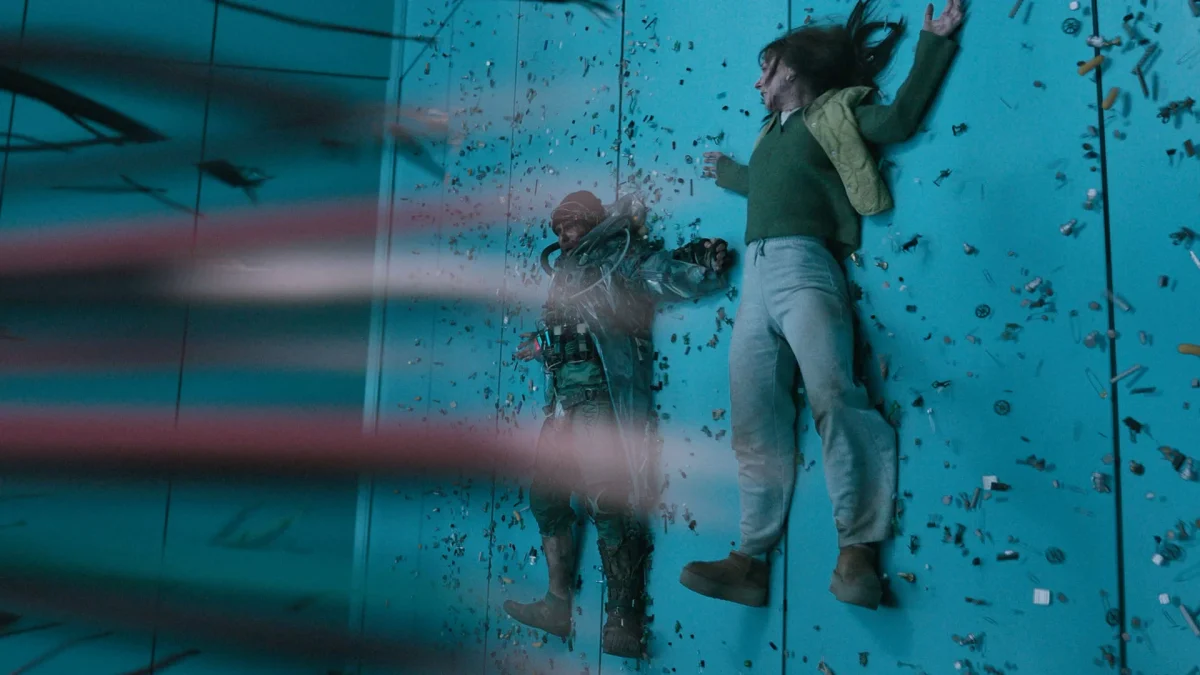
Haley Lu Richardson is a perfect example. “Good Luck” essentially knows from the jump that she’s the most interesting performer it has to work with, and her own character’s backstory makes use of her inherent capacity for heartrending simplicity, without much in the way of tangible development. A woman born with a singular and unexplained allergy to cellphones and wifi (sure, why not?), Ingrid grows friendless and lonely until some Kurt Cobain-looking biker who “doesn’t believe in phones” saunters into her life. And they have a cozy life together until… someone sends him a VR set in the mail, and he simply abandons their anti-tech ethos on the spot.
Where this subplot eventually goes feels even less rooted in whatever flimsy characterization was there to begin with, as Verbinski seems too interested in the vague generalities of “These damn kids with their cellphones and their TikToks!” than actually interrogating this technological upheaval in any way that would engage a younger audience beyond overwrought condescension.
Temple’s own subplot may ring closest to genuine satire about America’s preference towards technological comforts over genuine solutions to its rampant school shooting problem, but even the final development of that sequence is in service of an eventual narrative convergence that, by film’s end, doesn’t even add up to much of anything.
In truth, that’s really the greatest tragedy of “Good Luck, Have Fun, Don’t Die.” For a film (and accompanying filmmaker) so seemingly dead-set on locking horns with the state of the modern world and viscerally pushing against the inevitability of AI, what Gore Verbinski manages to come up with ultimately rings as tediously paced, disarmingly ugly (does an AI-centred film get brownie points for looking lifeless just because it’s *about* lifeless technology?) and, saddest of all, at a loss for any real challenge to the system it claims to so vigorously condemn.



![Sanson and Me [2022]: ‘Tribeca’ Review – On Earth, We’re Briefly Gorgeous](https://www.highonfilms.com/wp-content/uploads/2022/06/SANSON-AND-ME-Tribeca-Movie-Review-2-768x432.jpg)

![For Your Consideration: Bringing out the Dead [1999]](https://www.highonfilms.com/wp-content/uploads/2017/04/cage_stern_driving-768x340.jpg)
![Escape from Pretoria [2020] Review – A Relentlessly Engaging Jailbreak Thriller](https://www.highonfilms.com/wp-content/uploads/2020/04/Escape-from-Pretoria-2020-768x512.jpg)