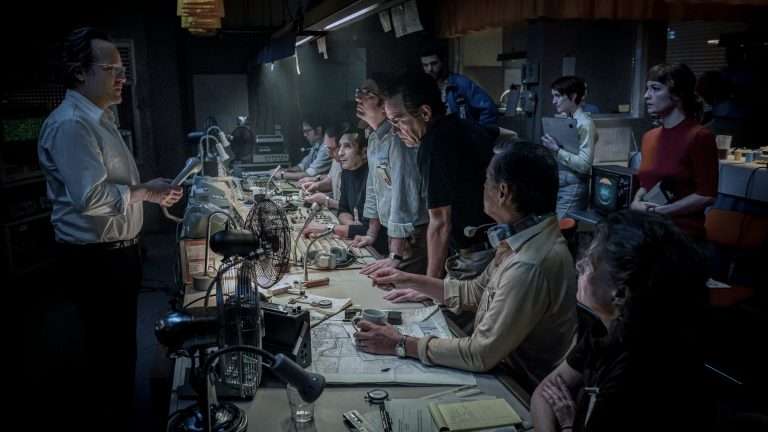
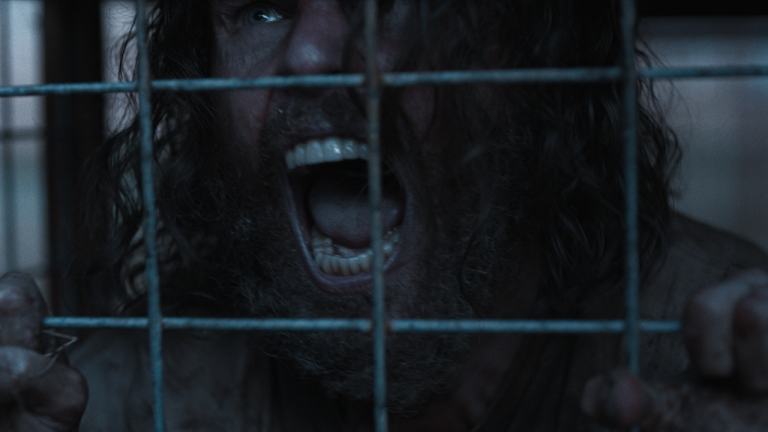
“In the Mouth of Madness” (J. Carpenter, 1994) occupies a singular place within modern horror. Inspired by the tradition of H. P. Lovecraft’s cosmic terror, it begins from a simple and devastating premise: we do not know reality. And it is precisely this ignorance that preserves our sanity. The unknown does not threaten only the body, but the very structure of the human mind, fragile in the face of the possibility that the universe does not recognize us as central or necessary.
Lovecraft conceived a cosmos populated by ancient, indifferent entities whose mere revelation would dissolve reason. Carpenter understands this principle and translates it into cinematic language. His horror does not rely on shocks or explicit violence, but on the gradual perception that what we take as real may be nothing more than an unstable surface. Fear does not reside in darkness, but in the suspicion that light might reveal something that should never be seen.
The narrative follows John Trent (Sam Neill), an insurance investigator hired to locate the writer Sutter Cane, whose novels seem to provoke outbreaks of violence and collective hysteria. As Trent immerses himself in the author’s work, he becomes unable to distinguish fiction from reality. The town of Hobb’s End, supposedly imaginary, proves tangible. Its inhabitants are at once ordinary and profoundly displaced. Carpenter films this space as a territory suspended in time, where normality extends a moment beyond comfort, and it is within this minimal excess that horror takes hold.
The director reinforces this sensation through a deliberately artificial visual language. Miniatures, practical effects, and visible textures refuse transparent realism and constantly remind the viewer that the world onscreen is a construction. Rather than breaking immersion, this artificiality intensifies discomfort: if reality can be assembled like a set, it can also be dismantled. Horror emerges from the materiality of images — the paint covering the walls, the wood that creaks, the makeup that does not conceal its own presence. There is no perfect illusion; there are only layers. And each layer suggests that the world can be rewritten.
The film operates as a metalinguistic reflection on the power of narratives. Cane does not merely write stories. He reconfigures the world through them. Reality becomes a contested text, subject to editing, repetition, and collective belief. The question that emerges is not only what is real, but who possesses the authority to define it.
At this point, the film touches a dimension that exceeds cosmic horror and approaches theological and philosophical reflection. What is considered madness by some may be recognized as truth by others. As Scripture states, “the message of the cross is foolishness to those who are perishing, but to us… it is power” (1 Corinthians 1:18). What we call sanity may be nothing more than a provisional consensus, sustained by the need for stability rather than by correspondence with reality.
This instability of reality is not unprecedented in Carpenter’s cinema. In “They Live” (1988), the director also interrogates perception, but through a different structural logic. Here, reality is layered rather than authored: the visible world functions as a shell concealing a system operating beneath it. Through the now-iconic black sunglasses, the film’s visual language strips away the surface of consumer culture to reveal stark commands (OBEY, CONSUME, MARRY, and REPRODUCE) imprinted across the urban landscape.
Carpenter employs practical effects, high-contrast typography, and abrupt shifts in image texture to render ideology materially visible. The world as we know it persists, but as a façade. Once the shell is removed, the hidden domain of the powerful emerges — an elite that shapes desire, behavior, and consent from below the threshold of perception.
The protagonist, Nada (Roddy Piper), whose name means “nothing” in Spanish, embodies both anonymity and potential. He begins as an invisible laborer within the system. Yet the film retains a measured optimism: the apparatus can be exposed, resisted, and ultimately confronted, a struggle he carries through to its violent conclusion.
Placed beside each other, however, this optimism dissolves. If “They Live” suggests that reality can be decoded and the system unmasked, “In the Mouth of Madness” proposes a far more destabilizing premise: there may be no exterior from which to resist. In one film, ideology hides beneath the surface. In the other, the narrative generates the surface itself. Nada fights to reveal the truth behind appearances, while John Trent discovers that appearances are all that exist, authored, revised, and consumed.
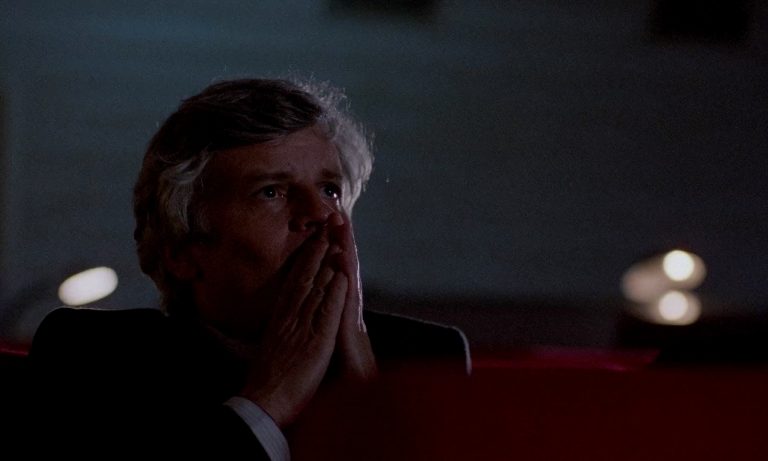
Carpenter thus moves from a politics of unveiling to an ontology of entrapment. The enemy is no longer a concealed ruling class but the very structure of reality as mediated through stories. Where “They Live” ends with a signal broadcast and the possibility of awakening, “In the Mouth of Madness” concludes with laughter in an empty theater, suggesting that recognition arrives too late, when resistance has already been written out of the script.
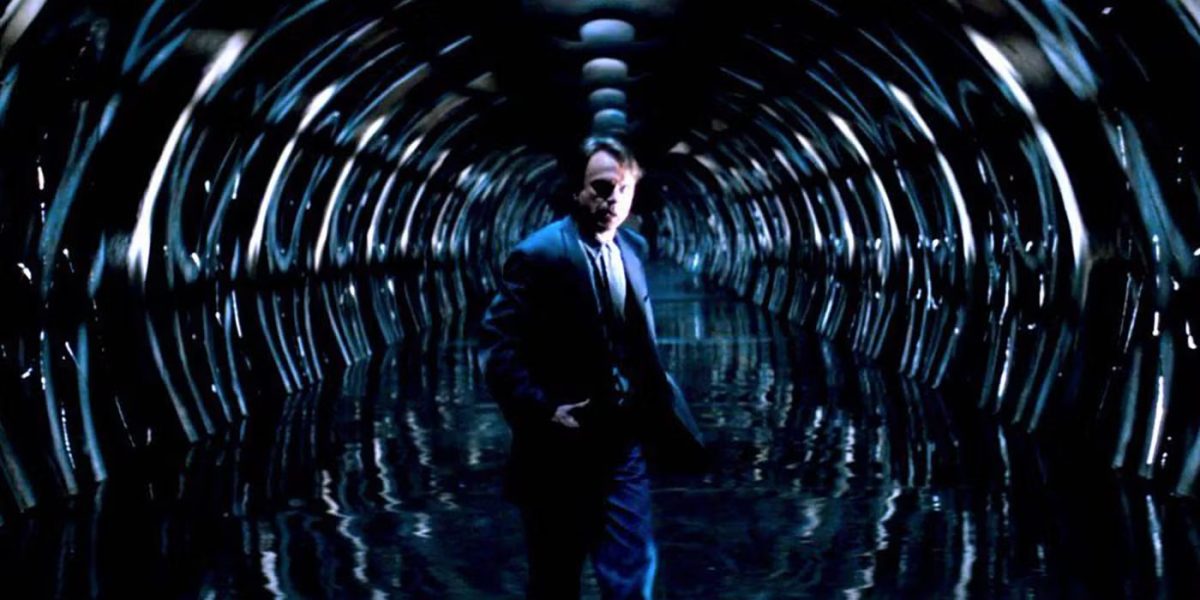
Just like that, he offers no answers. Instead, he constructs a progressive dissolution of certainties. Mirrors, doors, and impossible corridors suggest that the world is an unstable architecture. The protagonist seeks to restore rational order, only to discover that his own function is inscribed within the narrative he attempts to refute. He is not the reader of the text; he is its character.
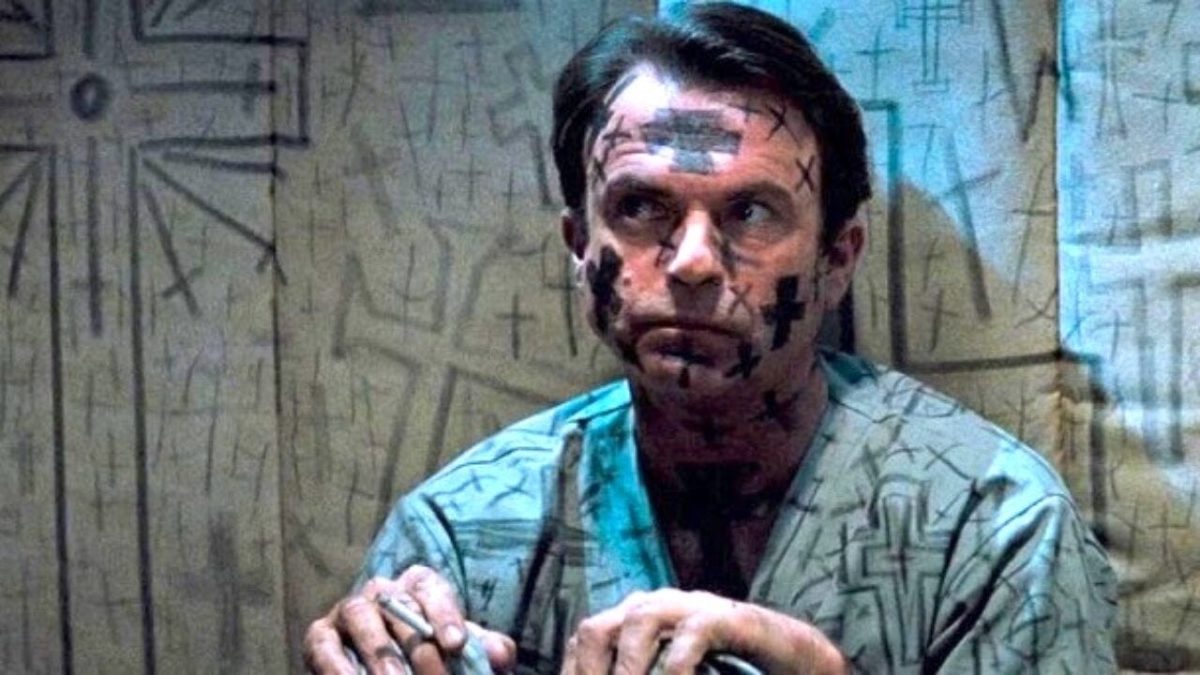
Trent’s journey ultimately reveals the loss of the human center as the measure of the world. For centuries, modernity sustained the belief that reason could order chaos and confer meaning upon reality. Carpenter dismantles this confidence with cruel precision. The universe of the film is not hostile; it is indifferent. There is no malice directed at humanity, only the realization that it occupies no privileged position. This perception is more devastating than any direct threat. What breaks is not the body, but the narrative that sustained the idea of human importance.
This dynamic resonates unsettlingly in the contemporary world. We live in a time of competing narratives, in which truth and fiction occupy the same symbolic space. Institutional authority is contested, while alternative versions of reality circulate with speed and adhesion. The film anticipates a scenario in which control of the narrative is equivalent to control of the real.
In this context, everyday experience becomes mediated by narratives that compete for legitimacy over what is perceived as truth. Networks, screens, and incessant flows of information produce parallel realities that do not cancel one another, but coexist, each claiming authority. Carpenter’s horror finds its echo in this fragmentation: we no longer know whether we inhabit the world or merely navigate versions of it. Trust in the senses becomes precarious, and memory itself may be rewritten through the repetition of images. As in Hobb’s End, the question shifts from “what happened?” to “who is telling the story?”
John Trent is confronted with this impossibility of neutrality. Even in resistance, he becomes an instrument of the author he sought to expose. His sanity is not destroyed by monsters, but by the realization that there is no exterior to the story. When he finally accepts his role, all that remains is to watch — like us — his own fall transformed into spectacle.
Carpenter stages this conclusion with implacable irony. Trent’s final laughter is not liberation, but collapse. He recognizes that he has always been inside the narrative he believed he was investigating. Life becomes entertainment; horror becomes product; reality becomes script. The film remains disturbing not because it predicts ancient entities, but because it suggests that truth may be less stable than we assume. In a world saturated with versions, belief becomes an act of risk. And perhaps it is in this confrontation — between our need for meaning and the indifference of the cosmos — that we find not madness, but the only form of lucidity still available to us.


![The Peanut Butter Falcon [2019]: ‘BFI-LFF’ Review – A funfair Caterpillar ride](https://www.highonfilms.com/wp-content/uploads/2019/10/peanut-butter-falcon-review-768x512.jpg)