Though comedy comes in all shapes and sizes, it’s safe to say that every era slowly comes to be defined by a particular style that dominates above all others. In this, the post-YouTube period of internet-bred American humour, the predominant mode of churning laughs from unsuspecting viewers seems to be to shock their systems with a heavy dose of cringe.
It’s a natural evolution of a genre that has always thrived on poking social norms with a stick, and in an age where those norms have spread through every screen to make us feel more exposed and vulnerable than ever before, comedians have found a whole new goldmine of satirical material seeping out when that poking gets to be especially aggressive.
“Soft Boil” may be the narrative short film debut of a writer-director, Alec Goldberg, whose previous work has been exclusive to the realm of documentary—documentaries on sombre subject matter ranging from gun violence to childhood trauma, no less—but the eclectic comedy background of his surrounding cast and crew boasts a wide-ranging resumé that speaks to the evolution of short-form farce that has led us to this moment.
“New Girl,” “Key & Peele,” “Black-ish” and, of course, “The Office” garnish the collective CVs of Goldberg’s cast, and while a particular, Tim Robinson-shaped shadow can’t help but loom overhead despite no direct involvement, this sampling finds its own promise in the uniquely crackled tenor of a less refined comedic voice.
This much is clear from the opening seconds of the short, as “Soft Boil” begins with the hoarse vocal exercises of Lulu (Camille Wormser, also serving as Goldberg’s co-writer), an aspiring actress warming herself up for an audition tape. From the very beginning, Lulu’s direct, awkward social grace pierces the air like a half-sharpened ginsu, leaving shreds of dead space to fall amid unsuspecting bystanders who find themselves too disarmed by her unexpected comments to fully react to them with any coherence than she herself can muster.
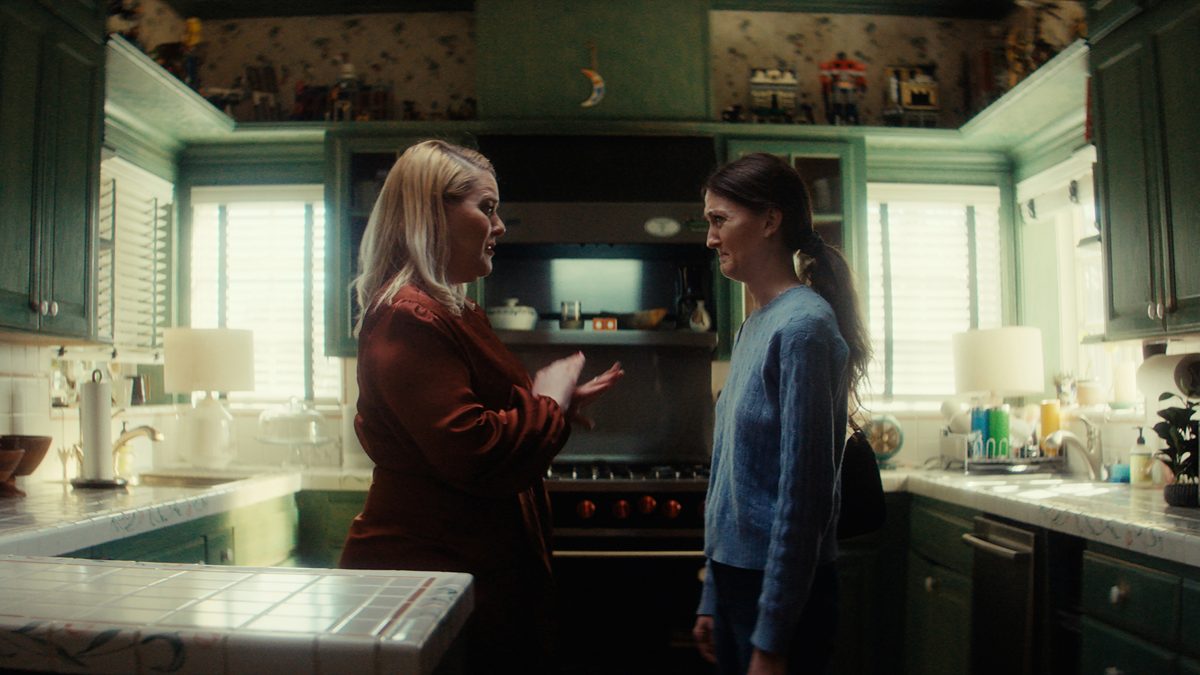
But as is typically the case with a struggling actor—even one who summons “once-in-a-lifetime opportunity” enthusiasm for a prospective Starburst commercial—bills must be paid, and Lulu rushes off from her seemingly supportive boyfriend (Patrick Tabari) for a babysitting interview. The interview goes about as well as expected from someone with a garbage bag taped over the window of her car as she proudly boasts that the Burger King job on her resumé was the real deal, but Christy’s (Vivian Kerr) other prospects are so dismal—we never get to see them, leaving Goldberg to let our imaginations do some of the legwork—that the job may very well be Lulu’s for the taking.
Wormser’s hunched posture and blunt line delivery give the character a semi-introverted disposition mixed with a fearlessness that feels entirely conducive to a style of comedy based on catching everyone off guard. A task as seemingly simple as picking up a guy at a bar—“He’s a guy,” Lulu’s friend Jess (Madison Shamoun) asserts, “so just ask him if he wants to have sex, and he’ll say yes”—winds up registering in Lulu’s mind as an opportunity to break the ice with a complete stranger with a bad Gollum impression. Given Wormser’s stated aim to bring more nuance to the portrayal of neurodivergence, cringing becomes, in this instance, a chance to deflate the tension that may come from bouts of social awkwardness magnified, as in the best of comedies, to a more absurd degree.
Goldberg’s command of the camera and edit are never quite as forcefully askew as Wormser’s performance and the surrounding minor perturbation of those on the receiving-end of her verbal dynamite, but small choices—like the brief establishing shots captured in dutch-angles—give the sense that Lulu’s world is a reflection of real social anxieties, intensified and held together by her own willingness to reciprocate that unforeseen energy with less deadpan than those who seem to have it all figured out.
If “Soft Boil” strikes as a taster for a tonal exercise that probably wouldn’t have lasted much more than its allotted 23 minutes, then Goldberg and Wormser’s final punchline is one that could only have been delivered with all that preceding build-up. And like that preceding build-up, Lulu’s adventures from here could very well split off in 100 different directions, but given one character’s description of “a test drive… for a car you know you’ll never, ever buy,” it seems as if Goldberg is aware of the particular appeal some bizarre experiences have in fleeting form.




![Sex, Lies and the College Cult [2022] Explained: How A Creepy Dad Formed an Abusive Cult-Like Group?](https://www.highonfilms.com/wp-content/uploads/2022/09/cc-768x432.jpg)

![Sorry To Bother You [2018]: ‘MAMI’ Review – An Inventive and Original Screwball Comedy](https://www.highonfilms.com/wp-content/uploads/2018/11/714047-sorry-to-bother-you-768x432.jpg)
![Margaret [2011] Review: A real coming-of-age drama](https://www.highonfilms.com/wp-content/uploads/2019/03/thenewyorker_movie-of-the-week-margaret-768x432.jpg)