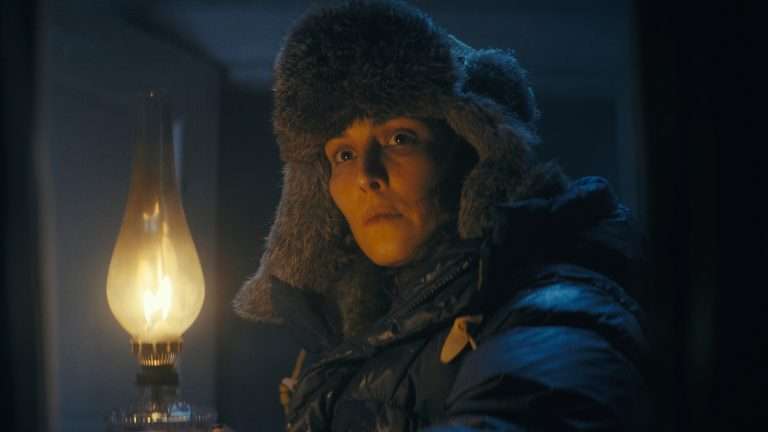
Mithun Balaji’s debut feature, “Stephen” (2025), pulls the rug from under your feet with its devastating final twist. Just when the audience believes they have decoded the motive behind the string of murders, including nine innocent young girls, and even his own parents, the film forces a complete rethink. Its spine-chilling climax reframes everything you thought you knew about the titular Stephen Jebraj (Gomathi Shankar), leaving you unsettled, uncertain, and armed with more questions than answers.
SPOILERS AHEAD
Stephen (2025) Plot Summary & Movie Synopsis:
“Stephen” begins in an unusually disorienting manner for a psychological thriller. The film opens with a young boy standing frozen in fear before a giant wheel at a fairground. As he trembles, the voices of his parents echo around him, repeatedly asking, “Are you enjoying, Stephen?” Before the viewer can grasp the meaning behind this unsettling moment, the scene cuts abruptly.
The narrative then jumps to a dimly lit room where an adult Stephen Jebraj is auditioning young women for what appears to be a romantic scene in a serial-killer story. The tone shifts sharply when it is revealed that Stephen is not auditioning them at all. Instead, he murders all nine girls in cold blood. Their deaths occur almost matter-of-factly, setting a chilling foundation for the chaos that follows.
Immediately after these murders, the film transitions once again. Now we witness a frantic search operation launched for the missing girls. The police seem to have everything they need to apprehend the culprit. They have clear evidence, a detailed sketch, and even Stephen’s exact location. Officers are ordered to shoot him on sight, given the severity of the crime. However, before they can act, Stephen walks into the police station and surrenders willingly.
His calmness during the arrest is deeply unsettling. In custody, he admits to killing all nine girls without hesitation. His composed demeanor raises doubts about his mental state, prompting the judge to order a psychiatric evaluation. Dr. Seema (Smruthi Venkat) is assigned to conduct the assessment, while Inspector Michael (Michael Thangadurai) continues to investigate the case from the outside, hoping to find clarity in a situation that feels increasingly out of place.
How was Stephen’s Childhood?
From here, the film moves back to 2006. We meet Stephen as a young boy growing up in a household ruled by volatility. His father, a failed athlete who never fulfilled his dream and ended up as a PE teacher, channels his frustrations into relentless abuse. Both Stephen and his mother become daily targets of his rage. In one of the film’s most distressing early sequences, Stephen’s father kills his beloved puppy Kuttan, cementing the toxic environment that shapes the boy’s formative years.
The timeline then leaps to 2012, revealing a drastic shift in the household dynamics. Stephen’s father is suddenly disgraced when he is accused of circulating a lewd video of a young girl. When the victim attempts suicide, the local community thrashes him brutally. In the aftermath, Stephen’s mother seizes control of the home. Although the power dynamic changes, the cycle of cruelty does not. Stephen’s mother begins abusing both Stephen and her husband, continuing the generational trauma.
Who is Murthi? Why does he save Stephen?
Meanwhile, in the present, Michael uncovers shocking details about Stephen’s family. The widely accepted narrative is that Stephen’s father murdered his mother before killing himself. However, Michael learns this was fabricated by Murthi, an investigating officer whose daughter attempted suicide in 2012. In order to protect Stephen at the time, Murthi crafted the false story. When pressed, Stephen reveals an even more disturbing truth that he himself killed both his parents after his mother blocked his attempts to move to Chennai for work.

Up to this point, the case appears to be aligning logically. Things take another turn, however, when Michael and Dr. Seema meet Mary John, the girl believed to be Stephen’s tenth intended victim. Mary also brings forth information about a mysterious girl from Stephen’s past whose presence complicates the narrative further. Gradually, these perplexing encounters begin to form a coherent picture, and Stephen is eventually convicted. Just when it seems the answers have arrived, the film prepares the ground for its most harrowing sequence, one that reframes everything the audience has understood so far.
Stephen (2025) Movie Ending Explained:
Who is Krithika? Why Does Stephen Kill People?
Once the police locate Mary, the only girl who survived Stephen’s elaborate audition setup, she reveals a crucial detail that she was always meant to be Stephen’s tenth victim. This is something Stephen himself apparently told her while they rehearsed the scripted “love scene” from his supposed serial-killer film. According to Mary, Stephen had each of the girls enact the same scene, only to murder nine of them in reality. However, when it came to Mary, he hesitated. The police initially interpret this as a sign of selective mercy, although the truth later becomes far more complex.
Mary also informs the investigators that the fictional love interest the girls were asked to portray was named Krithika. Her name becomes the missing piece of a puzzle that has already begun to contradict itself. When Stephen is questioned about Krithika, he delivers a story that is as emotional as it is suspicious. He claims Krithika was with him since childhood and had been the only person who genuinely loved him. They had lived together in Chennai for a few years, sharing what he describes as a peaceful and happy existence. However, according to Stephen’s version, everything changed the day he confessed to Krithika that he had murdered his parents.
Following this confession, Stephen explains that paranoia began to consume him. He believed Krithika would eventually tell the police about his crimes. As his fear escalated, Krithika took him to a doctor, recognizing that his mental state was deteriorating. Stephen fled from the clinic in distress and confronted Krithika outside in the parking area, apologizing and telling her he would get better. She agreed to continue living with him, offering reassurance that momentarily soothed his spiraling mind.
Eventually, their fragile balance fractured. One day, Krithika told Stephen that she would stay at her grandmother’s place for a few days. According to Stephen, this triggered the paranoia he had been desperately trying to suppress. He demanded she openly admit that she intended to report him to the authorities. Krithika, sensing the danger in his tone, conceded only to escape the situation alive. Instead of calming him, her reluctant admission ignited a murderous rage, leading Stephen to stab her repeatedly and kill her instantly.
He tells the police that the void Krithika left behind pushed him to search for the same love in other girls. This supposedly explains why he staged the “audition,” repeating the love scene with all ten women. His justification for sparing Mary was that she showed him the exact affection and innocence Krithika once did, which supposedly prevented him from killing her. To the court, this narrative paints him as a confused, grief-stricken, mentally unstable man. Based on Dr. Seema’s analysis and his own subdued, remorseful behavior, he receives a double life sentence totaling twenty-eight years rather than the death penalty.
However, the film then strips away every layer of Stephen’s carefully crafted persona. Inside the police van, while being transported to prison, he begins hallucinating. He sees his parents, Krithika, and all nine murdered girls speaking to him simultaneously. Their presence reveals the disturbing reality that the audience has been misled into ignoring. Stephen is not a conflicted, fragile young man shaped by trauma. He is nothing but a pathological liar.
The truth surfaces in fragments through this sequence. Stephen was the one who killed his puppy, Kuttan. He frequently slaughtered animals throughout childhood. Whenever his mother punished him for these acts, he responded with an evil smile, until one day he murdered her. His father was not abusive in the manner Stephen claims.
Stephen killed him merely to eliminate the person who might uncover the truth about his mother’s death. His story about Krithika is also riddled with omissions and distortions. When he eventually revealed his parents’ deaths to her, Krithika urged him to surrender to the authorities and accept responsibility. This simple, sensible request threatened the fantasy Stephen had constructed, so he murdered her, too.
Years later, he continued to miss Krithika, although not out of love or remorse. He missed the control he once held over her. To replicate that dynamic, he lured nine young women and killed them one by one. Mary survived not because she showed him affection but because Stephen needed a final narrative flourish. Hence, by keeping her alive, he created a sympathetic version of himself for the court, the media, and the world at large. The affection he spoke about never existed.
His motive, therefore, is not grounded in trauma, revenge, or emotional instability. He kills because he enjoys killing. His behavior evolves logically from childhood cruelty toward animals to calculated murders of people. He understands how to manipulate systems, which is why he surrendered early, knowing the police had orders to shoot him on sight. Stephen lied strategically during his psychiatric evaluation, and he succeeded. His twenty-eight-year sentence reinforces his confidence that he will eventually walk free and continue his cycle of violence.
In the film’s final moments, Stephen looks directly into the camera and delivers his secret openly to the audience, declaring, “I am crazy. I am evil to you. But to me, I am just Stephen.” He warns viewers not to imitate him, asserting, “Murder is a crime,” although his tone carries an eerie sense of pride. The chilling implication is that only the audience knows the truth. Neither the court nor the police nor anyone close to him ever uncovers his deception. The film ends on this deeply unsettling revelation, leaving viewers alone with a secret that the world of the movie will never learn.

Why Does Stephen Not Kill Mary John?
While combing through the evidence recovered from Stephen’s belongings, Michael notices a Christian wearable that stands out immediately. It is not something Stephen would typically own, and the item is linked to a retreat attended by young men and women from the local church. This detail prompts Michael to call in all the girls who participated in that retreat, especially since Stephen had visited the church shortly before surrendering. He hopes one of them might provide clarity regarding the tenth girl Stephen mentioned.
At the church, the investigation leads him to a surprising realization. The girl he is looking for works at the church itself. Her name is Mary John. Michael and Dr. Seema sit down with her for questioning, expecting hesitation or vague recollections. Instead, Mary directly states that Stephen spared her because she showed him genuine emotion during the mock love scene.
According to her, Stephen asked her to meet him at the church the next day. She claims he watched her from a distance, observing her sincerity, which supposedly softened him. From her perspective, Stephen’s decision stemmed from an emotional connection he could not bring himself to violate.
However, the explanation Mary offers turns out to be only the surface-level truth. The film gradually reveals a darker, more calculated motive behind Stephen’s decision. Sparing Mary was never an act of compassion. It was a key part of Stephen’s broader strategy to protect himself. Stephen knew the police possessed enough evidence to justify shooting him on sight.
The murders were too many, too brutal, and too clearly tied to him. To survive, he needed to create a witness who could humanize him, someone whose testimony would shift the narrative from premeditated serial killing to a psychologically fractured man who selectively stopped himself. Mary became that witness.
He manipulates Mary by presenting her with a false story about emotions, vulnerability, and gratitude. Because Mary believes he intentionally spared her life, she trusts the version he feeds her. Stephen is fully aware that Mary will never contradict him because doing so would risk invalidating the relief she feels at having survived. He also knows that her innocence and sincerity will make his narrative more believable to the authorities.
Furthermore, Stephen anticipates that the police will eventually uncover Krithika’s connection to him through Mary. He relies on this discovery. It allows him to introduce his fabricated tale about Krithika, thereby reinforcing his image as a troubled man grieving a lost love rather than a cold-blooded killer.
Through this carefully layered performance, Stephen secures sympathy in court, avoids the death penalty, and receives a reduced sentence on grounds of supposed mental instability. Now, Stephen is confident in how effectively his plan worked. He believes he will earn early release through good behavior and resume killing, continuing the pattern he refined since childhood. Mary’s survival, therefore, is not an exception to his cruelty. It is the result of a meticulously crafted safeguard designed to protect his future.
How do Stephen’s Parents Die?

One of the most compelling narrative threads in “Stephen” revolves around the death of his parents. Early in the film, the audience is led to believe that Stephen killed them, yet the circumstances of their deaths remain murky. The version Stephen shares during his psychological evaluation with Dr. Seema initially appears coherent. According to him, his father accompanied him on a car ride and smoked a few cigarettes on the way back. When they returned home, his mother discovered the smell of smoke and responded violently, unleashing her anger on the father.
Stephen claims he intervened to protect him, which only intensified her rage. During the chaos, she stumbled upon Stephen’s appointment letter for a job in Chennai and, fueled by jealousy and a sense of losing control, she declared that she would never allow him to leave. He recounts that he snapped in that moment and stabbed her. When his father later tried to urinate on her body in a drunken haze, Stephen supposedly killed him in retaliation.
This confession seems convincing at first, especially as it aligns with the film’s early portrayal of a volatile household. However, the “truth” Stephen narrates is carefully curated. It is a version crafted to evoke sympathy, justify his actions, and reinforce the image of a young man who broke under unbearable domestic pressure. As the film progresses, the real picture begins to emerge.
Stephen did kill his parents, yet his motivations were far more chilling. His violent impulses had manifested long before their deaths. As a child, Stephen regularly killed animals, including his own puppy Kuttan, and these acts gave him a disturbing sense of pleasure. Whenever his mother discovered his behavior, she beat him severely. These punishments were simply inconveniences that heightened his resentment. Eventually, he murdered her out of spite, not self-defense or emotional overload.
Stephen’s father, unlike the mother portrayed in his fabricated account, loved him deeply. There is no evidence that he abused Stephen or posed any threat. However, Stephen recognized that his father could eventually expose his violent tendencies and implicate him in his mother’s death. To eliminate that possibility, he killed him as well. The murder was a calculated step in covering his tracks.
The narrative becomes even more intricate when the film reveals that Stephen orchestrated additional layers of deception to protect himself. In fact, the lewd video scandal involving schoolgirls, including Inspector Murthi’s daughter, is shown to be Stephen’s handiwork, not his father’s. Murthi’s daughter attempted suicide after the video spread, and Murthi, devastated, assumed Stephen’s father was responsible.
Stephen allowed this assumption to grow unchecked because it served his interests. And by letting Murthi believe that his father was the culprit, he secured an unexpected ally. Murthi, out of anger toward the man he believed harmed his daughter, never pushed for Stephen’s arrest. This unintentional protection ended up enabling Stephen’s long-term evolution into the killer that the audience witnesses.
The implications are haunting. If Murthi had reported Stephen at that time, the chain of events that followed might never have unfolded. Stephen’s father would have been spared the false accusation, Krithika might have lived, and the nine girls murdered during the “audition” would not have fallen into his trap. The film highlights the tragic weight a single misinterpretation can carry, especially when that misunderstanding shields someone as dangerous as Stephen.
Will Stephen be Back? What is Luna: The Night Awakens?
After Stephen’s chilling direct-to-camera confession, the movie makes one final shift that deepens the mystery even further. Earlier in the narrative, Stephen told the police that he had hidden the bodies of the nine murdered girls somewhere in the forest. This detail drives the officers into a frantic search through the specified area. Despite combing through every possible location, they fail to uncover the bodies. All they find are a few scattered belongings of two victims, Surekha and Preeti. The absence of the bodies lingers as an unresolved thread, quietly unsettling yet never fully explored until the closing moments.
In the film’s final minutes, the story rewinds to a scene set a few weeks before Stephen’s trial. This sequence introduces a previously unseen character. The man’s appearance remains obscured throughout, and the camera never reveals his face. He first appears eating alone at a roadside restaurant as news of Stephen’s crimes plays on a radio in the background. Without reacting outwardly, he finishes his meal and then drives his truck into a remote, desolate area far removed from the rest of the world.
Once he arrives, the significance of the scene becomes unmistakable. The location contains several bodies stored in sacks, kept in a manner that suggests routine rather than shock. As he steps into this place and looks up at the moon, the screen shows the title card: “Luna: The Night Awakens.” This reveal signals that the story is far from over. The film concludes with an explicit “to be continued…” message, confirming that the universe of Stephen will extend into another chapter.
This brief yet unnerving glimpse opens several possibilities. Since Stephen firmly believes he will be released in ten years due to good behavior, the sequel will likely be set a decade after the events of the first film. The title “Luna: The Night Awakens” suggests a thematic connection to Stephen, whose name and actions revolve around darkness, secrecy, and transformation. The moonlit imagery also creates an atmospheric bridge between the two characters, implying that their fates may converge. The sequel may explore this partnership, positioning them as a formidable duo capable of continuing the killings on an even larger scale.
Meanwhile, characters like Michael and Dr. Seema, who now understand Stephen more clearly than anyone else, may become central figures in tracking both killers. Their roles could expand into a larger investigation that spans years, bridging the gap between Stephen’s past manipulations and the horrors that await in the next chapter.
Stephen (2025) Movie Theme Analyzed:
When Violence Goes Unchecked
The central theme of “Stephen” only fully reveals itself after the film’s devastating final twist. What initially seems like a mystery driven by trauma or revenge slowly unravels into something far more disturbing when it becomes an exploration of what happens when violence is ignored, excused, or quietly swept under the rug. It becomes painfully clear that Stephen has no remorse for anything he has done. In fact, the film suggests he never possessed the emotional capacity for guilt or empathy to begin with.
But “Stephen” refuses to place the blame solely on its titular character. Instead, it subtly indicts the people around him who repeatedly failed to act. His mother, who noticed signs of cruelty in his childhood, chose to discipline him with beatings rather than seek real help. His father, even after witnessing the unthinkable, decided to hide the truth instead of confronting it.
Then there’s Murthi, who knew more than anyone else and still avoided taking the one step that could have prevented the chain of gruesome murders: admitting Stephen into a mental asylum. The film argues that unchecked violence festers. When warning signs are dismissed, denied, or protected, the consequences eventually erupt, and everyone pays for it.