Of me, who am where I was and was where I am, the automaton of a real person, dispatched into the desert to walk through it?
I am filled by a question which no one can answer.
– Pier Paolo Pasolini, Theorem (novel)
The everyday existences of individuals remain pervasively regulated by entrenched structures of power. The disposition of power inscribes itself upon every social interaction, enforcing norms and hierarchies until they feel indelibly ‘natural.’ It doesn’t merely constrain; it creates subjects, crafting identities through social and moral codes. This raises the question: Who, and what, is the subject? Are individuals mere products of these structures, or does a true self persist beneath them? And is this condition universal? These questions led to a rigorous cross-cultural analysis of Pier Paolo Pasolini’s “Teorema” (“Theorem,” 1968), an Italian allegorical bourgeois parable, and C.P. Padmakumar’s “Sammohanam” (1994), a Malayalam meditation on desire.
These films traverse beyond the power structures, venturing toward individuals’ true being, a sacred revelation of their authentic selves. Both films garnered substantial critical acclaim. Pasolini’s sixth feature, “Teorema,” earned a Golden Lion nomination at the 29th Venice International Film Festival, with Laura Betti securing the Volpi Cup for Best Actress. Likewise, C.P. Padmakumar’s second and final venture, “Sammohanam,” based on “Rithubhedangal,” a story written by Balakrishnan Mangad, was selected for the ‘Best of the Fest’ category at the 1995 Edinburgh International Film Festival and clinched the 1994 Kerala State Film Award for Best Background Music.
In Pasolini’s “Teorema,” a mysterious Visitor (Terence Stamp) comes to a bourgeois Milanese family, seducing every member of the family, including the maid Emilia (Laura Betti), son Pietro (Andres Jose Cruz), mother Lucia (Silvana Mangano), daughter Odetta (Anne Wiazemsky), and father Paolo (Masimo Girotti), unleashing their repressed desires. After his abrupt departure, he leaves a void that shatters their facades: Emilia performs miracles before ecstatic self-burial; Odetta is catatonic; Pietro obsesses over transgressive art; Lucia seeks anonymous sex; the father relinquishes his factory, strips naked, and wanders on a barren slope in primal scream.
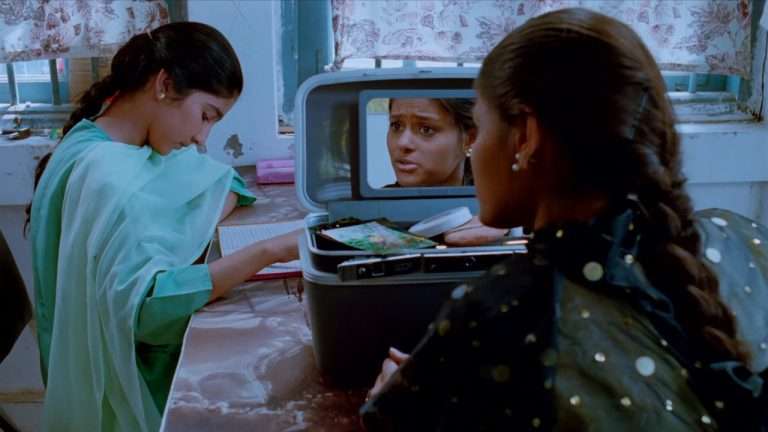
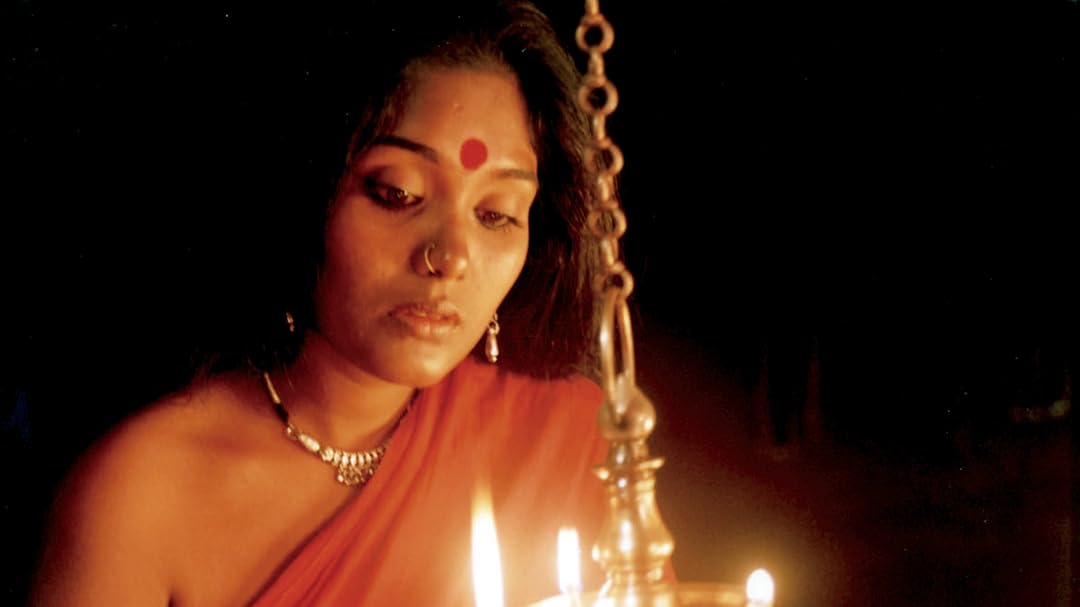
Similarly, “Sammohanam” unveils a mysterious girl, Pennu (Archana), who arrives in a quiet village seeking her dead uncle. Enchanting men, including wealthy farmer Chandu (Murali), his brother Ambu (Sarath Das), jaggery mill owner Chindan (Radhakrishnan), and trader Ummini (Nedumudi Venu), resulting in shattering marriages and friendships. Jealous violence erupts: Chandu severs Chindan’s earlobe, kills Ambu accidentally, then kills himself, as the Girl vanishes alone into the ether. This study probes the lives of these characters, revealing how the visitation unmasks the veneers of social and moral order that society has meticulously constructed, thus igniting an inexorable journey toward their raw, untamed selves.
Manifesting Repressive Existences: Lives Adrift in ‘Teorema’ and ‘Sammohanam’
In the opening act of both films, the narrative commences with depictions of the characters’ quotidian existences, confined within their personal comfort zones and circumscribed by the sociopolitical and moral strictures of the societies they inhabit. “Teorema” opens with a television crew interviewing workers outside a factory, which their former boss has unexpectedly donated to them (as the film progresses, it narrates the events leading up to the factory’s donation). It is precisely here that the film’s title emerges on screen, as the credits unfold across the rippling expanse of a dark crimson desert.
The film’s following sequence, rendered in subdued sepia tones and accompanied by angst-laden music, maintains a deliberate reticence toward its characters, rendering their actions slightly enigmatic. Only with the mysterious Visitor’s arrival do saturated colours re-emerge, making dialogue audible. During the brief sepia-toned prelude, the film immerses viewers in the central characters’ lives, confined within the structures of bourgeois order.
Paolo, the father, is the first character to appear, departing his factory in the rear of a Mercedes. This image encapsulates his dominion as the head of the household, his authority, and his control over the means of production. Next appears Pietro, the son, emerging from a Milanese high school as the cheerful scion of the bourgeoisie. Amid his peers, he playfully seizes the coat of a bigger friend, puts it on, tries a few clownish steps, elicits laughter from the group, then departs arm-in-arm with a female companion.
Then the scene shifts to Odetta, the daughter, wandering protectively among parked cars, clutching her books. Her boyfriend’s seizure of a photo album, revealing Paolo’s portrait, exposes that she has no image of herself except one mediated solely through overpowering male authority. The film then turns to Lucia, the wife, whose representative role symbolizes family status: depicted reading a book with an illegible title, her activity signals cultivated leisure rather than substantive engagement with its content. At the same moment, the camera cuts to a tight close-up of Emilia, the servant in the bourgeois household. She labours wordlessly (except at the end) with a rarely changing expression.
Must Check Out: The Dominance of the South Indian Films: Are We Witnessing a Fundamental Shift or A Passing Cycle?
“Teorema” primarily portrays the repression of individuals within the bourgeois order, whereas “Sammohanam” illustrates how the sociopolitical and patriarchal moral order represses society itself. The film opens with the death of Karuvan, the village’s esteemed paternal figure, profoundly shaking the entire populace. Society appears as a cohesive community where inhabitants show mutual concern. The first act uses its central figures to convey society’s outward tranquillity. Ambu, introduced first, embodies youthful bravery as he drives wild animals from the fields while striving to transform from boyhood into manhood. As the film progresses, another central character appears: Chandu, a devoted husband who savours joyful moments with his wife and daughter.
Yet he flashes anger at his daughter when she interrupts his private time with his wife. Next comes Chindan, who cherishes his sister Kunjani (Cuckoo Parameswaran) with profound care and shares a deep, enduring friendship with Chandu. Chandu even offers to help all the way to Chindan’s field. When Chindan mentions paying wages, Chandu retorts, “Should we talk business?” Ummini rounds out the cast, esteemed by villagers; he harbours profound affection for old Karuvan, and his thoughts initially appear to transcend society’s insular confines.
Beneath Idyllic Facades: The Sacred Visitor and the Collapse of Constructed Realities
The pivotal event in both films is the arrival of the mysterious visitor. In “Teorema,” the Visitor’s first appearance coincides with a stark shift to desaturated ‘real’ colours, from the bourgeois family’s muted, unfiltered palette. Upon the Visitor’s debut in the film, Odetta’s friend inquires in English, “Who is that boy?” to which she responds, with stark simplicity, “A boy.” Conversely, in “Sammohanam,” the Visitor is greeted amid lush floral abundance and verdant nature, an image signifying the society’s idyllic surface composure.
She lingers, gazing across the lush, fertile expanses of the village, before wandering through its green abundance. When the villagers first glimpse her traversing the fields, Ambu asks, “Who is that?” Janu (Bindu Panicker), one of the villagers, replies, “Could be someone passing through.” Chiruthamma (K.P.A.C. Lalitha), another one ventures hesitantly, “That is no passerby. Look at her walk, she seemed to know this place.” Later, when Chiruthamma inquires who she is, she answers, “I came looking for my uncle Karuvan. I’m of the aunt’s family. I haven’t come here in years.” Queried why now, with no kin left, she falls silent, murmuring only, “My uncle…” When asked her name, she says, “They call me by many names.” Pressed further by the insistent villagers, she adds, “Then call me ‘Girl’ (Pennu).”
Following the Visitor’s arrival in “Teorema,” Paolo, Lucia, Pietro, Odetta, and Emilia awaken to the regimented repressiveness of their prior lives, recognizing the difference now inscribed in both body and consciousness. While in “Sammohanam,” as the men grow affectionate toward the Girl, their concealed true selves, veiled beneath socially constructed personas, begin to surface. Unlike the characters in “Teorema,” they remain oblivious to this transformation until the final act. Infatuated with the Girl, Chandu sheds his mask of devoted husband and father.
His disaffection toward wife Janu erupts in a drunken glare, then escalates: while trimming a tree, he drops a branch on her. Unfazed, she accuses, “You dropped it on purpose.” She continued, “I know you don’t want me. You’re after that slut. If you kill me, you can have your way.” He climbs down, slaps her, and snarls, “Let her die.” Later, his daughter (Baby Anjana) whimpers, “Father spanked me while I was sleeping. I hadn’t done anything.”
Moreover, Chindan and Chandu turn bitter rivals over their shared infatuation with the Girl: Chandu slashes Chindan’s ear and shatters his sister’s marriage, prompting Chindan to slaughter Chandu’s cow in revenge. Even Chindan, despite his early devotion to his sister, Kunjani, slaps her across the face for her scorn of the Girl.
Just as the Visitor’s arrival profoundly impacts the characters in both “Teorema” and “Sammohanam,” their departure carries equal weight. In the second act of “Teorema,” the telegram announcing the Boy’s imminent exit plunges their lives into absurd melancholy; a haunting sense of something irrecoverably dissipated. Each character confesses to the Visitor the raw emotions stirred by their intimate encounters with him. “I don’t know myself anymore,” confesses Pietro, the first to bare his soul. “What makes me the same as others has been destroyed.
I was like all the others with many faults. You’ve made me different by taking me from the natural order of things.” Lucio admits, “I realise now that I’ve never had any real interest in anything… Now I realise it, you’ve filled my life with a total interest. So, in parting, you are not destroying anything they had before except, perhaps, my chaste bourgeoise reputation.” Paolo and Odetta, likewise, feel indifferent to their former selves. Emilia, forgoing speech, kisses the Boy’s hand deeply; a gesture signalling her transcendence of class-bound otherness.

Also Read: Pasolini’s Teorema (1968): Mystical Manifesto of the Communist Party
Following his departure, the film shows each character forsaking the grand house one by one, the final bastion of bourgeois order. In “Sammohanam,” the Girl departs only after witnessing the complete unravelling of the social order. Upon her departure, no lush floral abundance or verdant nature bids farewell; instead, a stark rocky mountain, symbolizing the society’s stripping to its raw essence, unmasked from its constructed patriarchal moral and social codes.
From Desire to Dissolution: The Undoing of the Self
These films portray desire as profoundly significant, where it manifests a transgression against the laws governing physical and intellectual processes alike. Pietro’s body interposes itself between what he is and what he yearns and must become. However, as he yields to desire, he turns to art, sublimating his bodily guilt, confessing: “We must try to invent new techniques, unrecognizable… which must be new… Nobody must realize that the artist is worthless, that he’s an abnormal, inferior being, who squirms and twists like a worm to survive.”
Yet he remains detached from it, trapped in hopeless corporeal existence. Like Pietro, Chindan faces a similarly hopeless existence toward the end of “Sammohanam.” After losing his ear and slaughtering Chandu’s cow in revenge, he confronts the Girl: “I did all this for you. I even lost my ear. Now you act like a stranger.” She replies, “I don’t understand: why do men take up arms against love? Why such vengefulness?” This marks their final shared scene. Meanwhile, Ummini, initially portrayed as an intellect who desires the Girl, emerges no differently from Chindan and Chandu, entangled in masculine rivalries.
The fates of Odetta and Ambu bear a striking resemblance in their respective films. After her encounter with desire, Odetta discovers her will, the will to reject the self. She now prefers to live in a catatonic state rather than exist as the father’s appendage. In this act, she renders herself absent, withholding herself from a narrative that held no true place for her, a sign of conscious refusal. On the other hand, Ambu harbours a deep desire for the Girl yet consciously evades it in his real life, a refusal to enter manhood.
The film depicts him witnessing how men become vengeful in their attempts to claim her as their own, a place he believes he has no footing in. Toward the end, when he attempts to confess his love, he falters, unable to fully convey it. His inner being consciously restrains him. Ultimately, he accepts his fate and remains an adult. Accordingly, both Odetta and Ambu can be called ‘the conscious refusers.’
Likewise, Chandu and Paolo stand out as the characters perfectly poised to grapple with the cosmic reality of being and nothingness, a total obliteration of their former selves. Conditioned to viewing himself as a self-sufficient individual in the capitalist market, Paolo succumbs to passion and realizes his identity is not innate but social, defined by his position within the relations of production. He deems even death no solution. “You must have come here to destroy,” he tells the Boy. “The destruction you have caused in me couldn’t be more complete. You’ve destroyed the image I always had of myself. Now I can’t see anything at all that can rebuild my identity.”
Paolo donates his factory to the workers and, in a climactic scene, disrobes amid the train station, confronting nothingness in a radical shedding of social identity. He then ventures toward the desert, where the film closes with him screaming into its vast expanse, running toward its rawness in a conscious embrace of his unadorned being. Toward the climax, in “Sammohanam,” Chandu storms the scene in a showdown to reassert his lost authority over the Girl and society. He intervenes in the fight between Ummini, killing his own brother Ambu in the fray. At this pivotal moment, his odyssey toward the conscious understanding of his raw self begins. He screams in agony, rolls across the field, and later appears walking towards a waterfall to embrace self-annihilation, his face not contorted in pain or grief, but etched with nothingness.
Conclusion: The Semiotics of Tears
After the characters’ profound self-discoveries, tears alone linger as a final testament in both films. In “Teorema,” Emilia, having healed a sick child and levitated above the rooftops, sets out toward Milan with an older woman (Susanna Pasolini). They pause near a housing project on the city’s outskirts, where Emilia requests burial and weeps, declaring, “These are tears… not of pain, but of hope.” It embodies the subaltern hope of a radical reinvention of humanity in classless harmony, wholly emancipated from the structures of class repression.
In stark contrast, “Sammohanam,” after the post-climax killings of Ambu and Chandu’s suicide, presents a harrowing frontal close-up of Janu, Chandu’s widow, clutching their daughter as she weeps while watching the Girl depart the ruined village. These tears offer no rejuvenation or hope, but mirror utter despair: a threshold beyond return. As the Girl recedes into the distance, Janu’s cries linger; a requiem for the irretrievably lost.