“The camera is a sketchbook, a diary, a phantasmagoria, a destiny, and a struggle.”
This observation by Federico Fellini serves as the perfect ideological lens through which to view Baz Luhrmann’s 2013 adaptation of “The Great Gatsby.” In the grand tapestry of American mythology, few eras shimmer with as much tragic brilliance as the Jazz Age, and few directors are as equipped to capture its frantic, arrhythmic heartbeat as Luhrmann. His film is not merely a period piece.
It is a sensory blitzkrieg that transforms F. Scott Fitzgerald’s skeletal, haunting critique of the American Dream into a technicolor elegy. By blending 21st-century kinetic energy with the rigid social stratifications of the 1920s, the film serves as a visceral depiction of a decade defined by its desperate need to outrun the past. However, to truly understand Luhrmann’s vision, one must view it not as a solitary work but as a dialogue with the ghosts of cinema past and the intertextual weight of Modernist literature.
Luhrmann establishes his cinematic vision through a stage setup that treats wealth not as a backdrop, but as a living, breathing character—a technique reminiscent of Orson Welles’ “Citizen Kane.” Just as Xanadu served as a stone manifestation of Charles Foster Kane’s ego, the architecture of Luhrmann’s film serves to distinguish between “Old Money” East Egg and “New Money” West Egg with surgical, almost caricatured precision. Gatsby’s mansion is a Gothic-revival fever dream—a “colossal affair” that feels less like a home and more like a brightly lit amusement park designed to lure a single, elusive moth.
In contrast, the Buchanan estate is a sprawling Georgian Colonial, draped in the lethargic red and white of established dominance. Here, the film engages in a deliberate intercinematic nod to the 1974 Jack Clayton adaptation. Whereas Clayton’s film used soft, muted pastels to denote class, Luhrmann uses hyper-saturation to suggest that for Gatsby, wealth is a performance that must be “louder” than the silence of his origins.
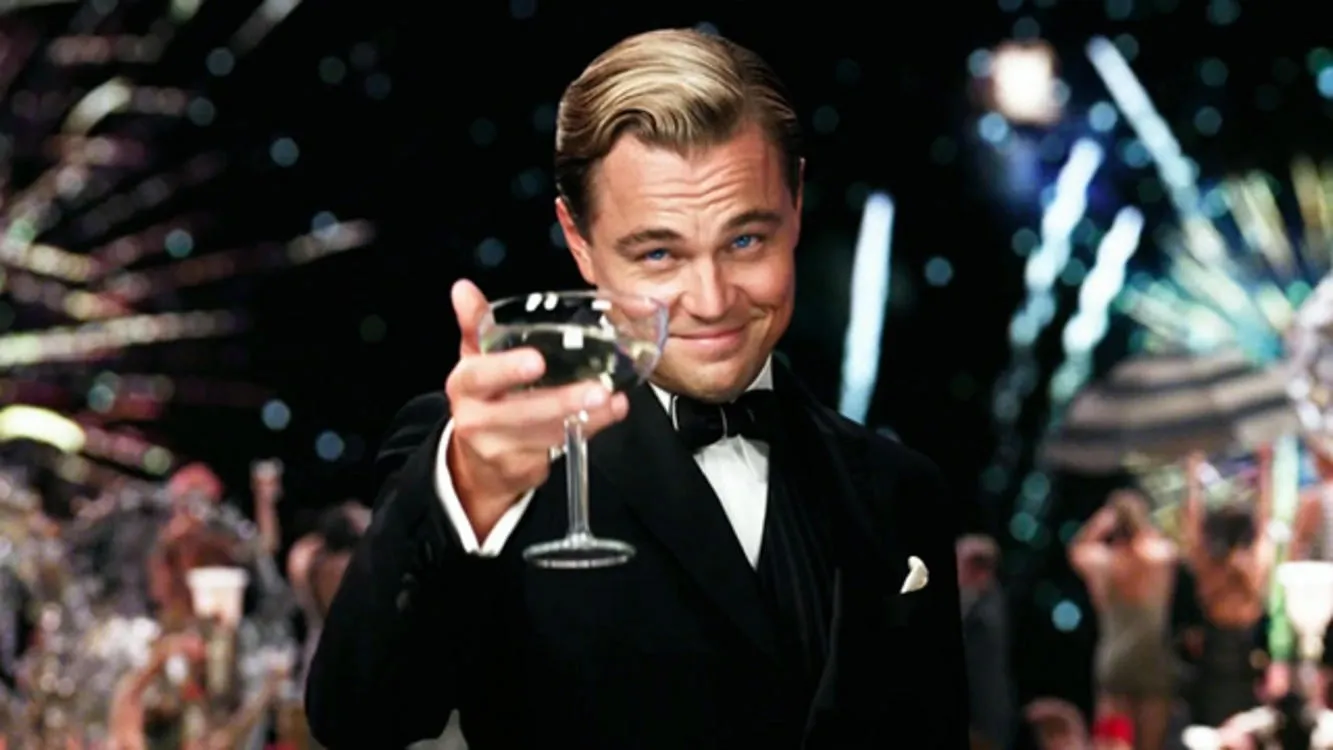
The scale of this environment allows Luhrmann to portray the “normal celebrations” of the period as bacchanalian rites. The party sequences, captured with sweeping crane shots and rapid-fire editing, mirror the era’s economic bubble: inflated, glittering, and perilously thin. It is within these scenes that the film’s narrative prowess aligns with its social commentary, as Nick Carraway observes that “the bar is in full swing, and floating rounds of cocktails permeate the garden outside, until the air is alive with chatter and laughter.” Luhrmann’s most controversial and effective tool in these moments is his “anachro-historicism.”
By layering modern hip-hop beats over 1920s rhythms, the film creates an intertextual bridge between the “Now” and the “Then.” This is not a stylistic gimmick but a critical argument: the Jazz Age’s obsession with celebrity and material accumulation is the direct ancestor of our contemporary culture. Just as Jazz was the “dangerous” music of the 20s, Hip-Hop occupies that space in the modern psyche. This choice echoes the frantic energy of T.S. Eliot’s “The Waste Land,” where fragments of high culture and low-brow street life collide to reflect a fractured, post-war reality.
Also Check: Transmuting Financial Ruin and Forbidden Love into Plays Fit for a Queen in ‘Shakespeare in Love’ (1998)
This atmosphere of excess is further anchored by the meticulous costume design of Catherine Martin and Miuccia Prada. In the 1920s, clothing was the primary indicator of status, and the film utilizes “sartorial storytelling” to define its players. Daisy Buchanan is draped in lavender, lace, and crystals that tinkle like the “money” Nick hears in her voice, symbolizing a fragile, untouchable purity that masks her inner hollowness. Meanwhile, Gatsby’s “pink suit” serves as a defiant cinematic reference to his status as a “parvenu”—an outsider playing a part he does not fully understand.
As Tom Buchanan sneers in a moment of peak class warfare, “An Oxford man! Like hell he is! He wears a pink suit.” This conflict unfolds within the semiotics of the 1920s, where even an errant thread could unravel a carefully constructed identity. The film thus treats fashion as a suit of armor that ultimately fails to protect Gatsby from the “ancient lineages” of East Egg.
The script, penned by Luhrmann and Craig Pearce, navigates these social thinking patterns by heightening the theatricality of Fitzgerald’s prose. The dialogue becomes a weapon, particularly in the sweltering tension of the Plaza Hotel scene—a sequence that serves as the film’s operatic climax. Here, the “Red Curtain” style falls away to reveal the raw, ugly bones of classism. When Gatsby demands that Daisy tell Tom she never loved him, the script highlights the era’s obsession with lineage over merit. This is where Luhrmann’s film earns its critical weight, referencing the intertextual concept of the “nouveau riche” vs. the “aristocracy.”
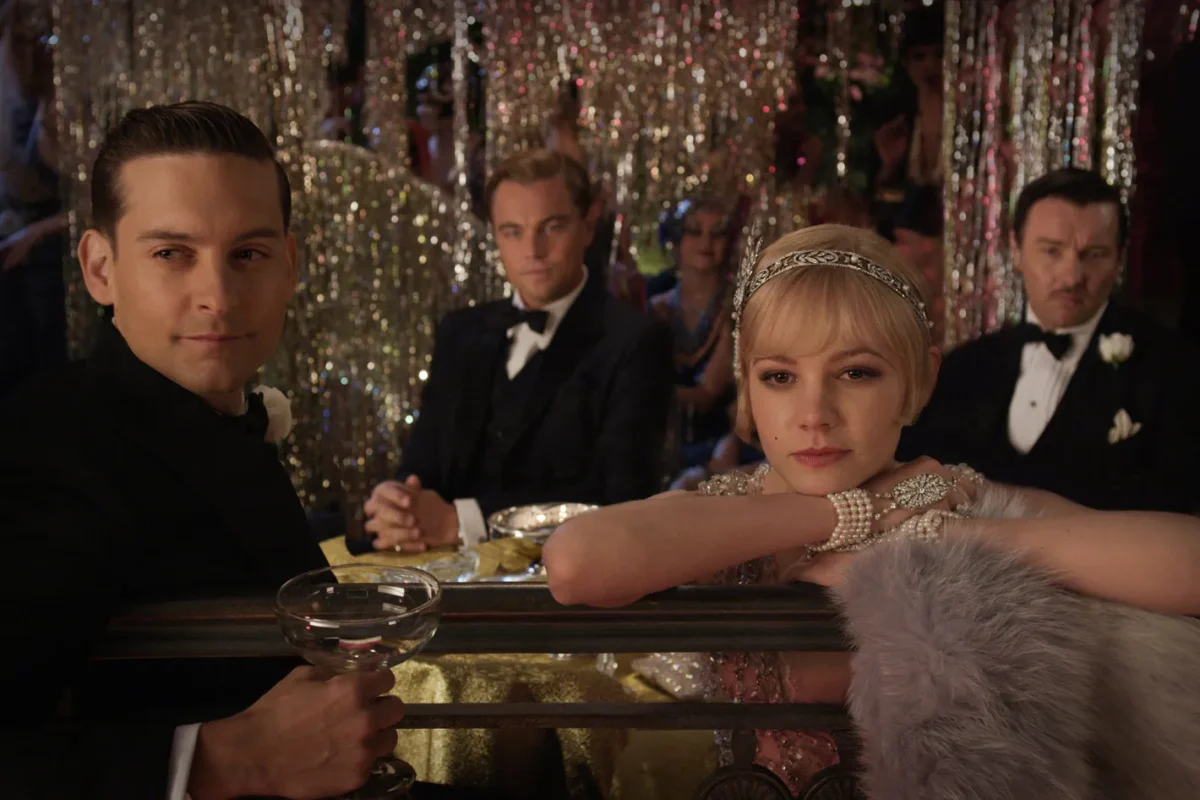
Tom’s retort—”Mr. Gatsby, I think you’ll have to tell me what kind of a row you are trying to cause in my house”—reasserts the invisible walls of class that no amount of bootlegged wealth can scale. This collision is further emphasized by the cinematography of the Valley of Ashes. While the Eggs are saturated in gold, the Valley is rendered in a desaturated, sepia-toned grit, presided over by the Eyes of Doctor T.J. Eckleburg. These eyes loom like a silent, cinematic God, echoing the haunting imagery of German Expressionism—specifically Fritz Lang’s “Metropolis”—where the workers are ground beneath the gears of a gilded city.
Furthermore, the film’s treatment of time and cultural relevance is defined by its refusal to be a static museum piece. As the film moves toward its tragic conclusion, it sheds its glitter to reveal a somber truth. The “Green Light” at the end of Daisy’s dock is treated by cinematographer Simon Duggan as a supernatural beacon, blurring the line between hope and delusion. Intertextually, this light represents the “Dutchman’s sails”—the original American dream of discovery that has since been corrupted by commerce.
Luhrmann’s Gatsby is ultimately a “Trimalchio”—a reference to Petronius’ “Satyricon,” which was a primary intertextual influence on Fitzgerald. He is the slave who became a billionaire only to find that the elites would never truly see him as an equal. As Gatsby lies dead and the crowds that drank his liquor vanish, the film captures the tragic vacuum left by the era’s hedonism.
Luhrmann’s “The Great Gatsby” ultimately emerges as a masterpiece of artifice that finds the core truth of its source material: that wealth is a shield used by the “careless” to protect themselves from the wreckage they leave behind. It solidifies its place as an indispensable entry in the pantheon of literary adaptations by proving that to be “faithful” to Fitzgerald, one must be “unfaithful” to the literal 1920s. Luhrmann’s use of hyper-real aesthetics serves to make the 1920s feel as immediate and terrifying as they felt to those living through them. It leaves the audience, like Nick, to reflect on those who “smashed up things and creatures and then retreated back into their money or their vast carelessness,” reminding us that we are all, inevitably, “boats against the current, borne back ceaselessly into the past.”