Stephen King’s “The Running Man” isn’t necessarily held up as one of his most essential novels in the vein of “The Shining” or “The Stand,” but it may be his most prescient. Decades before “Survivor,” “The Apprentice,” and YouTube livestreaming, King envisioned a sadistic reality show that served as the justice system for a compromised democracy in the hands of a wealthy upper percentile.
“The Running Man” was first adapted to the big screen as a gloriously campy cult classic starring Arnold Schwarzenegger that was predictive in its own way, as it seemingly anticipated the culture of ridiculousness and stupidity that would permeate mass entertainment in the coming years. In updating the story for modern times, Edgar Wright’s “The Running Man” draws a parallel to reality and justifies its relevance with a justified sense of rage.
There’s been a notable shift within Wright’s filmography in the wake of the conclusion of the unofficial “Corenetto Trilogy,” which he co-wrote alongside Simon Pegg. Although Wright had been heralded for his sharp, insightful genre parodies, his subsequent work leaned more towards sincerity.
The Old Hollywood sentimentality was immensely effective in “Baby Driver,” yet slightly undercooked in “Last Night in Soho.” Wright is too good an entertainer not to find sick pleasure in the dazzling spectacle of “The Running Man,” which is easily among the year’s most finely directed action films. The script that binds these sequences together is slightly more haphazard, but it manages to coast on the undeniable charisma of its dynamic star.

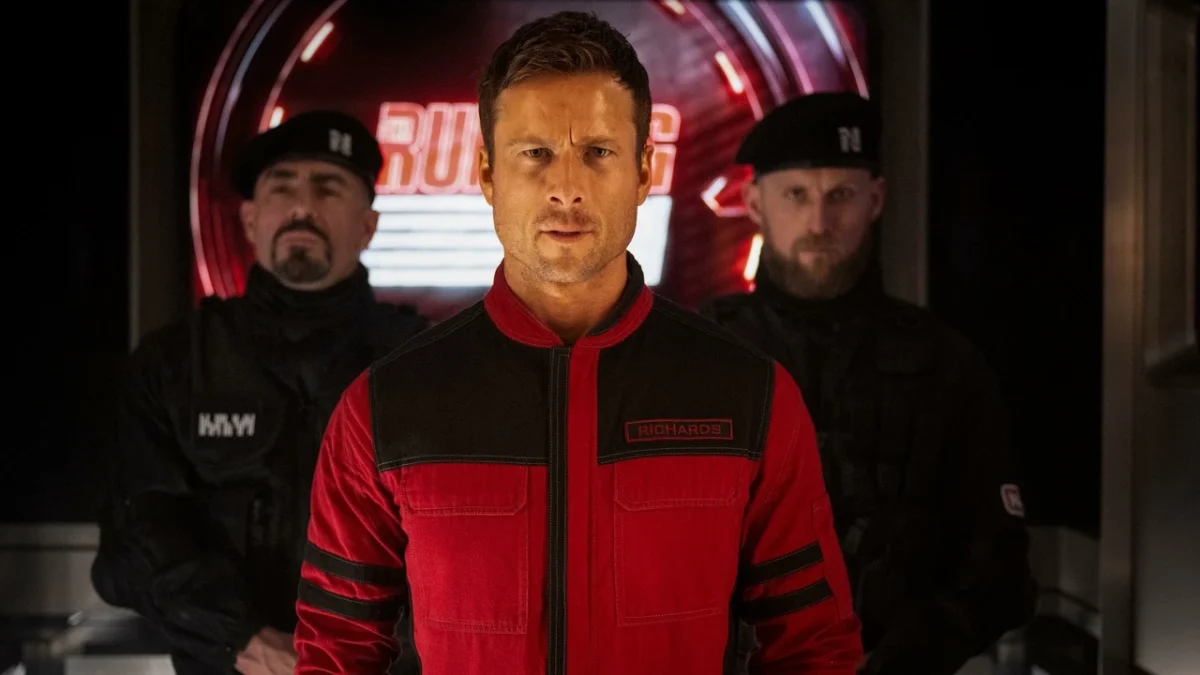
Although the original “The Running Man” envisioned its titular futuristic reality program as a direct stand-in for the justice system, Wright’s version is slightly more dynamic and, as a result, more frightening. Participants in “The Running Man” may elect to join under a presumed freedom of choice, but in actuality, they’ve been gamed by a system that’s determined to label them as villains. For Ben Richards (Glen Powell), choosing to fight so that his family can pay medical expenses means being labeled as a lazy, ineffective worker.
It’s after a tricky deal with producer Dan Killian (Josh Brolin) that Richards decides to compete in a dangerous competition in which he must survive for a full month as highly-trained assassins hunt him down. What begins as a reluctant ordeal ignites a burning flame of rebellion within a society that yearns to disrupt the status quo.
Wright’s approach to the universe of “The Running Man” is fascinating because it plays like an alt-reality rather than a distant future. Although there are wondrous environments crafted with a compelling blend of practical and digital effects, it’s a world that feels lived-in, damaged, and fractured.
Wright doesn’t add much context to the presumably totalitarian regime that has taken over the nation, nor does he peer into the society outside of its obsessive relationship with “The Running Man” itself. The result is a mix between the quasi-sadism of “The Truman Show” and the blunt, gleeful satire of late-stage capitalism in the work of Paul Verhoeven. Even if Wright is probing broad targets, “The Running Man” captures the ease with which audiences are swayed by seductive advertising claims.
The opening act of “The Running Man” is undeniably clunky, as Wright skips past a thorough explanation of the rules of the game for the sake of kicking up the action as soon as possible. It’s not incomprehensible because ultimately “The Running Man” itself does not abide by rules, as those in control can edit the guidelines at any instance to fit their goals.
The real consequence is that Richards’ relationship with his wife, Sheila (Jayme Lawson), and their daughter is given a fairly mundane setup that feels at odds with the high-energy tone that the rest of the film is pitched at. The reason it isn’t a disaster is the same reason why the rest of the film hangs together so well despite itself. Powell combines the everyman likability of a classical King protagonist with an inherent sense of altruism that makes him the inadvertent face of a movement.
“The Running Man” is strange in that it may feel like a collection of set pieces that are strung together with the flimsiest of logic, but each sequence is bursting with energy and momentum. Wright has the skill to find the stakes and impediments within each of Richards’ challenges, resulting in a breathless sense of momentum whenever Powell’s physicality takes over.
The instances in which the film has to announce its themes are a bit tougher. Richards is tasked with speaking directly to an audience of captive viewers, which means he has to break down his motivations in the broadest possible terms. That being said, Powell has the clear-eyed, unwavering combination of snark and stoicism that embodies why Richards’ anger is so resonant.
As is often the case with Wright’s films, there’s a lively ensemble that suitably ensures that there is personality within even the most straightforward of scenes. As much as Wright uses music and clever editing techniques to resemble the style of a legitimate game show, there’s something commendable about his knowledge that good actors can single-handedly elevate the material.
Brolin’s slimy, sneering role as a morally vacant producer with a fascist streak is imminently hateable, but it’s Colman Domingo’s performance as “The Running Man” host Bobby Thompson that is the film’s scene stealer. Although the now-infamous performance by Richard Dawson is a major reason why the 1987 “The Running Man” became such a notorious entry in the action canon, Domingo offers the appropriate scenery-chewing needed to modernize the role.
The rest of the supporting cast is slightly more uneven, given the surprising complexity of “The Running Man” universe. If Michael Cera’s role as an idiosyncratic revolutionary occupies just the right amount of time needed to score a fun set piece, then Emilia Jones’s presence as a bystander acquainted with Richards has bafflingly little to do by the time that the story wraps.
It’s inconsistencies like this that prevent “The Running Man” from entering the top tier of Wright’s work, even if its aesthetic components are leaps and bounds stronger than a majority of the year’s studio films. “The Running Man” doesn’t quite match the grandiosity of its ambition, but it certainly has its finger on the pulse.



![A Spike Lee Joint: Chi-Raq [2015]](https://www.highonfilms.com/wp-content/uploads/2019/06/Chi-Raq-768x512.jpg)