There is no firm rule on what constitutes a good adaptation, and there are many great films inspired by books that share nothing in common. In the case of “Wuthering Heights,” a novel that has already been brought to life in several films, writer/director Emerald Fennell wasn’t under pressure to make the definitive version of Emily Brontë’s highly unusual source material.
While Fennell does capture the provocative sexual intrigue and bleak outlook of the novel, her “Wuthering Heights” leaves out significant segments that aren’t just essential to a straightforward adaptation, but to a cohesive narrative. What Fennell fills the void with is mostly empty provocation. Although few period pieces in recent years are so eloquently designed, Fennell’s perspective on “Wuthering Heights” is as foggy as the Yorkshire moors.
“Wuthering Heights” starts with an intentionally jarring opening sequence that suggests a more lurid adaptation is afoot, but the film’s scope is broadly similar to that of previous adaptations made in 1939, 1970, 1992, and 2011. The difference is that the character of Hindley Earnshaw, the shrewd and abusive heir to Wuthering Heights, is absent entirely.
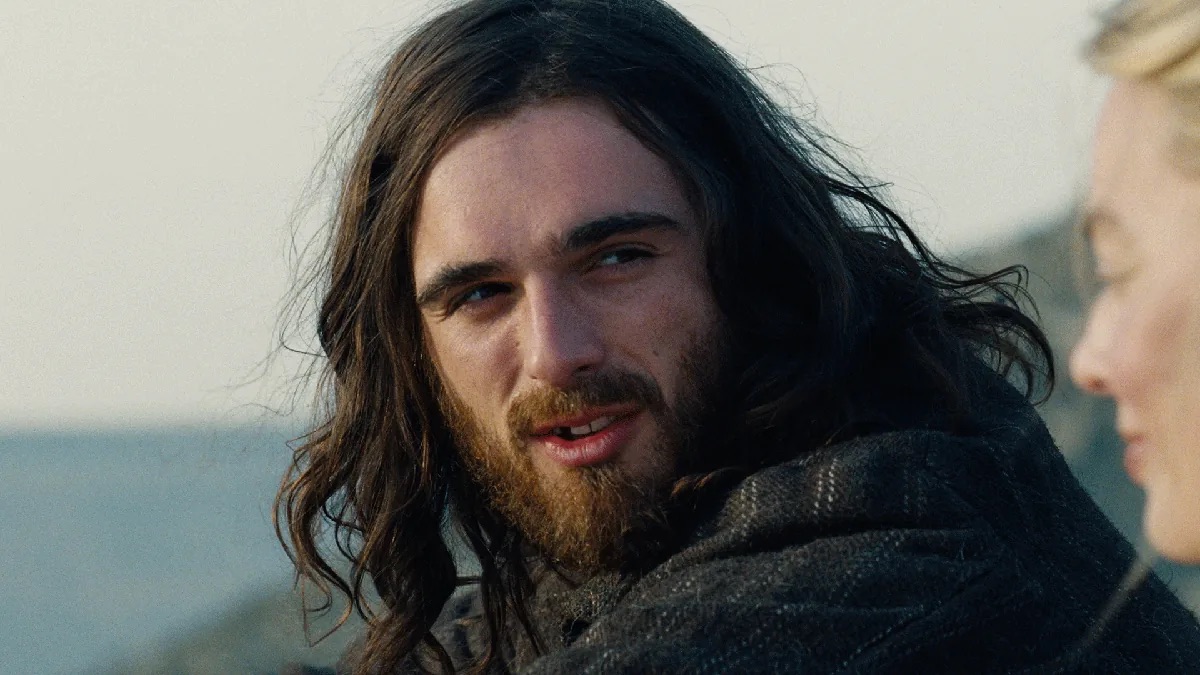
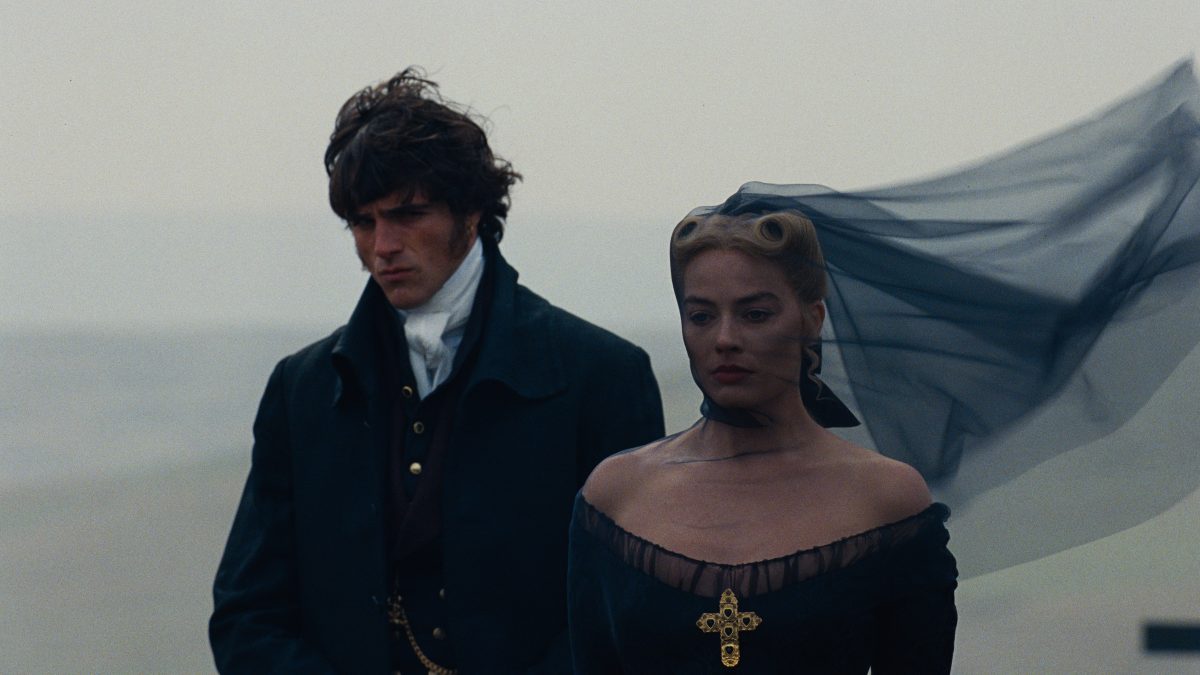
Instead, young Catherine Earnshaw (Charlotte Mellington) has a fraught relationship with her father (Martin Clumes), who takes in a stray boy that her daughter names “Heathcliff” (Owen Cooper). The attraction and friction that exists between these two adopted siblings only grows stronger once an older Catherine (Margot Robbie) and Heathcliff (Jacob Elordi) begin to develop into maturity, despite knowing that social hierarchy will keep them apart.
Fennell’s alterations, whilst done to help condense the film to a suitable length, sand off the edges of what were written to be ethically ambiguous characters. Mr. Earnshaw is such a cruel, hateful figure that it’s hard to imagine how Cathy developed any shades of compassion. Although there’s an initial hint that Heathcliff’s parentage, which has been subjected to intense literary scrutiny, may be revealed, Fennell settles on turning him into a hapless victim whose inner darkness is only inspired as a response to trauma.
Perhaps a decision to make Cathy into a pompous, haughty child of privilege would have given “Wuthering Heights” the outline of a perspective, but Fennell seems unwilling to make her totally ignorant and unable to sell her vindictiveness. This is partially due to casting. Although Fennell seems to pick and choose when she wants to announce time jumps, the 35-year-old Robbie is unconvincing as a teenager who is on the verge of a sexual awakening.
The decision to treat all the characters as instinctive and emotionally unstable could very well be a means of suggesting they are all childish in their own ways, but it makes it harder to determine what sort of developments are occurring. The inauthenticity is particularly glaring when compared to the strong performances by Mellington and Cooper, who are much more sympathetic as the younger Cathy and Heathcliff, respectively.
Also Read: 24 Best Indie Romantic Comedy Movies Of the Century
Elordi’s striking physical presence would seem a more natural fit for Heathcliff, and he’s mostly convincing once the character re-emerges after his heart is spurned. Although it’s conceivable for Elordi to be a cold and ruthless man who amassed an enigmatic fortune, the more primal, animalistic side of the character is too often painted with broad strokes. It’s another case in which Fennell’s “pick and choose” approach to the novel is misappropriated.
While the book’s assumptions about Heathcliff’s motivations are more simplistic because they’re told from the perspective of the untrustworthy housekeeper Nelly Dean (Hong Chau), the film doesn’t take advantage of its ability to grant him more screen time. Being told exclusively from Catherine’s perspective may have also been a bold narrative choice, but Fennell dips into other characters’ points of view whenever it’s convenient to incorporate an instance of sexual depravity.
“Wuthering Heights” is almost aggravatingly haphazard in its opening due to Fennell’s rushed approach to identifying key points of conflict and recurring visual cues that will be iterated on to the point of vexation throughout the rest of the runtime. It’s no coincidence that the film begins to sing once Cathy and Heathcliff are separated. As any romance lover would understand, it’s longing that makes love grow stronger, and it’s particularly critical for characters like Cathy and Heathcliff, who can only deal with their feelings in destructive ways.
The gap not only resets the film’s pacing but also gives Elordi and Robbie the opportunity to revitalize the nonexistent chemistry that they had in the film’s first hour. Fennell, being the rabble-rouser that she is, seems to delight in the fact that neither character has matured when in each other’s absence, and are prone to finding petty grievances.
To describe Fennell as a firebrand storyteller isn’t inaccurate, but it’s also not a put-down. In her debut feature “Promising Young Woman,” Fennell utilized extreme scenarios to advance uncomfortable discussions about consent and victimization. Although her sophomore effort “Saltburn” was rife with narrative uneasiness and blunt thematics, it nonetheless made for an entertaining ride. “Wuthering Heights” is a strange case where the source material has stood the test of time, even if its provocations haven’t.
While Brontë’s overt sensuality may no longer be considered as tactless as it was in 1847, the book still wrestles with complex ideas about abuse, affection, and equity. To distill “Wuthering Heights” to a series of drawn-out sex scenes doesn’t really push the needle in any direction, as it’s hardly the first period drama to be more authentic to actual history. While there could be appeal in seeing two A-listers commit to something truly graphic, “Wuthering Heights” is surprisingly tame, especially when compared to Fennell’s previous work.
“Wuthering Heights” also shows the same blindness to class dimensions as Fennell’s other films, which seemed to treat wealth as a source of bitterness and barbarism, whilst acknowledging that the desire for capital could inspire similar ferocity among the less advantaged. Wealth is a background factor in “Wuthering Heights” because of the unusual power dynamics between Heathcliff and Cathy.
It’s often noted that he is at a disadvantage, but nothing in the film makes the case for this fact. Mr. Earnshaw’s “ownership” of Heathcliff, and how that perspective continues through Cathy, is obliquely mentioned but never fully explored. Similarly, the affluence of the rival Linton family is seen as an inconvenience that doesn’t add any significant tension to Cathy and Heathcliff’s relationship, as they seem capable of tormenting one another without the involvement of separate partners.
Fennell’s relationship with race is also worth addressing, given that any allusions to Heathcliff’s ethnicity in the book are ignored, making the hatred he receives from the Earnshaws less nuanced. Although “Wuthering Heights” is already stuffed without enough ideas, acknowledging Britain’s history of racism may not have been a skeleton key; it’s an unfortunate coincidence that the film’s two most vindictive characters (Edgar and Nelly) are portrayed by actors of color.
Also Related: Top 10 Margot Robbie Performances Ranked
Nonetheless, it is through the introduction of Edgar (Shazad Latif) and Isabella Linton (Alison Oliver) that Fennell’s “Wuthering Heights” becomes more arch and campy, an approach that makes the more melodramatic components more entertaining. When the story comes down to a series of jaded exchanges and sarcastic insults, it’s far more palatable for the performances to be exaggerated to the point of irrelevance.
Fennell is without a doubt hyper-aware of how an audience will react to deliveries and pointed glances, and sets up a comedy of errors that plays effectively for a live crowd. Even if it reaches a point in which any nuances from the novel are long-since departed, Fennell’s “Wuthering Heights” succeeds when it is content to do its own thing.
Latif’s performance is no less of a caricature than that of Elordi or Robbie, but the actor does seem to be comfortable chewing the scenery, given that the most interesting things done by Edgar in the novel take place after Fennell chooses to end her adaptation. Oliver, who is saddled with some unfortunate physical comedy towards the beginning, excels once Isabella’s obsession with Heathcliff becomes more ridiculous, making her the film’s scene-stealer. Unfortunately, the freedom this pair has is not extended to the rest of the cast, even if they can’t be blamed for their underwritten roles.
At 136 minutes, “Wuthering Heights” feels both too sparse to justify its length and only a fraction of the story. It’s not the first “Wuthering Heights” adaptation to ignore the second half of the novel, but the removal of the entire flashback framing device and allusions to a ghostly presence make it all the more disappointing when the structure is so conventional. With that being said, “Wuthering Heights” is rarely boring. Even the most uneventful passages are punctuated by the occasional outrageous symbolism that at least provokes a reaction.
“Wuthering Heights” is not without its virtues, and its technical craftsmanship is itself worthy of being witnessed on the big screen. The costumes aren’t only beautiful, but help to convey things about the characters that are more powerful than dialogue. The score by Anthony Willis is overbearing, but successful in their sweeping epicness, and the original songs by Charli xcx are mostly terrific (“Chains of Love” could very well be an Oscar contender for Best Original Song next year). “Wuthering Heights” is too abrasive to be emotionally involved, yet not brave enough to be completely transgressive. Fennell is entitled to make something anew with “Wuthering Heights,” but what she’s come up with is only grasping at meaning.



![Still Human [2019]: ‘NYAFF’ Review: What it takes to be human?](https://www.highonfilms.com/wp-content/uploads/2019/07/Still-Human-highonfilms-768x512.jpg)

![Somebody’s Darling [2016] : Supernatural Manifestation of Fraternity Culture](https://www.highonfilms.com/wp-content/uploads/2017/12/somebodys-darling-1-1024x576-768x432.jpg)
![Army Of Thieves [2021] Netflix Review – A Bland Prequel To Zack Snyder’s Army Of The Dead](https://www.highonfilms.com/wp-content/uploads/2021/10/Army-of-Thieves_20201112_Unit_11074_R-768x512.jpg)