“Wuthering Heights” is the only published work of Emily Brontë. It was after three years that Charlotte Brontë revealed the author’s real name. In 1847, the novel was published under the name of Elis Bell. Since its publication, it has stirred up much controversy among the readers and the critics. According to D.G.Rosetti, “it is a fiend of a book, an incredible monster”. The strange book consists of two families of the West Yorkshire Moors. The Earnshaws and the Lintons.
The plot is far from being monotonous. It oscillates between generations and narrators. The narrators are Heathcliff’s tenant, Mr. Lockwood, and the maid of the two families, Nelly Dean. The author created a world where readers had to question their morality and ethics in order to sympathise with any of the characters. Brontë questions the marital idea arranged by society. She asks: What is love? How far can one go for love? Where is the line between insanity and cruelty?
Since it is a milestone of classic literature, the novel has inspired numerous film and television adaptations. These range from early English versions such as A. V. Bramble’s “Wuthering Heights” (1920), William Wyler’s Academy Award-winning 1939 adaptation, and Peter Kosminsky’s “Emily Brontë’s Wuthering Heights” (1992), to reinterpretations across many languages: the Hindi films “Hulchul” (1951) by S. K. Ojha and “Dil Diya Dard Liya” (1966) by Abdur Rashid Kardar and Dilip Kumar; Jacques Rivette’s French “Hurlevent” (1985); Luis Buñuel’s Spanish “Abismos de Pasión” (1954); Yoshishige Yoshida’s Japanese “Arashi ga Oka” (1988); and the Filipino film “The Promise” (2007), among many others.
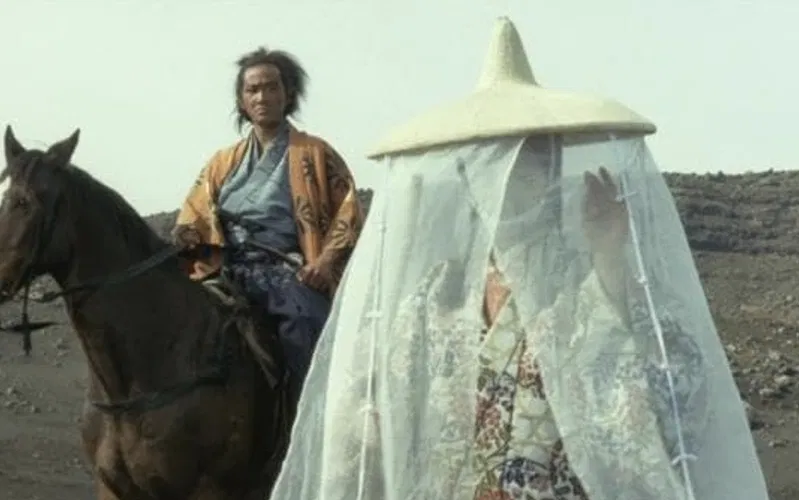
Each of them is an improvised version of how the director interpreted the novel. Somehow, it snatches the Brontean aura away. They either failed to reach the intensity of the original work or exaggerated the narrative. For example, in Wyler’s version, the story concludes after Catherine’s death and shows her ghost and Heathcliff roaming around the Moors. Both Andrea Arnold’s and Timothy Dalton’s movies end with Catherine’s death as well. “Arashi Ga Oka” or “Onimaru” succeded to portray the gruesomeness a little. The Japanese Jidaigeki film takes place in the Muromachi Period. The era setting does justice to Gothic Literature. It showed Onimaru (Heathcliff) played by Yusaku Matsuda, desecrating the grave of Kinu (Catherine) played by Yuko Tanaka, to be with her.
The director portrays the second generation through Onimaru, whose cruelty toward Kinu (Cathy), played by Tomoko Takabe, carries an unsettling sexual undercurrent. Hence, the Japanese culture is sculpted into the novel’s essence. When anyone adapts this novel, they need to realise that the novel is not only about tragic love, but also about revenge. There is a role of fate that etches Catherine and Heathcliff as the star-crossed couple in the history of literature. from the abandoned boy of Liverpool to the owner of the estates, from the boy who kept track of being with Catherine, on almanack, to the boy who hanged Isabella’s dog, Fanny- it is a whole journey.
Catherine is an impulsive character, but her character faces major twists twice in the plot: one when she stays at the Lintons’ and is bedazzled by their wealthy, lavish lifestyle; two, is when Heathcliff leaves Wuthering Heights. No wonder it is an extremely complex plot, where the characters, the generations, timelines, and narrators are intertwined. Even on the crust of the novel, the names of the characters can be confusing for the reader- there is Catherine, Cathy, Heathcliffs, Lintons, and Linton Heathcliff.
Catherine’s death occurs in chapter XVI, which wrecked Heathcliff’s sanity. He takes away all the reasons why readers were sympathising with him. Even the first edition was divided into two volumes, where the first one highlighted Catherine and Heathcliff, and the second one highlighted their next generation. This shows how pivotal the second half is, since Heathcliff’s cruelty is intensified here. , like – treated Isabella like a servant, tortured her psychologically and physically.
Also Check: Where Was Wuthering Heights Filmed? Your 2026 Yorkshire Location Guide
When Isabella taunts him over Catherine’s death, he hurls a knife at her. He then takes revenge on Hindley by encouraging his drinking and stripping him of his money through gambling. Hareton, Hindley’s son and the rightful heir, is deliberately raised as an uneducated brute. His own son, Linton, is treated merely as a tool until the boy’s death, and Cathy is kidnapped and forced into marriage with Linton so that Heathcliff can secure control of Thrushcross Grange. Leaving out these actions in an adaptation risks seriously misleading the audience.
Oscar-winning director of “A Promising Young Woman” (2020), Emerald Fennell, stated that what she directed is not a faithful adaptation of “Wuthering Heights” (1847), but her version of it, because the plot is complicated and difficult. Before discussing anything else, we must pay heed to the maximalist cinematography of the movie created by Linus Sandgren. It perfectly showed the gloomy and tumultuous weather of the Moors, which paid a tribute to the gothic atmosphere. Dilapidated and dingy Wuthering Heights showed the economic state of the Earnshaws, and in contrast to it is their nouveau-riche neighbor Lintons. After Catherine (Margot Robbie) returned from Thrushcross Grange, her costume was visibly changed into gaudy, lavish clothes. Catherine’s hairdo becomes more complicated as she is torn between Linton and Heathcliff, whereas Isabella maintains her simple hair, signifying her simple admiration for a single man, Heathcliff.
The hint of sitophilia was enough to portray not only the subterranean desire but the tug of emotions among the characters. For example, when Heathcliff returned after making a fortune, while dining with the Lintons, there were two tangled lobsters on the table that symbolised the clash between Catherine and Heathcliff. Many more conceits are carefully threaded into the plot to evoke the suffocating atmosphere of Thrushcross Grange. One striking example is the use of a doll’s house, a visual metaphor for the smothering domestic cage Catherine inhabits. Even more unsettling is the covering of Catherine’s bedchamber with a surface that mimics her own skin tone, complete with blue veins and freckles—an image that feels unmistakably Hannibal Lecter–ish.
Everything is very extravagant; the actors did a great job. But following Theseus’s Paradox, if a director replaces the contents of a Novel to adapt it, does that remain the same work? Amidst censoring the main plot, characters, and changing the characters, where is Emily Bronte? Among many things that make “Wuthering Heights” (1847) unique is the yearning. The audience craved for the characters to be unified, but Brontë brutally sets them apart till they die.
Fenell messed with this important part and united them physically. She laced the plot with sadomasochism, clandestine sex, and, as I mentioned before, sitophilia. Brontë provided two narrators, which made the plot even more intricate. Mr. Lockwood and Nelly Dean both narrate the story, and it is affected by their personal preferences. Fenell debarred Mr. Lockwood, which messes with the audience’s perspective.
To conclude, I will repeat, as an admirer of “Wuthering Heights” (1847) and a movie buff, its adaptations do not do justice to it. While I discussed this point, referring to other works, the major focus here is on recent work by Emerald Fenell. The novel does not define hate, love, obsession, or revenge. It is totally upto the audience how they decide to fill the silence. In the future, maybe there will be more adaptations, and they’ll be the versions of the directors. As an audience member, I eagerly wait to see when someone actually portrays Emily Brontë’s version on screen.