Some cousins share a face but speak different languages. They recognize each other at family reunions, yet their lives forked decades ago. That’s the relationship between Rahul Sadasivan’s “Dies Irae” and Alfred Hitchcock’s “Psycho.” Both films start with a dead woman and end with a bedroom whisper. Both trap their men in houses that remember too much. But one ghost speaks Malayalam; the other mutters in Freud. Two films, separated by oceans and decades, share a haunted blueprint. One is a cornerstone of American cinema. The other is a ghost story from Kerala. But dig into their soil, and you find the same roots: guilt, obsession, and a mother’s love gone rotten.
The Wrong Object in the Wrong House
Both stories begin with a transgression. In “Psycho,” Marion Crane steals money. Her crime is financial. In “Dies Irae,” Rohan ghosts a lover, Kani, and pockets a red hair clip from her room while paying a visit after her death. His crime is emotional, but it’s his material theft that leads to an unraveling. All these actions seem small at first. But they lure our protagonists into the wrong house.
For Marion, it’s the Bates Motel. For Rohan, it’s his own modern mansion, which becomes a cage. The architecture turns predatory. Norman Bates’s Gothic home looms over the motel, a physical manifestation of his split mind. Rohan’s sleek house, with its vast spaces, becomes just as claustrophobic. The horror enters through everyday rituals. Suddenly, the safest spaces are the most dangerous. The real narrative trick, however, is the bait-and-switch.
We think we know the ghost. “Psycho” makes us fear Norman’s mother. “Dies Irae” makes us fear Kani’s vengeful spirit. We are wrong both times. Well, for the most part. The famous shower scene murders our initial protagonist. Similarly, “Dies Irae” pivots with a chilling revelation. The spirit is Manu, a dying loner obsessed with Kani. This reframes every prior scare. The fingers stroking Rohan’s hair were not Kani’s loving touch but Manu’s imitation.
Manu’s ghost wears Kani’s ghungrus. The anklets jingle when he moves. This sound becomes the film’s Bernard Herrmann score—a non-verbal character that announces presence. Rohan hears it while eating ice cream. The tub lid flies off, and something chokes him. What he feels is not Kani’s touch but rather Manu’s obsessive love attempting to mimic Kani’s gestures. Manu studied Kani so completely that he became her.
Like Norman, who absorbed his mother’s identity, Rohan is tormented by a ghost that has absorbed Kani’s identity. Who then is the true protagonist of the films? “Psycho” changes focus from Marion to Norman. “Dies Irae” does not change focus to Manu, but Manu is the driving force behind the haunting of Rohan. At least in this part of the movie, the focus stays with Rohan.
But the haunting force is Manu’s displaced desire. The films are spiritual cousins in this structural deceit. They use a woman’s death to explore the living men left tangled in her absence. One uses psychology. The other uses folklore. But they arrive at the same terrifying question: who is the monster here? The answer is never simple. This blurry line between victim and villain leads us directly to the heart of the horror: the mother.
Mothers, Monsters, and the Prisons We Keep
If guilt is the engine, then the mother is the locked door. Here, the kinship deepens. Norman Bates and Manu are both created by a suffocating maternal bond. Norman preserves his mother’s corpse. He speaks in her voice. He becomes her. Manu’s mother, Elsamma, performs a different kind of preservation. She keeps his decaying body in their home. She takes Kani’s possessions for him and supports his delusion long after he took his last breath. Her statement is a haunting echo of the theme. “I didn’t even give him to God; how would I allow you to take him away?” she tells Rohan.
Both mothers create “private traps.” They operate within it. Norman cannot escape the house on the hill. Manu cannot escape his soul from the anklet tied to his corpse. Their mothers are the wardens but also fellow inmates. This is a shift from the supernatural to the intensely personal horror. The horror is no longer a jump scare, but the love that cannot release someone, even when it should. Elsamma is a tragic, frightening figure. In American cinema, we’ve seen this in “Hereditary,” another film about a mother’s grief conjuring up a monster. The theme is universal, but the expression is cultural.
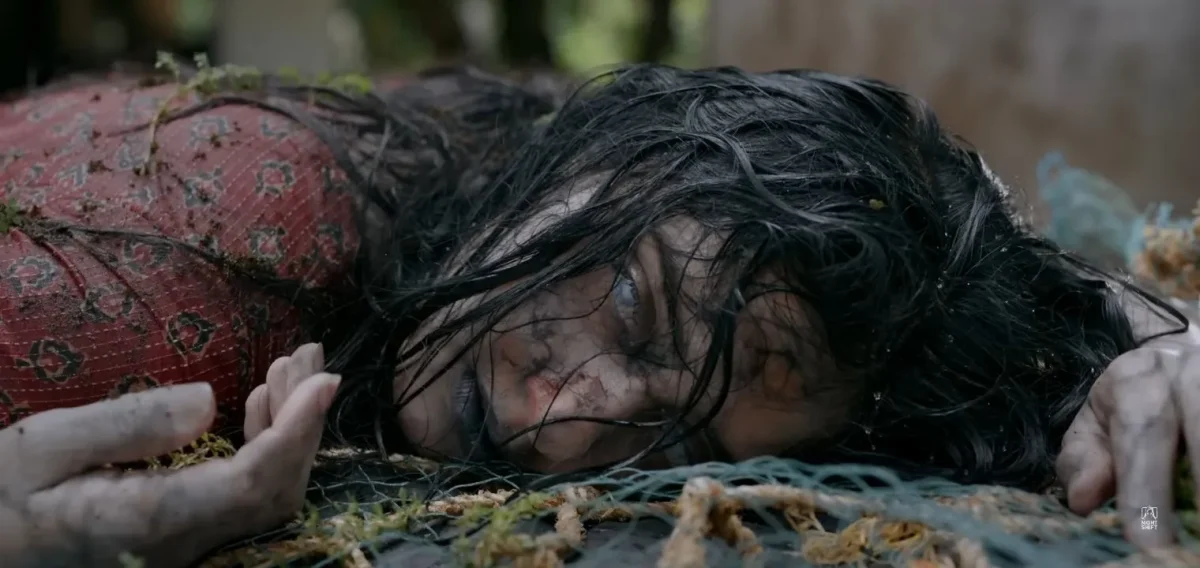
“Psycho” explains Norman through Freud—Oedipus, repression, the id. “Dies Irae” explains Manu through the pathinaru, the 16-day mourning period where souls linger. This is where it diverges from Psycho’s clinical Freudian analysis. Hitchcock gives us a psychiatrist’s monologue to explain Norman. Sadasivan gives us Madhu, who speaks of souls clinging to favorite things. One framework is scientific. The other is spiritual. Both are valid maps for the same terrifying territory: a broken human mind. The finale confirms this divergence. “Psycho” ends with Norman’s internalized ghost staring back at us. “Dies Irae” ends with a more literal, lingering haunt.
The Ghost That Remains
Both films weaponize domestic space – the shower, bedroom, and kitchen sink. Horror happens where you brush your teeth. That’s the Hitchcock rule, and “Dies Irae” follows it to the letter. When Rohan burns the anklets, the spirit disappears through the roof, and the fire spreads, incinerating the body. It’s a violent and cathartic image, and yet, the hair clip remains. The past still holds onto Rohan. He hears a click. The red hair clip is back on his bed. A female voice whispers his name, “Rohan.” This final twist is the film’s refusal to conclude.
It implies that Kani’s ghost was present all along. It was just silently witnessing Manu’s violent imitation. The haunting is layered. Guilt is never isolated to a single source. This final ambiguity is the film’s greatest kinship. Hitchcock taught us that monsters never disappear. They wait. Sadasivan learned the lesson. The ghost is not vanquished; it is simply waiting for the next haunting.
Then how does this Malayali cousin fare against the iconic original? Well, it doesn’t need to compete. “Psycho” is a sharp, sudden knife. “Dies Irae” is a slow, smoldering fire. One redefined cinema, revolutionized it with editing and psychology. The other weaves a rich tapestry of sound and folklore. Both prove that the best horror lives in the familiar—a motel, a bedroom, a mother’s love. They show us the real phantom is the guilt we carry and the history we refuse to bury.