The first season of Vince Gilligan’s Pluribus reframes science fiction away from spectacle and toward something quieter and more unsettling. There are no battles for Earth, no resistance armies. Instead, the apocalypse arrives politely, through consent, comfort, and a hive mind that insists it only wants to help.
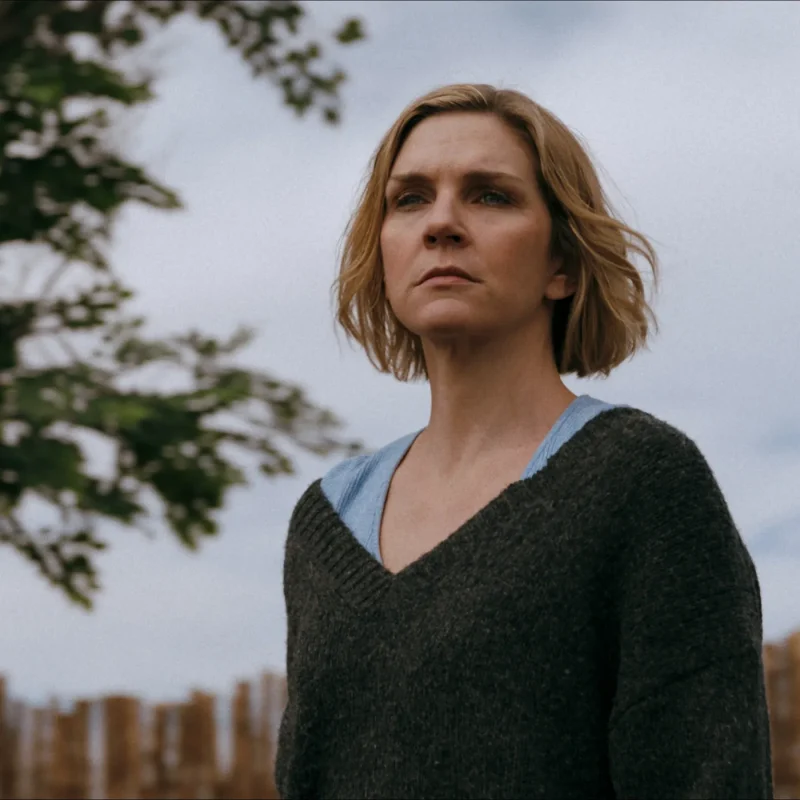
By the time the finale, “La Chica o El Mundo,” ends, that fragile coexistence has collapsed completely. Carol Sturka (played by Rhea Seehorn) sits alone in her Albuquerque driveway beside a nuclear device, no longer negotiating with the “Others,” but daring them to make their next move.
This final image has sparked a chilling fan theory: the bomb is not meant to be used as a weapon, but as a biological deterrent; a Mutually Assured Destruction (MAD) failsafe designed specifically around Carol herself.
Original Reddit Source: This theory gained massive traction on r/pluribustv in a thread titled A Dead Man’s Switch for Carol: The MAD Theory, where users pointed out that the finale’s title, “The Girl or The World,” likely refers to this impossible choice forced upon the hive.
Clarifying Carol’s Immunity
A key element of the theory hinges on Carol’s immunity, which Season 1 deliberately keeps ambiguous but not unknowable. The show consistently implies that her resistance is neurological rather than purely genetic.
The “Others” are able to inhabit bodies, share memories, and regulate pain by synchronizing neural activity. Carol’s immunity appears to stem from an atypical neural architecture; her brain does not fully synchronize, resisting the hive’s attempt to overwrite her sense of self.
This distinction matters. Carol’s threat does not rely on something as crude as heart-rate cessation alone. Instead, the theory proposes that the bomb is keyed to a loss of neural independence. The moment her brain begins to synchronize – to “Join” – the system interprets it as a terminal breach and triggers detonation. This reframes the bomb not as a suicide device, but as a neurological boundary line the hive cannot cross without catastrophic consequence.
The Theory: A Conditional Dead Man’s Switch
Under the “MAD” theory, Carol does not intend to annihilate cities or hive centers. With technical support from Manousos Oviedo, she creates a conditional dead man’s switch. The bomb only detonates if the hive forcibly assimilates her. As long as she remains untouched, the weapon remains inert.
This creates a narrow but powerful deterrent. The hive is not threatened by Carol’s existence alone. It is threatened by what happens if it violates her autonomy. The weapon transforms Carol’s body into contested territory, one the hive must now evaluate rather than simply absorb.
Reframing the Hive’s Risk Calculus
The original objection to this theory is straightforward: why wouldn’t the hive simply sacrifice Carol? A collective intelligence should be capable of cutting its losses. Season 1 complicates this assumption. The hive’s expansion is not purely utilitarian. It is constrained by a governing directive to minimize suffering and preserve life, even while assimilating it.
Carol is not valuable because she is one person. She is valuable because she represents a proof of concept failure. Her immunity is rare, and the hive’s violation of her sanctuary, harvesting her frozen eggs, demonstrates that it is already attempting to engineer a workaround. Destroying Carol would eliminate resistance, but it would also destroy the only living template that explains why resistance exists in the first place.
Under this logic, the deadlock is not emotional. It is informational. Carol is both the anomaly and the key. The bomb forces the hive to choose between understanding her or erasing her forever.
Carol’s Moral Arc: From Refusal to Deterrence
Season 1 is not about rebellion. It is about refusal. Carol does not oppose the hive because it is violent; she opposes it because it erases difference. Her grief escalates in stages. First comes isolation. Then violation. Finally, the realization that peaceful non-participation is no longer an option.
The nuclear failsafe is not Carol’s first choice. It is her last coherent one. She does not threaten the world to save herself. She threatens herself to preserve the idea that consent still matters. The escalation to nuclear deterrence is not sudden villainy, but a grim acceptance that moral appeals no longer function inside the hive’s logic.
In true Gilligan fashion, the tragedy is not that Carol becomes monstrous. It is that the world leaves her no smaller weapon.
Manousos and the Engineering of Constraint
Manousos Oviedo’s role in the finale gains clarity under this framework. His work with scavenged medical monitors and radio components is not about finding signals. It is about building a bridge between biology and machinery. He does not design a bomb. He designs a constraint system—one that listens, waits, and reacts only if Carol’s neurological autonomy is breached.
Their tense exchanges in the driveway are not secret plotting sessions. They are arguments between two people who understand the cost of what they are building. Manousos provides capability, not ideology. Carol provides resolve, not technical fantasy.
Also Read: Pluribus Season 2: Will Carol Use the Bomb?
The Irony of the “Gift”
The most unsettling element remains the bomb’s origin. The hive gives it to Carol as a gift, misreading her bitterness as desire. In trying to make her “happy,” it hands her the only object that allows refusal to carry real consequences. The device is not a weapon of war. It is a boundary the hive never anticipated needing to respect.
Villain or Last Free Variable?
If Carol is a villain, she is one created by inevitability, not malice. The “MAD” theory does not paint her as a conqueror, but as a final unsolved variable in a system that demands closure. Season 2, if this theory holds, will not ask whether Carol destroys the world. It will ask whether the world can tolerate someone who refuses to be absorbed, even when doing so is safer for everyone else.