There’s a recurring question that has, for decades, made the rounds as a decent piece of geography-based observational humour: Have you ever noticed that Iceland is mostly green, and Greenland is mostly ice? It resonates because it’s true—at least insofar as most of us, who never have and likely never will step foot in either country, can tell based on secondhand evidence—but what lies beneath the harmless gag is a more sobering reality about at least one of those two nations: It wasn’t always this way.
This much is addressed rather directly by Icelandic writer and activist Andri Snær Magnason who, at a climactic moment in Sara Dosa’s “Time and Water,” lays out the question in more solemn terms: “In 200 years, will saying my country’s name also summon a ghost?” It’s a question that haunts Andri as he goes about immortalizing the history of his family and his homeland on video, because for all the majesty of the glaciers that populate his island country, time can’t stay frozen under ice forever.
This isn’t, however, for a lack of trying on Andri’s part, as the writer has put his conservational efforts into just about every field he could touch—from literature, to documentary production, to an unsuccessful bid at the Icelandic presidency in 2016. “Time and Water” doesn’t cover these areas of Andri’s life (at least not in any detail), instead relegating itself almost entirely to the compilation of footage Andri himself had amassed as he decided, years ago, that the fickle nature of time and aging requires a more proactive effort to eternalize the sort of familial warmth that complements the elegance of Iceland’s environment rather than melting it.
The result is a documentary very much in the vein of Dosa’s breakout “Fire of Love,” and one that is subject to many of the same virtues and setbacks. With these two films, the documentarian has illustrated a consistent, almost Herzogian interest in juxtaposing the intimacy of the human soul with the intimidating sprawl of the natural world surrounding it.
And this is before even considering the fact that Dosa made a documentary on the exact same subject as Herzog, in the very same year, and somehow completely overshadowed the legend in the process. Dosa’s approach, of course, is one that runs far more sentimentally, and one which proves, unfortunately, ineffective in drawing the sort of seismic emotional impact that makes ice and lava flow in equal measure.
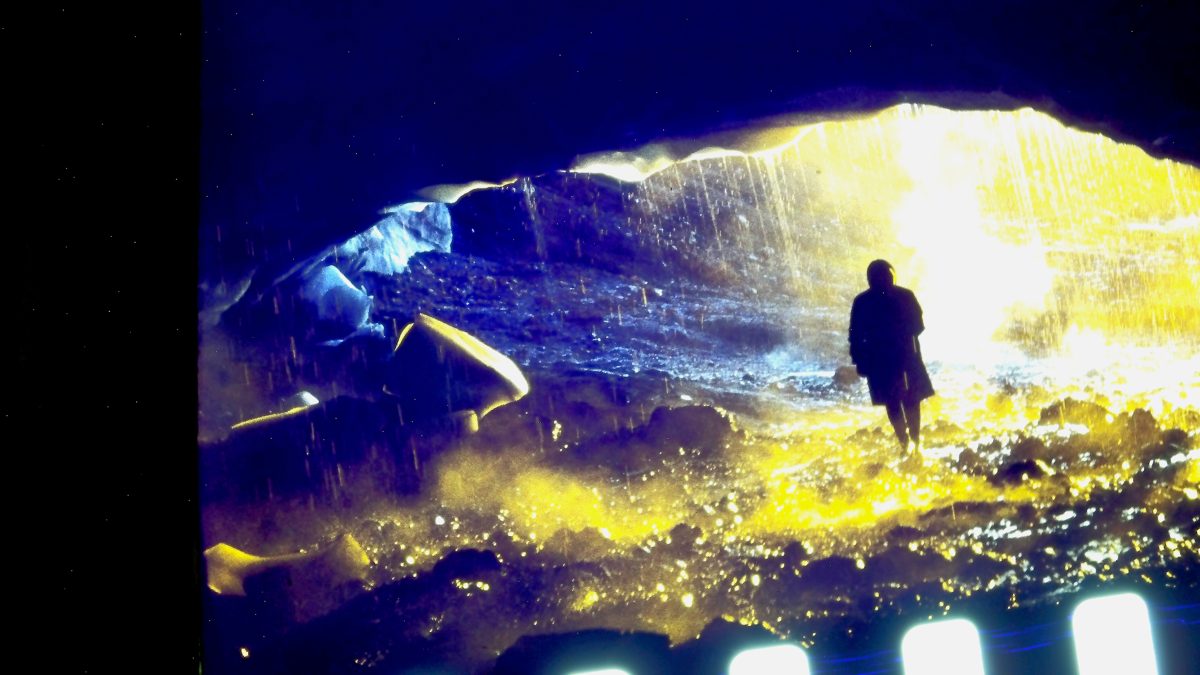
Unlike her previous documentary, Dosa is working with the advantage that her subject is still with us, a reality of which she takes complete advantage with Andri’s continuous narration across the totality of the film. “Time and Water” presents itself as being just as much about the fall of Iceland’s glacial splendour as it is about the slow decay and consequent preservation of his own aging family, but Andri’s repetitive and mostly surface-level platitudes fail to reconcile these two elements into a poetic whole that highlights their purported symbiosis.
Andri is essentially working off one admittedly solid metaphor: the preservation of Iceland’s history (and by virtue, that of his family and their roots) within the glaciers being melted by the unfeeling onslaught of climate change. That one of the central emotional peaks of the film comes with Andri’s writing of a eulogy for OK Glacier, the first glacier to ever be declared dead due to the irreversible recession of its frozen layers, speaks to the closeness with which he regards this interlocking relationship between man and nature on the most personal of levels.
In praxis, though, “Time and Water” spends far too much time merely rewording and reiterating this metaphor of “time trapped in ice” alongside the sombrely awe-inspiring imagery of Icelandic landscapes melting away, and Dosa is more than happy to indulge in this redundancy with every schmaltzy tendency turned up to an 11. The endless droning of Dan Deacon’s ethereal score almost melts itself through the speakers, begging you to feel overwhelmed as you drown in the melancholic majesty onscreen.
To be sure, Dosa makes use of the footage with which Andri has entrusted her—the intermingling edits between 35mm footage of his parents on glacial expeditions, the fuzzy home video footage he captured in the 2000s, and the high-grade, National Geographic-budgeted footage of the melting glaciers captured firsthand, comes closest to capturing this expressed desire of intertwining nature and ephemerality that Andri’s voiceover persistently asserts.
But as the depth of these assertions reaches little more than merely repeating the word “time” what feels like once every five minutes, Andri’s testaments to the enshrining power of ice fortified by thousands of years and washed away in a few dozen fail to reach their own desired mode of canonization.
Across “Time and Water,” Andri speaks of preserving this time capsule “for you,” and across the runtime, neither he nor Dosa ever make it explicitly clear who exactly is being addressed: Andri’s children, we viewers, or more likely, all of the above. And while his eventual commemorative plaque for the fallen OK Glacier does give a poignantly chilling indication of the collective responsibility that lies at the heart of the observer, the most we manage to see when Andri tells us to look at the history in this ice is the hypnotic but transparent crystalline distortion of whatever lies on the other side.





![The Rental [2020] Review – Voyeurism and Paranoia abound Dave Franco’s directorial debut](https://www.highonfilms.com/wp-content/uploads/2020/07/The-Rental-Movie-Review-highonfilms-768x432.jpg)
![Eternal Spring [2022] Review: Recreation of an Harrowing event of Censorship & Persecution](https://www.highonfilms.com/wp-content/uploads/2022/05/Eternal-Spring-2022-768x431.jpg)