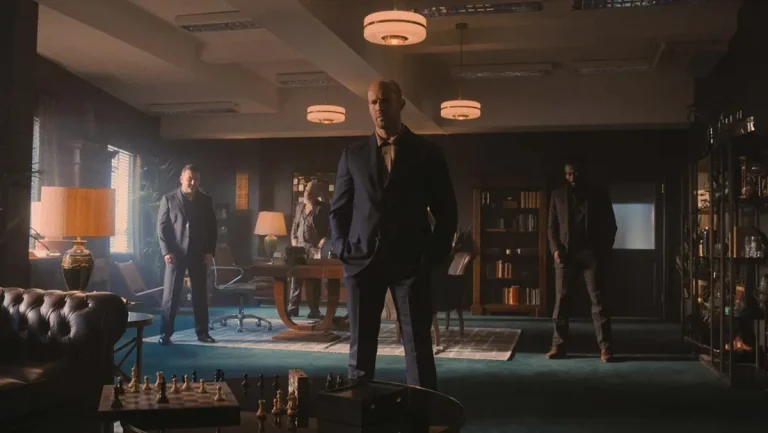
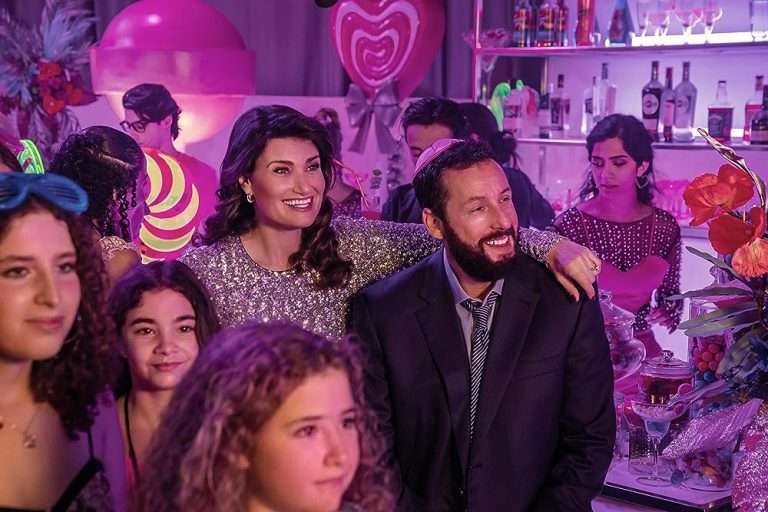
Celine Song’s “Materialists” opens with a call to prehistoric times: a fictive “caveman” reenactment of the first marriage ever, and caricaturizes the primitive to critique the present. In darker corners of our dating-culture zeitgeist, primal tendencies are often positioned as a basis for modern behavior, especially as the case in manosphere podcast circles, where it’s used to justify misogyny in the name of tradition. The opening scene is a tongue-in-cheek nod to this phenomenon, twisted on its head. This is followed by Lucy chatting with Daisy about her client, Sophie, who fares “okay” across criteria such as appearance and profession, but fails to stand out as a “niche” or be deemed a high-performer and therefore ineligible to tap into an exclusive dating pool.
Lucy is clinical in this appraisal, which establishes that, in the realm of matchmaking, people are commodified as products or service providers. This is not a groundbreaking practice limited to elite matchmaking; we peacock our resumés for a highly selective job market, parading skills, strengths, and certificates like products to prove we’re a good “fit”.
Lucy is later called upon to thaw out the cold feet of her other client, bride-to-be Charlotte, on her wedding day. Lucy extracts the source of Charlotte’s innermost fears and desires without judgment, and likens marriage to a business deal: something that can be walked out of. Then the seed was sown: I couldn’t resist interpreting this moment from my Indian perspective, an act of processing information that felt instinctive. What specificates this scene to the South Asian experience is its sharp contrast with the cultural norm of the arranged marriage, where this emergency exit may rather be the exception than the rule.
I know a woman whose husband refuses to consent to divorce despite years of inflicting violence upon her. She is financially independent as well as the primary caretaker of her children. He refuses to let her go of him, and despite filing a restraining order against him, he has broken into her (separate) home, nearly endangering her life and causing severe physical injuries. This is a man who has pushed his pregnant wife down a flight of stairs. Despite the evidence, her trips to the courtroom have proven futile and have trapped her in a legal limbo. Lucy’s advice, as well-intentioned as it is, would be moot here because many of these women have no avenue for walking away.
My family background is complex: my parents’ marriage is the result of an elopement. My father’s family was relatively open-minded and accepting of any partner he would have chosen for himself. My mother’s family was violent and abusive, and being the only daughter of the household, she was pressured constantly, even when she entered the workforce, to succumb to an arranged marriage.
My parents met at work, and despite their differing ethnic, financial, and social backgrounds, they found common ground in each other. I’ll be the first to admit: their relationship was as flawed as any, and I still don’t view it with rose-colored glasses, no matter how cinematic the origin story sounds, but I appreciate the courage it must have taken them to fight for their right to choose their partner and face the forthcoming music.
Also Read: Materialists (2025) Movie Review: Classic Rom-Com Tropes Unravel To Reveal the Cynicism of Modern Dating
If I ever choose to marry, my parents have made it clear that it should be a partner of my choice, and that race, caste, class, faith, nationality, sex or gender, skin color, etc. would never be a part of the conversation. Imagine my shock when a family friend—who I naïvely believed held similar views—expressed her unsolicited opinion that it would be okay for me to “marry a woman, but not a Muslim”. I initially thought it was her ill-thought-out attempt at cracking a “joke”, but giving her even that much credit would be ascribing too much intelligence, and she was dead serious.
You could easily find an older lady from half a century ago, a woman from two decades ago, and a young girl today, and it wouldn’t be unusual for all of them to share the anecdote that their parents insisted they were married once they were considered of age, with little choice in the matter. Marriage was never a requirement in my house, and it always remained a question of “if” and not “when”, but my parents insisted that I should be educated, financially literate, and most of all, happy. I learned that even as times changed, this was still not the reality for many of my peers across economic and social classes, and it feels like culture shock in a familiar land.
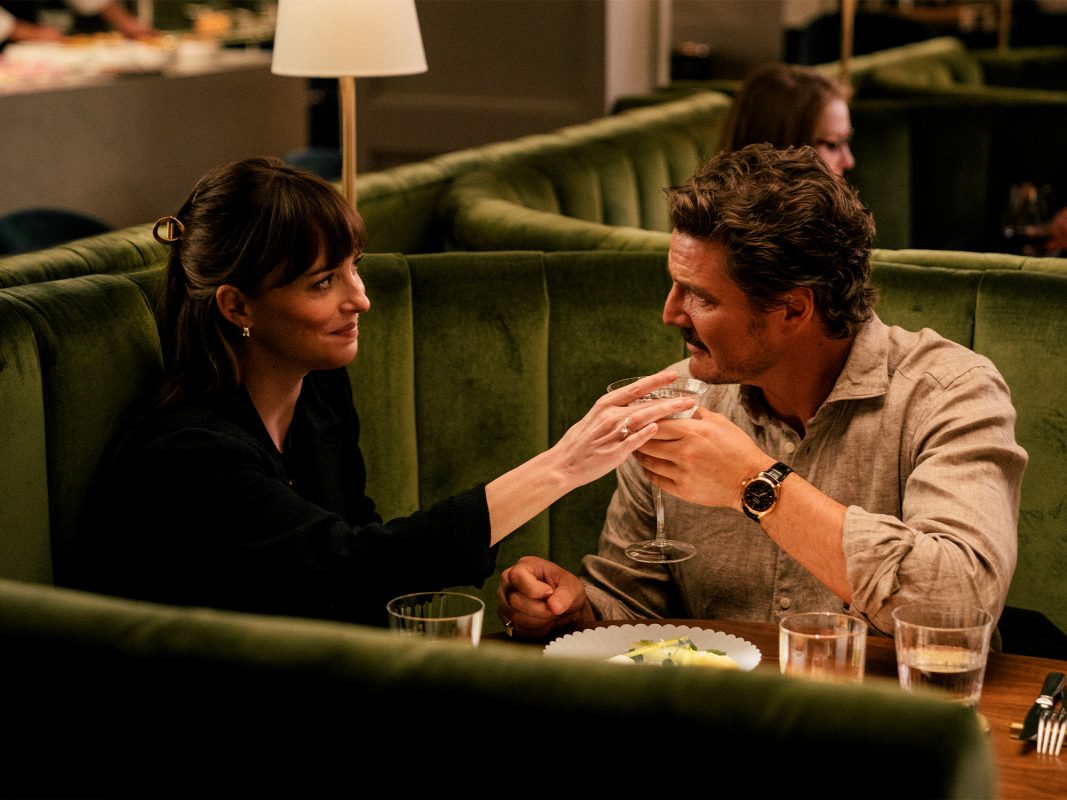
In “Materialists,” Lucy, seated with Harry, says she’d like a Coke and a beer, and like magic, she is instantly served this strange combination by her ex-boyfriend, John. Despite the posh setting and company of the venue, she doesn’t opt for a more suitable beverage like champagne or wine, a choice that’s a device for cheeky foreshadowing. Coke and beer, both in their own right, are everyday, casual, comfortable, familiar beverages. Wine and champagne, on the other hand, are special, occasional, celebratory, but come with a high price tag. Vis-à-vis the controversial ending, this was the hint that the Coke was destined to pair with the beer, not the champagne.
Lucy explains to John that the semblance of a happy family is a major factor for a successful match. In the arranged marriage system, not only are the bride and groom evaluated for their individual characteristics like income, age, or even the shade of their skin, but also their overall family background. In particular, caste-based discrimination is still largely open and prevalent, as evidenced by the gross normalization of stating it as one of the criteria during the search.
Harry asks Lucy to evaluate him from the perspective of a mortician or insurance claims adjuster, riffing off of the quip she made about her profession earlier, and is deemed “perfect” and a “10 out of 10” by her scale. His line of questioning proves he is willing to be seen as a liability instead of an asset, unlike her other clients. This is what truly makes him a “unicorn”.
Harry nudges at the opening scene when he claims that she perceives him as “smart”, but talks to him like a “caveman”, as if he is bound to primality beyond his control. Their conversation refreshingly portrays dowry as a comically outdated practice, relegated to the past. This transitions into the knife-in-the-gut moment: Lucy’s boss, Violet, informs her of Sophie’s assault by Mark P. Violet claims there is no way a matchmaker can account for how someone will behave in an intimate setting. Now, consider the potential aftermath of a disastrous arranged marriage scenario: your parents, relatives, neighbors, and their dog chose your partner for you, but they have no idea how your spouse will behave with you behind closed doors.
Deception is possible even in love marriages, but the closest you’ll get to knowing a person’s character intimately is if you’ve experienced long-term, uncontracted cohabitation with them. You’ll have access to glean more insights into their behavioral patterns, reactions to stimuli, and value (mis)alignments, which is arguably more revealing than a 2-hour living-room congregation with their parents or their matrimonial website profile. How is one to gauge the compatibility of a partner if the concept of a “live-in” relationship is, frustratingly, still frowned upon?
Everything stacks up: When marital rape still isn’t considered a punishable offence, but ironically, a spouse denying sexual intimacy is grounds for cruelty… marriage becomes a treacherous, labyrinthine affair. My non-South Asian friend once casually glorified the arranged marriage system by correlating it with India’s record-low divorce rates, but when you put two and two together, you realize this is because of the societal stigma of spousal separation, strategically inflicted upon women to wield control. Society assumes the role of default matchmaker, but washes its hands off any accountability over the consequences, much like Lucy’s boss.

Related: Materialists (2025) Movie Ending Explained & Themes Analyzed: Do Lucy and John Have a Happy Ending?
Lucy wears the same necklace twice, once at the wedding and again at John’s play: an indication that she isn’t as wealthy as her clientele, but makes efforts to indicate otherwise. There’s a noticeable difference in Harry and John’s handshake: the former is firm and steady, whereas the latter is loose and swinging, contrasting their poise and stature in life. Harry displays an intrinsic sense of security when he doesn’t once glance suspiciously towards Lucy, who is speaking with her ex. Conversely, secure is not a state John can elicit in Lucy. She bravely admits to John that he is the better actor between them, but he whittles down matchmaking to “just dating”, which stings because it goes against what Lucy primarily seeks: feeling valuable.
It does, however, lead to a turning point: Lucy now pushes back against unreasonable clients. This fire is further kindled during Lucy’s contentious phone call with Sophie, who claims that she feels like she’s been working for Lucy this whole time, not the other way around. This lines up because the word choice at Adore is always “recruiting” clients, never being “hired” by them.
Sophie concludes this scathing appraisal by stating, “I am not merchandise”, a callback to the film’s motif of self-commodification in dating culture. Lucy’s world unravels from here. One evening, she traces the scar on Harry’s leg as he’s asleep. He is awoken immediately and withdraws from her. Harry has barely had any lines for a while, but his words now uncover a hidden reality: his height was a façade because the scar is the result of elongation surgery.
He justifies his choice by expressing that now he’s just “worth more”. The camerawork follows suit, witnessed by the shift of perspective in this kitchen scene as Dakota is framed to appear taller than Pedro in almost every angle. Ironically, in this moment, John’s value increases. No, not because he might have been taller than Harry. It’s because he’s always been honest about who he is, warts and all.
His openness about his flaws lends the upper hand to Lucy, who once chose to leave him, in line with her adage to Charlotte about walking away, and having access to the truth grants her the informed agency to do so again, or choose to stay. Even though symbols of “worth” can be bought, no amount of money can replace one’s idea of inherent worth, something all three, Harry, John, and Lucy, lack to differing measures.
Lucy’s encounters continue to flip her original beliefs on their head. John receives a stipend from his play and feels “rich”. They crash a wedding and jokingly voice over the “giving away of the bride” as a delivery service. Lucy makes a statement along the lines of: “Just because you can afford it doesn’t mean it’s worth having”.
The film arrives at the thesis that in a relationship, effort is the true “value”, and the asset with the highest pay-off. The impending question, left open at the end, is: will Lucy and John continue to make this investment? Materialists’ ending sequence bookends the film neatly by circling back to where it all began: caveman lovers declaring their betrothal with flower rings. Lucy tells John that she dreamt of the “first marriage”, and serendipitously, John proposes to her with a flower.
Somewhere along the way, my brain stopped analyzing the film from my South Asian perspective. I think it’s because the questions we ask: about our worth, our place in the world, and our connection to each other, are universal, and when distilled to their purest form, are acultural. The most granular level of my conclusion, is that the negotiations we make regarding our worth with the world are meaningless, because the true binder and only currency of human connection is effort, and this applies not only to romantic relationships, but to platonic and parent-child ones, and even the bond you have with that little plant growing in your garden that you make the effort to water every single day.