
Olive Nwosu’s debut feature, “Lady,” opens with a shot of a young girl walking through the narrow spaces between tightly-packed dwellings near water. She steps into one of the houses to notice something that no child should ever have to witness. The camera doesn’t show what she sees and remains focused on her face for a few seconds. Yet, it reveals all there is to know about the traumatizing nature of this brutal incident that may haunt her for her whole life.
Nwosu, who wrote and directed the film, uses similar reaction shots throughout its duration to highlight individual worldviews of her female characters, who simultaneously mirror the socio-economic tumult in the country and its roots. Through their deeply personal accounts, Nwosu analyzes the cultural discourse in Nigeria while following their intersecting tales of liberation.
Her script, however, doesn’t lean on the extremes that Western filmmakers tend to exploit, where they use a foreign landscape simply as a playground for their reductive genre exercises. She doesn’t see this world through rose-tinted glasses either and criticizes it for all its flaws. Yet, unlike the usual depictions that make it seem like these conflicts happen in a vacuum, she places the blame where it’s due, underlining how appeasing foreign influences for personal gain affects the economy. Besides that, she confronts the authorities even in everyday moments in the script.
In one of its early scenes, a character returns to a place she had left many years ago, only to notice a tragic pace of evolution, and comments on it with a touch of sadness while trying to bridge the emotional gap between herself and the woman she meets. It’s these little moments at the intersection of personal and political that make “Lady” transcend beyond its narrative scope.
While expressing justified anger toward the authorities, the script adds a few layers of political discourse, even if parsing it through a personal lens. The central character, Lady (played by Jessica Gabriel’s Ujah), becomes our eyes and ears through a tale of sisterhood and solidarity set in the bustling streets of Lagos.
She appears confident, self-reliant, and un intimidated while driving through its crowded city or speaking with a group of men who ask her about the country’s political unrest. They sound more informed but not as driven as Lady, who remains committed to her ambitious pursuit. She invests her time in her work as a cab driver, gradually working her way toward a hopeful future.
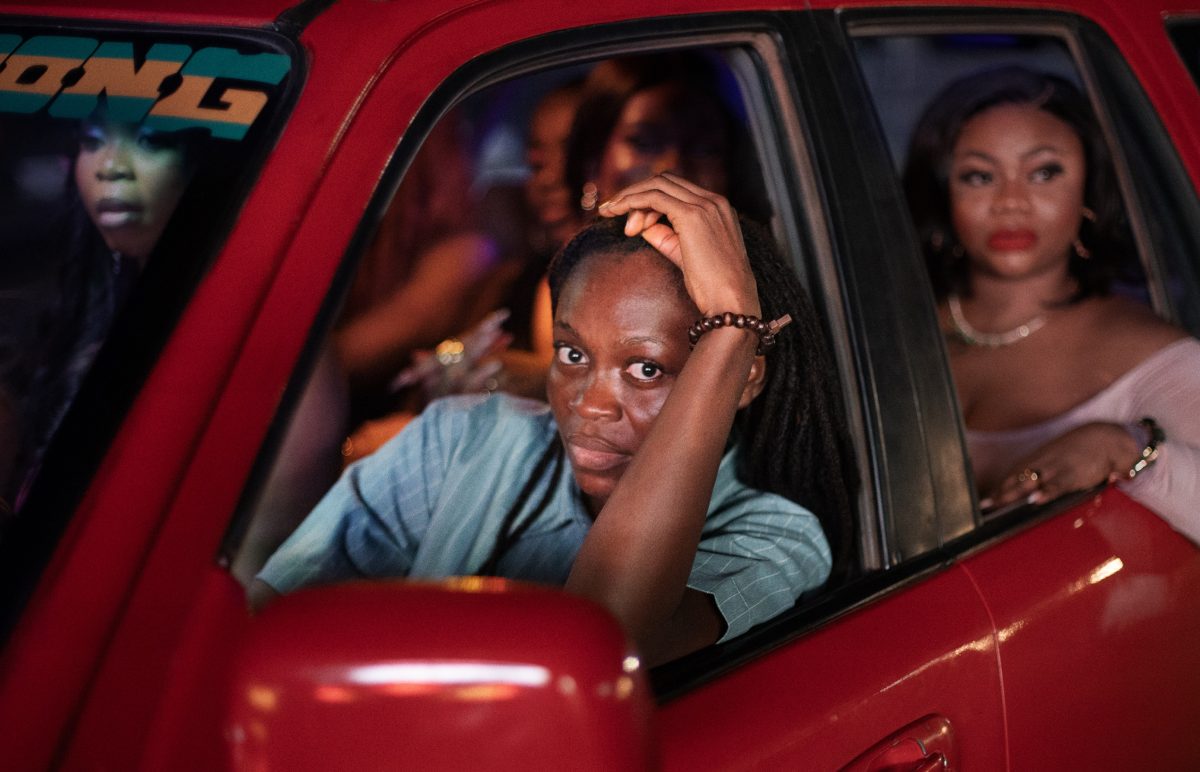
Soon, she lands another job where she needs to drive a group of women around the city at night. During their interactions, she seems unlike any of those sex workers. They seem brash and full of life, whereas she appears stoic, almost as if she is considering how her reaction would translate at any given minute. She doesn’t seem hopeful about any constructive change in the country and is critical of the system, but doesn’t let her ideological acumen affect her eagle-eyed focus.
In a later scene, she joins these women in a free-wheeling conversation about the place they desire to settle in. While it could have been a cloying scene about escaping their dreadful present with a faux-aspirational tone, the script presents it with all its complexities while offering a closer look into their psyche. It respects the pleasing dreaminess of their musings but also reveals the darker roots of those desires through distinct points of view.
Despite following the tale through Lady’s eyes, the script presents other perspectives with just as much detail, which offers a more layered understanding of what it might be like to live as a woman in this relentless city. Lady’s character is so thoughtfully rendered that we can vividly recall how she felt at every point of transition in her transformative journey, even days after watching the film.
Jessica Gabriel’s Ujah’s earnest performance is central to that lasting resonance, capturing all its thematic details with restraint. Nwosu’s directorial approach is just as necessary in building tonal contrasts—between light and bleak, quiet and chaos, hope and despair—to chart Lady’s personal evolution through her internal struggle between self-preservation and self-determination. It captures her strength and resilience while addressing all her life’s choices with due compassion.
Besides, the film also addresses gloomier aspects of their reality as women doing what they can to survive in those spaces, while surrounded by a world largely catering to a male gaze. Yet, the script is rarely didactic. Most of its critique appears organically in its neatly-plotted script, leaving you with a pang, while leading to a well-meaning call to action.
Eventually, after packing her film with plenty of depth and nuance, Nwosu ends it with a fittingly powerful note, backed by a cleverly chosen, punchy, vibrant track from a rapper who has also gone through a similar transformational journey. It also belongs to an album where she documents it in a similarly introspective lens and surgical detail. It’s a powerful note to bookend this poignant ride that faithfully presents the ebb and flow of this city without losing grip of its potent subtext.



![Choked [2020] Netflix Review – A tale of a crumbling marriage crushed by a socio-political metaphor](https://www.highonfilms.com/wp-content/uploads/2020/06/Choked-highonfilms-768x432.jpg)

![Mad God [2021]: ‘Locarno’ Review – A Bizarre, Surrealist Cinematic Experience](https://www.highonfilms.com/wp-content/uploads/2021/08/Mad-God-768x576.jpg)

![Paulie Go! [2022] Review – An Incredibly Entertaining Coming-of-Age Comedy](https://www.highonfilms.com/wp-content/uploads/2022/05/Paulie-Go-2022-768x431.jpg)