To watch Taiwanese cinema seriously is to accept an invitation that most popular films never offer: the chance to sit with time instead of racing through it. These films do not chase relief, spectacle, or easy emotional release. Hou Hsiao-hsien and Tsai Ming-liang, the two most important filmmakers to emerge from Taiwan over the last four decades, approach cinema as a way of thinking through memory, loneliness, history, and modern life. Their films ask for patience, attention, and emotional surrender in ways contemporary mainstream cinema rarely dares to demand.
One excavates the colonial wounds that a nation was told to forget. The other turns the camera on the present, on the quiet, almost unbearable loneliness of modern urban life. That both should arrive at the same formal answer, slowness, stillness, silence, is not a coincidence. It is a shared conviction that the image, if held long enough, tells the truth.
Hou Hsiao-hsien, one of the most important directors in Taiwanese New Wave Cinema, has always made films the way a person writes in a private diary: slowly, honestly, and with a great deal left unsaid. Drawing deeply from his own life growing up in a rapidly industrialising, westernising Taiwan, Hou built a body of work that is less interested in telling stories than in excavating them. His films bear a consistent focus on Taiwan’s past, which marks them as the most important materials dealing with history and social changes.
Hou Hsiao-hsien’s “A City of Sadness” (1989), “The Puppet Master” (1993), and “Good Men Good Women” (1995) are often grouped together as a historical trilogy examining Taiwan’s political and cultural formation across the twentieth century. Through these films, Hou expanded his focus from intimate autobiographical memory toward collective history, exploring how personal lives are shaped by political upheaval, colonial legacy, and national transformation. His cinema frequently returns to the past through fragmented memories of childhood, migration, and generational change, treating history not as a fixed narrative but as something emotionally remembered and continually reconstructed. In doing so, Hou raises enduring questions about Taiwanese identity beyond simple ethnic or ideological categories.
In the late 1970s, the local film industry was confronted with a lot of challenges. Taiwanese society was going through tremendous changes, and the cinema that emerged from this turbulence was unlike anything that had come before. From 1983 through 1989, a new kind of cinema evolved. These films reveal a realism which is startling in its authentic and artistic portrayal of rural life in Taiwan. As a champion of this movement, Hou created a unique, observational documentary-like style, with the use of deep focus and long takes, non-linear narrative, and elliptical editing, straddling the historical, political, and cultural frontiers.
Between the Japanese occupation and nationalist incursion, “A City of Sadness” proves a particularly dense and baffling film. One can hardly understand its complexity without understanding the circumstances of the Taiwanese film industry, the historical situation of Taiwan, and the multiple rewritings of that history. Hou’s distinct style and narrative structure in “A City of Sadness” are not significant merely for their aesthetic qualities.
Imbricated in this style are discursive elements such as photography, sound writing, and female voice-over that privilege the formation of a dialogue responding to the polysemy of this period’s recent reconstruction. Hou’s style displays characteristics that can be described as self-restricting. The use of relatively static long takes, ellipsis, minimal use of tracks and pans, temporally unmarked transitional spaces, tableau-like close-up geometricization of space, delimitation of frame, and repetition are all self-imposed restrictions in his films.
One fundamental characteristic of Hou’s style is the long take. While Italian Neorealism was concerned with the immediate present of postwar Italy, Hou’s work has been a search for identity through reminiscences of a Taiwanese past. The soul searching leads to the countryside to find more authentic remnants of culture in the face of an explosion of consumer culture in the city. This positions identity crisis as a site for self-examination.
“A City of Sadness” works in this mode, setting the plot at the repressed site where Taiwanese identity was negotiated. Before this moment in history, the Taiwanese relationship to the mainland was more or less unproblematic. From the 1950s to the present, the turbulent and originary period of 1945 to 1949 remained banished from public discourse until Hou made “A City of Sadness.” In this sense, neorealism is not an operative model here.
Read More: A Guide To How To Get Started With Tsai Ming Liang: An Essayist of Mortality
Axial alignment of the camera and spectator is the linchpin of Hou’s stylistic system. An example is the ambush along the country road. The principle at work is obvious because the scene is split into two long takes, and the only camera movement involves reframings. The first shot shows the second brother waiting near the camera, smoking. This defines the axis, which runs down the road to a few houses where some carriages arrive.
The brother tosses his cigarette and walks slowly toward the carriages. As he leaves, the Japanese sword in one hand suddenly becomes visible, and the scene is transformed with a foreboding of menacing violence. When he breaks into a run and begins fighting, the second shot jumps backward and above the first camera position, yet essentially maintains the same camera axis.
Hou’s use of transitional shots with vague connections to the diegesis provides a gentle punctuation between scenes, a pause that adds to the film’s measured rhythm. These shots employ an indeterminate passing of time. One of the most surprising stylistic forms is the minimal use of shot-reverse shot. “A City of Sadness” has only six such moments. However, the abundance of repetition coalesces to form the affective power of the film.
Because the camera sits on various points of an axis, the same view is repeated over and over throughout the film. The more important the space, the more often its image is repeated. This is responsible for the emotional effectiveness of Hou’s style, because the shots come to resonate. As a view is repeated, a residue of action and emotion builds. For example, the view of the hospital hallway. A band is marching down the outside steps during the celebration of Japan’s defeat. Long-separated friends reunite beneath its graceful, arched entrance.
When the political situation turns sour, and the violence of the February 28 incident begins, wounded Chinese are carried through the portal, followed by an angry mob of Taiwanese. Later, the radio broadcast is heard. Not long after, Hinomi screams at the hospital threshold to give birth. Emotions and memories associated with life, death, and pain coalesce. The emotional residues are capable of charging even empty shots.
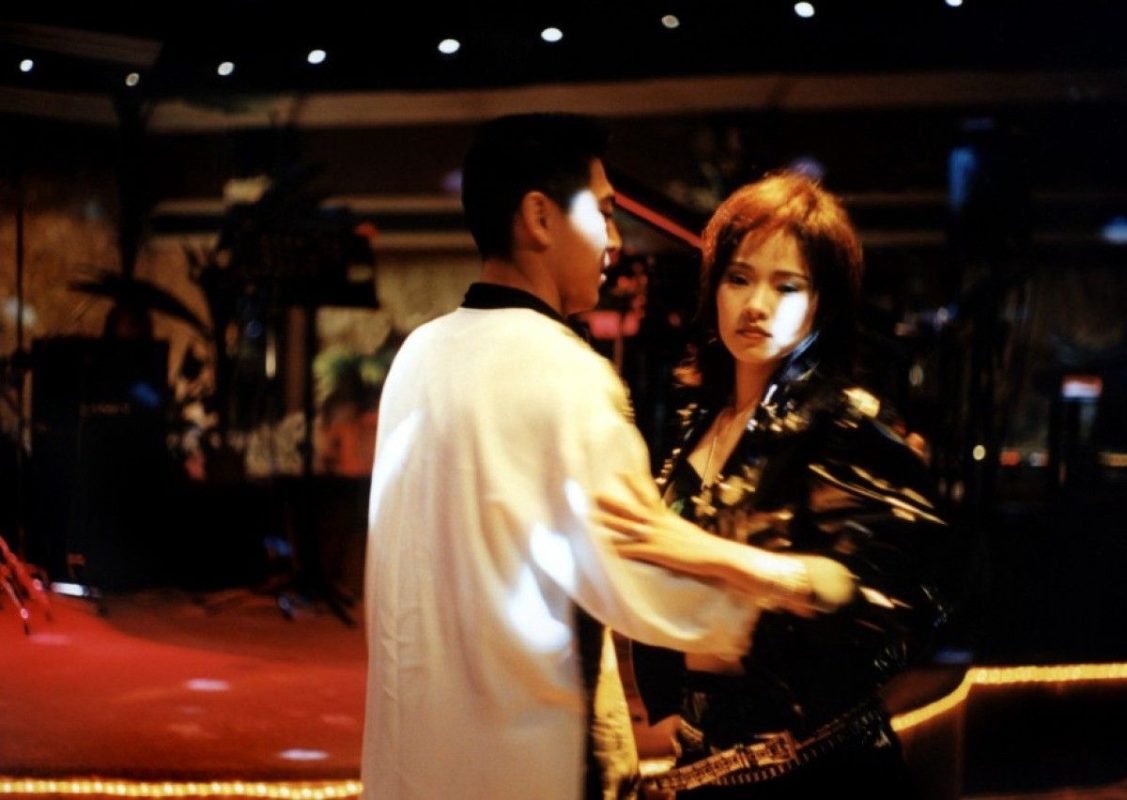
The last image of the film is simply the staid Chinese vase sitting before the diamonds of stained glass. Nothing happens. But the events that echo throughout that space infuse it with a quiet sadness. The contrasts of the repetitions would have been clumsy and ineffective had they been traditionally juxtaposed by means of montage. Instead, by virtue of their common placement in nearly identical mis-en-scene, they resonate across the vast temporal reaches of the narrative.
Hou’s thoughtful restraint in representing violence seems to indicate his ambivalence to the filmic image. Yet it is this ambivalence that lends the narration of Taiwan its dynamic complexity. While perhaps Hou is not historically correct in depicting Taiwan’s society, and his disjunctive form of representation arguably discredits his politics, the film provides an excellent stage to discuss a nation that has historically developed a culture of hybridity, a state of multiple, colliding ethnicities and languages. By staging the traumatic memories of the nation through its charged spaces and double writing, the film represents history with all its uncertain multiplicities.
If Hou’s cinema is an act of excavation, then Tsai Ming-liang’s is an act of exposure. Where Hou reaches backward into suppressed history to ask what was done to a people, Tsai turns the camera on the present to ask what the present is doing to them now. The shift between the two filmmakers is not merely one of subject matter or generation. It is a shift in the very nature of the wound being examined. Hou mourns a collective past that was violently erased. Tsai mourns a collective present that is quietly dissolving. And yet both directors arrive at the same formal answer: stillness.
Tsai Ming-liang’s films reflect the Taiwanese experience of negotiating the dialectic of tradition and modernity. His films have been analysed in relation to discourses of modernity and the voyeuristic portrayal of gender and sexuality. Tsai’s idiosyncratic film style scrutinises the ways in which the politics of representation pertain to the emerging social and political discourses in Taiwan.
Tsai’s work functions both as a mirror that reflects the contemporary ills of Taiwanese society and as a capitalist commodity exchanged between festival organizations and their audiences. Yet the films, at the same time, challenge the legitimacy of the very conceptual frameworks that ought to define them. Tsai’s films were uniquely placed to illuminate the relationship between slowness, cinephilia, and stillness.
Also Related: 10 Best Films of Tsai Ming-liang, Ranked
At the centre of his obsession between stillness and movement appears the question of time. Tsai’s films open up a space for philosophical and aesthetic reflection within the film itself. His later films open up to two aspects of cinematic stillness: the stillness of the camera and the stillness of diegetic action. These are not the same thing, and it is precisely in their coincidence that Tsai’s cinema becomes most itself. Tsai’s “What Time Is It There?” takes up a special place in the discussion of stillness.
The film’s opening shot functions like a memory, carrying traces of Tsai’s earlier works within its frame. In a static long take lasting nearly three and a half minutes, Tsai carefully composes the space: the dining table occupies the right foreground, the corridor at the center leads toward Hsiao-Kang’s bedroom, the kitchen sits to the left in the middle ground, and the balcony rests in the background, creating a striking sense of depth. Over the course of the shot, the father brings a plate of food from the kitchen, sits down to smoke, calls out for Hsiao-Kang, pushes open his bedroom door, returns to the table, and eventually walks onto the balcony, continuing to smoke in silence.
The shot is a static long take with very little happening. And yet it contains everything: the texture of daily life, the weight of routine, and the particular heaviness of a household living in the aftermath of loss. This opening shot is an instance of stillness and slowness that embodies both the stillness of the camera and the stillness of diegetic action. The rhythm of the shot is achieved through the movement of the father between foreground and background and through the various everyday activities that he performs. In Tsai’s films, the stillness of the camera is matched by a stillness of diegetic action.
Tsai’s cinema of slowness not only features stillness but also sonic silence. In Tsai’s films, solitude and silence are one and the same, a state of being that epitomizes much of contemporary life in a metropolitan city. If the silent moments of characters in their isolated state seem natural, silence is made more conspicuous and awkward when characters are shown to be together but without verbal communication between them. This silence is never accidental. It is constructed, chosen, and precise.
Sometimes such a setting illustrates the breakdown of a relationship between characters, such as that between Hsiao-Kang’s parents in “The River,” who, whether standing in the elevator or walking along the corridor when they visit Hsiao-Kang at the hospital, do not exchange a single word. In these instances, Tsai clearly prefers to use visual and silent devices rather than verbal expression to construct his cinema of slowness.
An aesthetics of silence does not simply exist but has to be constructed through rhetorical devices. Resolute fixity, the shot as a still image, and the tendency to restrain movement within the frame while framing these figures are two devices for constructing sonic silence. As the eloquent emptiness in “Vive La Sociale” suggests, silence in Tsai’s films is never merely the absence of sound. It is a presence in itself. Tsai’s films are filled with silent moments in the absence of dialogue, voice-over, and musical score.
Instead, uncomfortable sounds are foregrounded to instil a sense of unease, stretching the experience of time. Furthermore, while non-diegetic music provides sonic relief, it also challenges heteronormative and nationalist ideologies. Tsai’s visual and sonic strategies create an ambiance of silence that allows thought and emotion to rise to the surface. The stillness of the camera and diegetic action serve to interpellate an audience schooled in postwar European modernism and American avant-garde film, so that the culturally unfamiliar can be rendered as the formally familiar.
The absence of dialogue minimises the need for translated subtitles, so that silence and uncomfortable sounds become the universal language. The slowness of pace correlates with the physical environment and cultural signification. Tsai’s own cinephilia, reimagined as intertextuality in his films, generates a further cinephile discourse of stillness and silence.
Both Hou Hsiao-hsien and Tsai Ming-liang insist that the image carries responsibility, and that what a film withholds is more powerful than what it shows. Neither filmmaker offers resolution nor comfort. What they offer instead is something cinema rarely attempts: the full, unedited experience of being alive in a particular place and time, with all its grief, its silence, and its uncertain multiplicities.