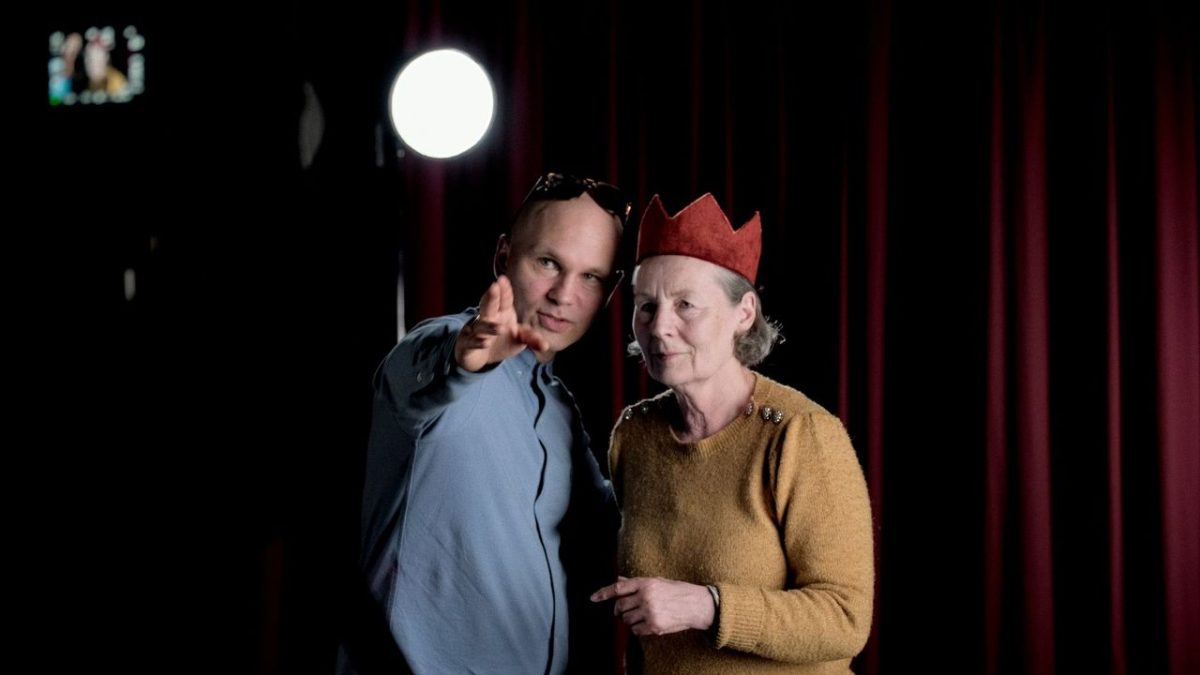
“Birita,” a documentary that premiered at the CPH: DOX festival, sees filmmaker Búi Dam exploring his personal life through the lens of his mother’s transition into a new stage of her own. His mother, Birita Mohr, is a well-known theater actress from the Faroe Islands in Denmark, grappling with Alzheimer’s.
As someone who spent much of her life living as her characters and meticulously building their alternate realities, she struggles to find a footing in her own. She spent many of those years working on plays, knowing not only her lines but every potential layer of emotional subtext. So, it’s difficult to see her facing her life without a way to process her own thoughts and emotions.
That grave dilemma remains the centrifugal force of this film, as the director uses theater as a means to channel those difficult emotions. He decides to stage Shakespeare’s “King Lear” with his mother in the lead role. In the film, he reveals the reason behind this ambitious undertaking, rooted in his personal history with her.
He recalls seeing her on stage as a child and being in awe of her. Years later, as a married man with a child on the way, he sees her through a more mature lens. We see him showing her some footage of her past work, which earned her a lot of love and recognition, reminding her that she is a remarkable artist who continues to live through the legacy.
It’s a gut-wrenching moment that the director places at the beginning of his film, immediately gripping us with its emotional depth and mournful undertones. After that, he offers a peek into the rehearsal that would bring his mother back on stage. Her castmates treat her with due reverence, but it seems odd to put her in this situation in her delicate state. Anyone who knows the challenges of Alzheimer’s can understand how difficult it might be for her to be there, distant from her own self, her cognitive abilities, and the emotional contours that would be necessary to build a character. So, it begs the question: who is it all helping?
The director believes that for someone like his mother, who has spent most of her life in theater, being back on stage can actually be helpful. It can be argued that the space might remind her of her creatively fulfilling past and the years when it made her feel loved and cherished by her fans.
Yet, the documentary doesn’t dwell enough on how it helps her in that direction. It doesn’t feature enough interactions with Birita herself, nor does it use any other way to reveal her interiority. That is definitely more challenging for a non-fiction project than a narrative film or play, the latter of which can show characters speaking about their own complicated emotions (among other creative choices).
Also Read: Remembrance of Things Past: 15 Great Films About Memory
Anthony Hopkins-starrer “The Father” approached it remarkably well, as his heartbreaking performance and Zeller’s direction made us understand the depths of his disorientation and anguish. It was a rare project to focus on the person with Alzheimer’s more than his loved ones. Before that, Julianne Moore-starrer “Still Alice” found a respectable balance between both sides of the dilemma, grounded by Moore’s layered performance.
If we’re talking about documentaries, Maite Alberdi’s “The Eternal Memory” is a shattering piece of cinema about a Chilean journalist diagnosed with Alzheimer’s, told through the lens of his endearing relationship with his wife and actress. Alberdi’s film introduces another layer of cultural and political turmoil, as she analyzes chapters of the revered journalist’s past.
While documenting those factual footprints, she also captures the charming, bittersweet beauty of him and his wife’s marriage. Búi Dam’s film falls short in that respect, leaving us with only a little insight into his mother’s illustrious past as an artist. His camera conveys her present-day struggles in theater or in real life, but it doesn’t fully explore her emotional state. Instead, the film shows more of how he is coping with the burden.
As someone who isn’t dealing with such severe circumstances, I’m in no position to judge how someone in his state deals with their pain and sorrow. Yet, it leaves you wondering whether the documentary could have been introduced as a project about the son instead of the artist. In that case, one may argue that the film explores the mother-son bond through the central dilemma related to the play, which was deemed controversial by some locals. Yet, the film doesn’t expand much on the family’s reasoning behind their decision, nor does it offer much detail into the relationship between the director and the actress.
What the film still excels at is making the whole affair evocative through authenticity. It shows deeply personal aspects of the filmmaker’s life, revealing parts that almost feel like we shouldn’t be privy to. Through those moments, he likely aims to bring that authenticity while connecting the past with the future, and inescapable aspects of ageing with the marvel of birth. Yet, it doesn’t coalesce to the degree it could have, despite its heartrending emotional core.





![Lookback on Lumet: The Hill [1965]](https://www.highonfilms.com/wp-content/uploads/2018/05/vlcsnap-error837-768x431.jpg)