Lakshmipriya Devi’s debut directorial, “Boong,” brought glory to India as it was announced as the Best Children’s & Family Film at the BAFTA 2026 on Sunday evening. “Boong” beat international nominees like “Arco,” “Lilo & Stitch,” and “Zootopia 2” to win the coveted award. In her award acceptance speech, director Lakshmipriya Devi not only prayed for peace to return to the Indian state of Manipur but also hoped that the children at the crossroads of the political unrest regain their joy and innocence of childhood – a situation that metaphorically aligns with the subject of the film.
From a broader outlook, “Boong” appears to be a delicately simple coming-of-age tale about a young boy seeking to reunite with his father. But at its core, “Boong” is the story of a world where identities are defined by politics, social status, and fractured narratives of power. There is a creative embeddedness of the personal within the political, where the child’s gaze allows for the creation of a contested space of resistance as he seeks to venture out on an adventure of finding the father.
This action of his can also be translated as the search for his self-identity, as the film’s social commentary flows from this aspect of adventure. The clash of ethnicities, the myriad gender roles, the issues of marginalized lives, and the systemic neglect in place are all built around this quest.
Boong, the titular character, is played by Gugun Kipgen, who lives with his mother, Mandakini (Bala Hijam Ningthoujam), in a small village in Manipur. After experiencing the dejected feeling of being abandoned for a long time, he, along with his best friend, Raju (Angom Sanamatum), takes on a cross-border trip alone to bring back his father and reunite his family.
Boong is aided in this journey by his school friend Juliana (Nemetia Ngangbam), who sneaks them inside a van carrying her grandfather’s dead body and gives them a free ride to the place where Boong’s father supposedly works – Moreh, a town on the border of Manipur and Myanmar.
Brojendro, aka Boong, has been portrayed as a rebellious kid from the film’s beginning. His usual mischief and adventures include knocking down some of the big metal letters placed above his school gate so that it appears as ‘Homo Boys School’. And later, he sings Madonna’s Like a Virgin as the school prayer. But his defiant acts are pushed to extremes when he sets out to achieve a naive goal amidst the larger socio-political horrors that exist along the fault lines of the land and its border.
There is innocence in the way Lakshmipriya Devi sets up the ordinary world, or the ‘known world’ of the film. She then slowly bestows upon us the burden of responsibility as she reveals the unknown world, and we witness the two children navigating the symbolically rough terrains of the politically charged borderland of Myanmar. It raises the stakes, and we are worried about the characters. A gun-clad army man warns Raju, “You shouldn’t be fooling around in a place like this alone”.
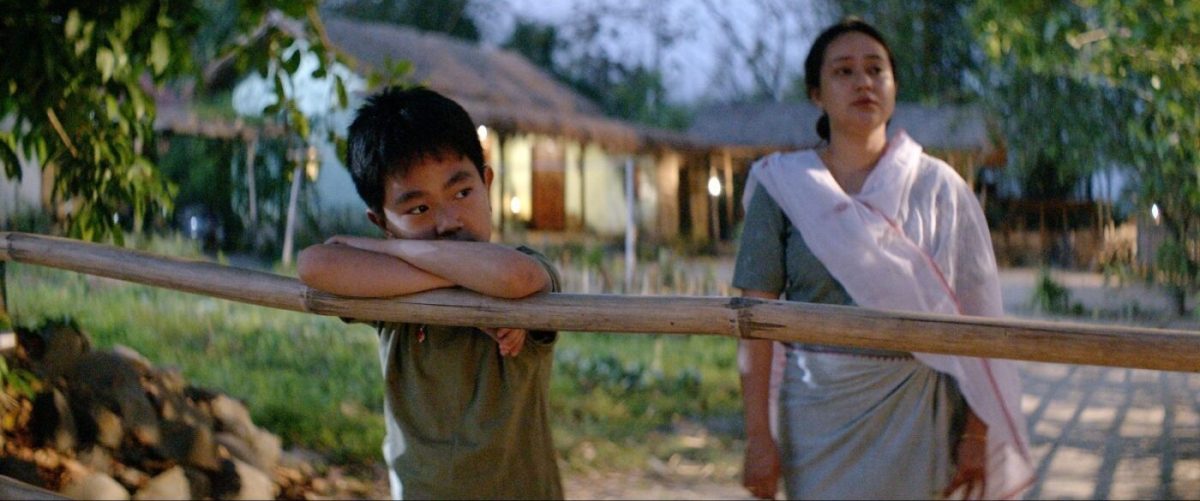
Soon, Boong and his friend cross the threshold, and the land in question immediately invites both physical and emotional challenge for the kids. As they pedal around with a photo of Joykumar, Boong’s father, asking for his whereabouts, the kids also fight among themselves as they momentarily lose out on the grace of their shared understanding. After that, they also invite the attention of the rival kids of Myanmar, who chase them around with their slingshots, rubber, and stone toys.
With the test of friendship on one hand and his family ties on the other, Boong gets to approach the inmost cave of his journey and bravely and wisely faces his ultimate ordeal. He finds out that his father is now married to a different woman and is happily living a new life with their little daughter. Boong’s grief can be perceived here as well as his relief, but there’s no rebuttal, for he knows that his mother will need his strength more than the truth. The past matters to him, but not more than his future. This places the overall arc of Boong’s character as radically innocent but also very emotionally mature.
His mother, Mandakini, has so far played a dual role of a ‘provider’ and a ‘caregiver’ in their case of an absent father/husband. From taking Boong to school to teaching him, cooking, and doing the entire household activities single-handedly, she never stops believing that her husband will come back.
Occasionally supported by Raju’s father, Sudhir (Vikram Kochhar), she resists both emotional dependence and the social and cultural policing in a community that often stigmatizes close terms of a married woman with a man who is not her husband. She even refuses to partake in the death rituals of her husband, as she chooses not to correlate the ideas of absence with death. “Please celebrate your own death ceremony,” she says in her reclamation of agency in a post-patriarchal space.
The presence of the merchant family, Sudhir Agarwal and his son, Raju Agarwal, as Rajasthanis settled in Manipur for generations, signals the broader insider-outsider debate in the region. Despite their linguistic and cultural assimilation as well as their economic contribution to the land, they continue to be regarded as ‘outsiders’ by the natives. When Sudhir tries to help Mandakini out of a scenario, the local community threatens him with the first-hand excuse of his ethnic origin. Hatred also finds a home when the personal interactions between Mandakini and Sudhir increase.
In another situation, Boong calls out his friend Raju as an outsider, in a fit of rage over losing his father’s only photograph. Raju too shoots back by calling him ‘momo’. Although they apologize and remain loyal to each other, the particular situation highlights how racism might be conditioned amidst such situations of cultural complexity and territorial anxiety. The impact of the exclusionary politics being operated by the adults also has a spillover effect, which gets carried to the children. Such practices can limit cultural integration as ethnic prejudice becomes a barrier to cross-cultural solidarity.
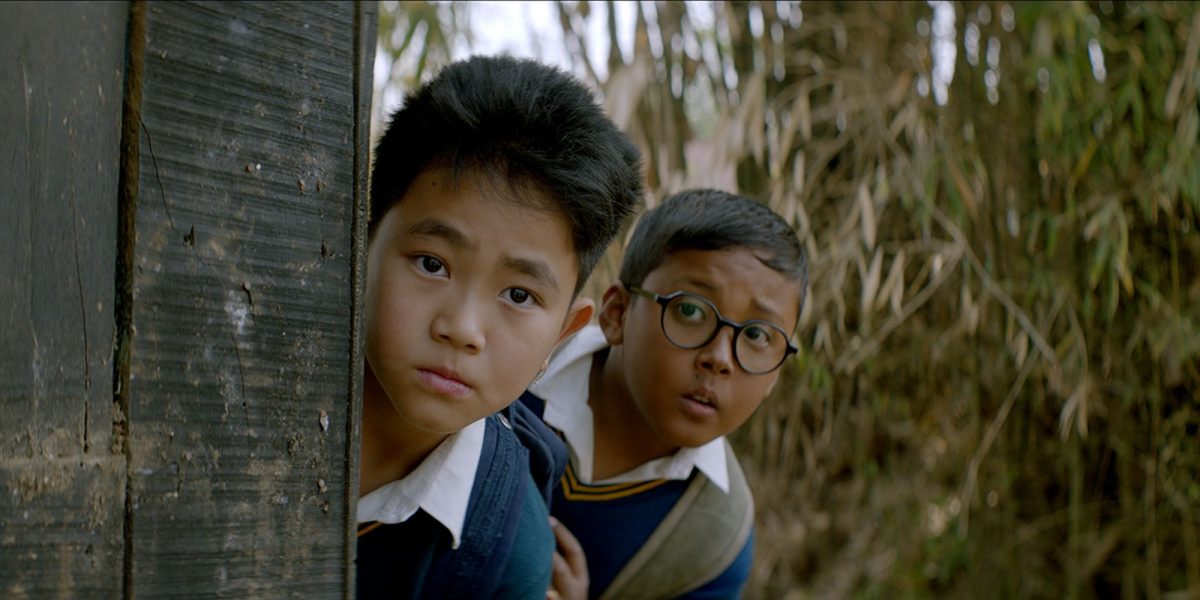
In fact, it is these issues of gender and culture that truly become the film’s real core. This is because, beneath all the neat innocence and the playful tone of the film, “Boong” interrogates the larger politics of ethno nationalism and cultural othering in Manipur. It also tries to expose the kind of moralities that do not go beyond mere performative limits in the public space.
The secret indulgence of banned Bollywood films by the village head highlights the lie that exists in the quiet trenches between the constructs of ideology and hypocrisy. The film also refrains from presenting Joykumar, the father, as a villain or a victim. Instead, it allows for an ambiguity to take over and frame how his absence becomes politicized in the hands of those wielding power.
The second half of the film entirely takes place in Moreh as it becomes both a symbol of abandonment and possibility. It is a place where Boong’s father disappeared, and it is also a place where the answers to his search lie. When Boong and Raju run out of luck and money, they find themselves desperately seeking the help of JJ.
The portrayal of JJ, a flamboyant drag performer in a rundown club in Moreh, also focuses on queer marginality in a region where gender binaries are invisibilised. JJ functions as an unexpected aid to Boong in his search. Importantly, JJ’s intervention occurs at a moment when the adult authority figures in the film—parents, teachers, state institutions—have either failed or retreated. In this way, “Boong” also asserts that lives that exist in the fragments and margins of neglect, both geographical and gendered, can still be a possibility of hope. JJ helped the boys when the more ‘respectable’ adult figures of the society failed to act.
Lakshmipriya Devi’s craft is visualized by a sincere grasp of child psychology and of character dedication and cause. There are occasional tonal imbalances faced while balancing between the various aspects of a feel-good fable and the harsh modern world realism, but it never undermines the film’s impact when it comes to the depth of its political layering or emotional effect. Perhaps the greatest and most direct of all metaphors in the film is that of Joykumar abandoning his family, which can be read as a nation turning its back on a state.
In contemporary times, the Indian state of Manipur has been going through a tough phase of administrative neglect, political violence, and ethnic conflicts. There is no naming of such conflicts or direct reference to any in the film, but “Boong” embeds it in its subtext throughout. Moreover, the cross-border facilitation of trade, illegal migration, and insurgency also has a say in the film as Boong’s father, Joykumar’s identity is kept unclear. Although he owns a furniture shop in Moreh, there are hints of him belonging to the dark corridors of armed resistance against the state. And Boong’s fate of future uncertainty mirrors the almost similar political realities of the state and its citizens today.
If that is true, then the political philosophy of “Boong” is perhaps one of beckoning. And as suggested in its conclusion, we can infer that sometimes it is best not to seek the truth, unless we’re ready to face the truth. This is also a symbolic nod to the present condition of Manipur, which is now struggling to reckon with its own history. “Boong” communicates with the innocent idioms of childhood, but it’s a profoundly honest film that stays true to the relevance of its homeland.
Boong is produced by Farhan Akhtar, along with Vikesh Bhutani, Alan McAlex, Ritesh Sidhwani, and Shujaat Saudagar.

![Yeh Ballet [2020] Netflix Review – A typical underdog tale laden with umteenth cliches](https://www.highonfilms.com/wp-content/uploads/2020/02/Yeh-Ballet-Netflix-768x427.jpg)