Don’t let the title fool you; David Freyne’s new film “Eternity” is not a horror movie, and it doesn’t have any jump scares or creepy violin music. It is, for the most part, a breezy, consistently funny rom-com with a uniquely compelling concept that is perhaps never quite used to its full potential. But much like the idea of living forever, the love triangle at the center of one of 2025’s sweetest films raises some uncomfortable questions. Though subtle, the movie’s charming humor and accessible style mask a disturbing existential truth: forever and ever might actually be kind of awful.
Family man Larry chokes on some pretzels and wakes up in his younger, more Miles Teller-ish body, aboard a metaphysical train en route to the “Junction,” a post-death purgatory where unfortunate souls who have passed on must pick a specific dream world to spend the rest of eternity. Larry’s wife, Joan (Elizabeth Olsen), arrives shortly thereafter, fresh off a battle with cancer, and the two briefly reunite.
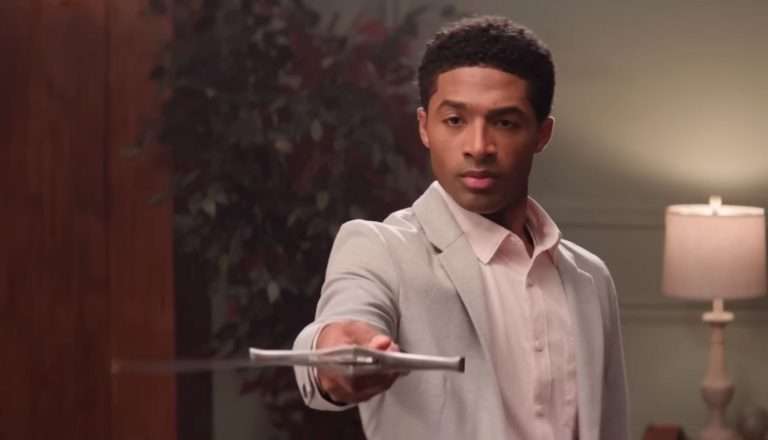
Larry is all set for sailing off to fictional Hawaii, except there’s someone else waiting for Joan, too: her first husband, Luke, who never made it back from the Korean War. Suddenly, Larry finds himself in a competition for his own wife’s heart after 65 years of marriage—and the stakes are eternal.
Again, the more frightening implications of such a situation never fully surface in “Eternity,” which only lets up on the jokes to try to make you cry. And yet they consistently bubble underneath the lore and premise.
The first concept we’re introduced to is that characters spend eternity in bodies that reflect the age at which they were their happiest. That means that while the central trio all arrive (conveniently) in their 30s, some characters we come across are much older or younger, such as a kid who was hit by a car. Theoretically, what if someone was happiest at the ripe old age of 90 in a body that could barely move? Shouldn’t everyone be a baby, anyway? And what about an actual baby?
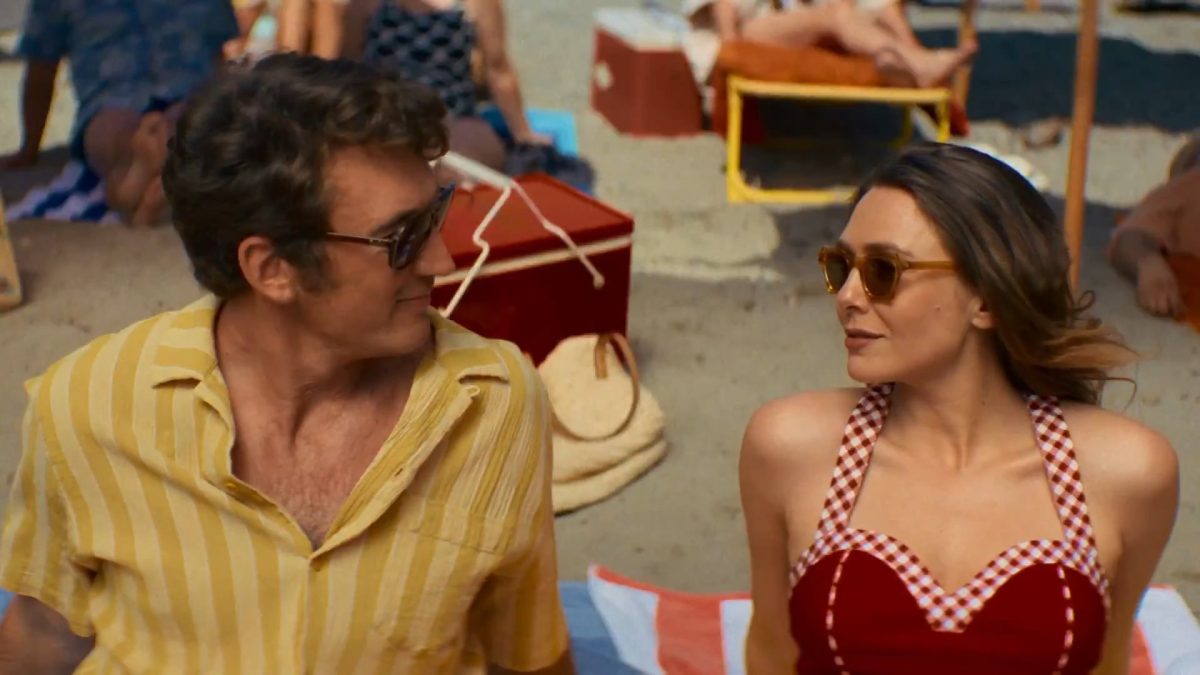
We are told early on that choosing our final location is a permanent decision that cannot be undone (though, of course, the power of love will later have something to say about this rule). While this decision comes with a lot of pressure to begin with, the concept of a “location” is left undefined and confusing. One such world is a vast romantic getaway in the mountains; another is a crowded stretch of beach jam-packed with people. Another, still, is Nazi Germany with “100% less Nazis.” One has to wonder who is even developing these worlds.
Despite some locations being shown as heavily crowded, we are also told these destinations have a limit and stop accepting new additions once an unknown number is reached, which raises a new fear: given enough time, will every world end up feeling like a Wal-Mart on Black Friday? (I believe it was Sartre who said, “Hell is other people.”) What about the alternative—picking a world that no one else in human history has ever picked again? While such a situation might sound tempting at first to us introverts, remember, this is forever, and ever we’re talking about.
Also Read: The 15 Best A24 Comedy Movies
We also see multiple people try to escape the world they’ve chosen, driven mad by boredom or regret. There’s even an in-universe police force dedicated to chasing these poor souls, which presumably wouldn’t exist unless this were a common issue. The police drag those trying to escape to the “Void,” pure black nothingness that works as some type of stand-in for hell. If the dread of being stuck somewhere uninteresting wasn’t bad enough, mere dissent will rob you of all five senses forever. In a “world” where choosing your fate is permanent, the setting itself becomes part of the anxiety.
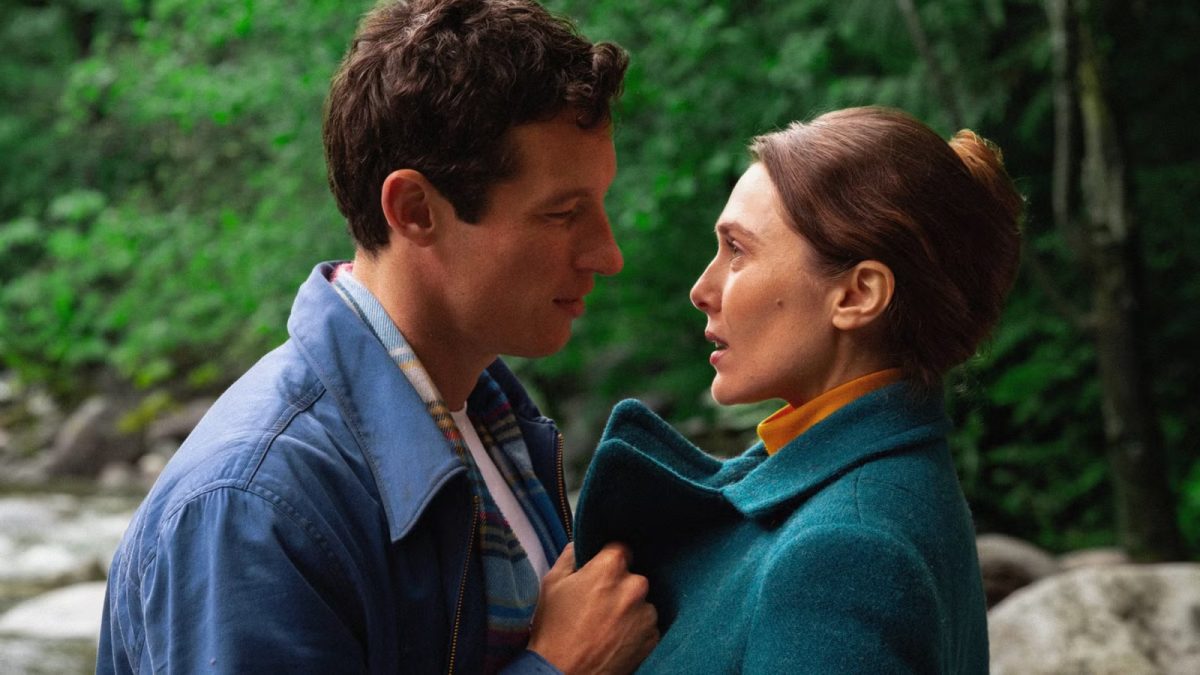
The most specific fear that “Eternity” presents, however, is choosing the wrong partner. Joan loves both of her husbands, but in different ways. Her short-lived relationship with Luke was passionate but abbreviated, while her marriage to Larry was comfortable and lasted for most of her life. She is presented with a dilemma: keep a good thing going or see if a life with Luke would bring her even greater happiness.
After all, we are reminded by virtually every character in the movie that Luke is exceptionally charming and attractive, and boring old Larry is sweet but, you know, boring (“Eternity” has several strengths, but none surpass the simple pleasure of watching Miles Teller pretend to be a pretzel-loving octogenarian, elated that his hips work again in the afterlife). Philosophically, Joan’s dilemma echoes Kierkegaard’s ideas on dread and choice: refusing to decide is a form of inauthentic existence, though in her case, she has good reason not to.
Choosing between the two means saying adios to one of them for good. It also risks hurting the one she leaves behind (polyamory is brought up but subsequently laughed off—sorry, “Challengers” fans). But perhaps most frightening of all, Joan will be stuck with the person she chooses, well, forever.
The premise itself expects Joan to pick someone: someone to kiss, someone to go hiking with, someone to watch sunsets with for all of eternity. Even when she tries to avoid the choice altogether, it isn’t because commitment terrifies her, but because she doesn’t want to hurt anyone’s feelings. “Am I in Hell?” Joan says at one point, frustrated with having to choose between suitors. We chuckle, but it’s a good question.
One could argue Joan already signed up for forever when she said her vows with Larry, since the “death” in death-do-us-part could also signify the death of consciousness. But even in marriage, there is always the possibility of things ending—even if there isn’t an expectation for it—just like it did with Luke. In this new scenario, such an outcome can never occur. Old age no longer exists, and a sudden discovery of irreconcilable differences won’t change a thing.
Must Read: In Response to “They Don’t Make ‘Em Like They Used To”: Rom Com Edition
There’s even a quick joke where Luke accidentally sounds like he’s complimenting Joan’s kids a little too enthusiastically before rushing to clarify. It’s a throwaway gag, but it highlights another very real fear. Imagine discovering a deal-breaker after you’ve already committed to sharing a world with a person, trapped with someone you don’t fully know. More broadly, whether we recognize it or not, part of what makes relationships captivating is the potential for conflict and overcoming adversity. If a relationship can never end, then any conflict becomes frightening. You can’t “die” again in Eternity’s take on the afterlife, but you can suffer all the same.
This is all a metaphor for actually tying the knot in the first place, of course. Joan is a character who has a good relationship, one that could be solidified as “permanent,” and yet there’s an old flame waiting in the wings who promises a high that her current man will probably never match. Her dilemma mirrors a broader generational anxiety of heading down the right path with the wrong person.
The film addresses this fear, but by breaking its own rules. Joan leaves with Luke upon Larry’s request (a romantic notion out of concern for her happiness), but quickly realizes she doesn’t want to build a new life all over again. She sneaks back to the Junction and reunites with Larry, who stuck around to bartend in her absence. The two finally abscond to a suburb reminiscent of the home from their previous life.
Will her decision haunt Joan? Probably not. The film’s rosy ending suggests that eternity might already be analogous to 65 years of marriage—familiar, repetitive, and only a little terrifying. Luke is a character who represents passionate, romantic love. He’s often compared to old movie stars of the 50s, the era in which he died. He also waited a lifetime for her arrival, which is a gesture reminiscent of the romantic inclinations of that era.
But it’s Larry’s selflessness, his willingness to live a life apart from Joan, that paradoxically draws her back to him at the end. If any relationship could escape the cosmic dread built into the film’s premise, it might be one that’s already built to last—so says the rom-com.
The thread from “Eternity” most ripe for existential dread—the “Void”—ends up playing no part at all. A more postmodern (and, of course, scarier) ending would trap Joan and one of the men in eternal emptiness, surrounded by nothing, yet crucially still together. Instead, we get an old-fashioned coda where not only does the nice guy get the, uh, wife, but the sheer length of an imperfect, pretty-good relationship becomes its own reward.
It’s not a bad ending; the teary-eyed women at my screening even produced some quiet applause. But even here, as Freyne continues to leave the more existential repercussions in the subtext, the knowledge that Joan and Larry are still on the run lingers. And Luke now has to wrestle forever with the knowledge that his wife prefers a guy named Larry, a fate too horrible even to comprehend.
“Eternity” might not explore the more terrifying ramifications of the premise, but neither can it entirely hide them across its 114-minute runtime. And by sweeping those darker implications under the rug, the film unintentionally speaks to a broader cultural attitude on how our attraction to permanence works. By trying to make ‘forever’ romantic, “Eternity” reminds us why it’s so unnerving to begin with.




![The BFG [2016]: Spielberg’s Territory but not Spielberg Enough](https://www.highonfilms.com/wp-content/uploads/2016/07/The-BFG-4-featured.jpg)