The immediacy of Cristian Mungiu’s weighty realist filmmaking style has always been bolstered by the stark specificity of his chosen subject matter. It’s precisely this specificity that made “4 Months, 3 Weeks and 2 Days” such a harrowing depiction of Ceaușescu-era illicit abortions, or “Beyond the Hills” a shattering depiction of the distant chill of isolated Romanian Orthodoxy, or whose relative lack made “R.M.N.” an effective if moderately routine depiction of small-town xenophobic discrimination. With “Fjord,” Mungiu dips somewhat into those same waterways in unpacking the aftershock of latent social judgment, but once more, the piercing precision of his chosen avenue clears this path to flow with all the fervour of a vigorous rapid.
Don’t let Mungiu’s highest-profile casting choices or his location change fool you. “Fjord” may have shifted its sights to the ostensible idealism of a serene Norwegian village, but the rippling effects of a distant upbringing follow him and his characters like a black overcast that leaves any hint of sunshine as little more than a distant memory. Unconditional love, according to Mungiu’s latest subjects, is the sole motivating factor for anything and everything they do, but under the oppression of such a searing atmosphere, believing such fanciful assertions is much easier said than done.
For the newly immigrating Gheorghiu family, this harsh truth becomes an increasing burden on their lives the moment they set foot in their new waterside home. Emigrating from Romania to the matriarch’s hometown in the distant Norwegian fjords, father Mihai (Sebastian Stan, finally dusting off the Romanian accent and almost all of his hair, for his Mungiu collaboration) and mother Lisbet (Renate Reinsve) have settled with seeming ease alongside their five children of varying ages. Annoyingly strict in their Christian devotion, the Gheorghius are otherwise quite friendly and well-liked among their new neighbours, as Mihai takes a job in IT while Lisbet makes use of her nursing experience at a nursing home.
The eldermost children have adjusted quite well to their new surroundings, until frightful circumstances tip off the locals that something might be amiss in the Gheorghiu household. Teachers notice hidden bruises on the children’s shoulders, and coupled with an offhanded remark about how a facial mark came from their mother, the townsfolk begin to suspect that the Gheorghius’ rural religious fundamentalism has led them to act abusively towards their children. Because this is Norway, Child Protection Services are quick to intervene, and just as immediately, Mihai and Lisbet find themselves separated from their children and forced to endure a system that seems designed against their best interests from the start.
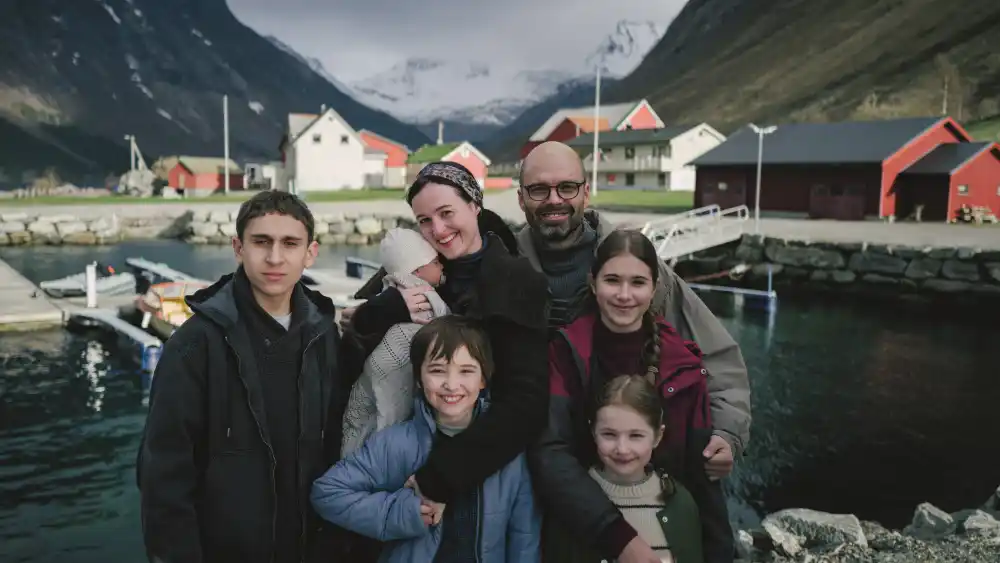
Any normal viewer would immediately find themselves on the side of the protective agency tasked with keeping the children’s safety in mind, especially in the face of such blunt and uncompromising religious influences that would sour any rational outsider from believing that the discipline in this household would end with “a slap on the butt,” or that such measures would even be warranted in themselves.
But in casting “Fjord” with his two most recognizable and widely liked figures, Mungiu has already implicitly found some sort of latent audience empathy with the Georghiu parents that complicates what would normally be such a clear-cut stance, and his performers make every use of their position to further dilute the obviousness of their faults.
It isn’t so much that Mihai and Lisbet are completely innocent of any wrongdoing to their children, but Stan’s headstrong obstinacy and Reinsve’s reserved anxiety contextualize these parents as coming from an era and culture that simply doesn’t, perhaps to its detriment, see these issues in quite the same way as their host country—and unfortunately for them, those differences in view are fundamental.
What makes this situation murkier beyond the opaqueness of the parents themselves, though, is just how swiftly the Norwegian justice system manages to stack the deck entirely against the family before they even have a chance to assess the situation, and Mungiu’s ever-frenetic but strictly calculated camera locks in on all sides of the lose-lose dilemma.
The paramount prioritizing of the children’s safety is never called into question, but neither is “Fjord” quick to accept that the resulting immediate and hard-line disconnect between parents under dubious investigation and the children they’ve just uprooted to a new home is an easily acceptable proposition for anybody involved.
As every concession is made on the family’s part—from Lisbet relinquishing their infant child to a foster mother, to Mihai’s almost hilariously framed attendance of, and half-hearted interest in, an anger management course—the increasing sense that there is some religious/cultural persecution at play can’t help but creep in when almost no leeway is reciprocated on the part of the institution, leaving “Fjord” to evolve into a gradual and gripping courtroom drama by the river.
Still, Mungiu maintains an ambiguity to the parents’ behaviour that seeks not to admonish against religious upbringing or, conversely, crusade against a more leftist sense of secularism. Rather, “Fjord” taps into the paranoia on all sides that reaches its apex when it becomes so much easier to lay the blame at the feet of an ideology or culture separate from one’s own. A picturesque fjord is nothing if not serene, but sometimes it’s terrifying to think that we can’t see what lies behind the next bend.



![Taxi [2015]: An Awe-Inspiring Iranian Minimalist Cinema](https://www.highonfilms.com/wp-content/uploads/2016/01/201511112_5.jpg)
![Stupid Young Heart [2019] ‘IFFI’ Review- A Surprisingly Mature Take on the Immaturity](https://www.highonfilms.com/wp-content/uploads/2019/12/stupid_young_heart_still_1-768x433.jpg)
![Loving Vincent [2017]: Re-imagining the Last Days of a Tortured, Misunderstood Artist](https://www.highonfilms.com/wp-content/uploads/2018/03/PA000463_8_high-res-web-768x522.jpg)
![The Disaster Artist [2017]: Filling the Hollow](https://www.highonfilms.com/wp-content/uploads/2019/02/the-disaster-artist-768x432.jpg)
![Dogborn [2022]: ‘Venice’ Review – An Evocative Drama Rooted in Humanism](https://www.highonfilms.com/wp-content/uploads/2022/09/Dogborn-2022-Movie-Review-2-768x384.png)