“Ha-Chan, Shake Your Booty!” (2026) is the best type of character study. It does not reduce its protagonist to a single defining characteristic, nor does it reduce her individualism for the sake of adhering to formal structure. The titular heroine of “Ha-Chan, Shake Your Booty!” is effervescently likable, but that doesn’t mean that the film condones all of her actions. The way that she chooses to cope with the pressure mounted upon her can be uncomfortable, unnerving, and at times frustrating.
This emotional authenticity, the likes of which are rarely depicted so convincingly, does not prevent “Ha-Chan, Shake Your Booty!” from being whimsical, crowd-pleasing, and at times fantastical. It’s the type of singular vision that can only occur when the filmmaker and lead performer are completely in sync with one another, which is exactly what occurred between director Josef Kubota Wladyka and Rinko Kikuchi in the best performance of her entire career.
The inception of “Ha-Chan, Shake Your Booty!” was the collaboration between Wladyka and Kikuchi on “Tokyo Vice,” the brilliant HBO Max crime series that was sadly cancelled after its second season. Wladyka’s past credits include several gripping psychological thrillers, but he’s also found work directing standout episodes of acclaimed streaming shows, including “Tokyo Vice.”
The episodes Wladyka directed were noteworthy because of the new depth he found within Kikuchi’s role as the senior journalist Emi Maruyama, who had quietly become the show’s standout. It was evident that the two shared a connection and that Wladyka was willing to trust Kicuchi to tell a very personal story. As revealed in the closing credits, the story of “Ha-Chan, Shake Your Booty!” was made as a tribute to Wladyka’s mother.
Also Related: The Many Faces Of Mortality: 15 Great Movies About Death
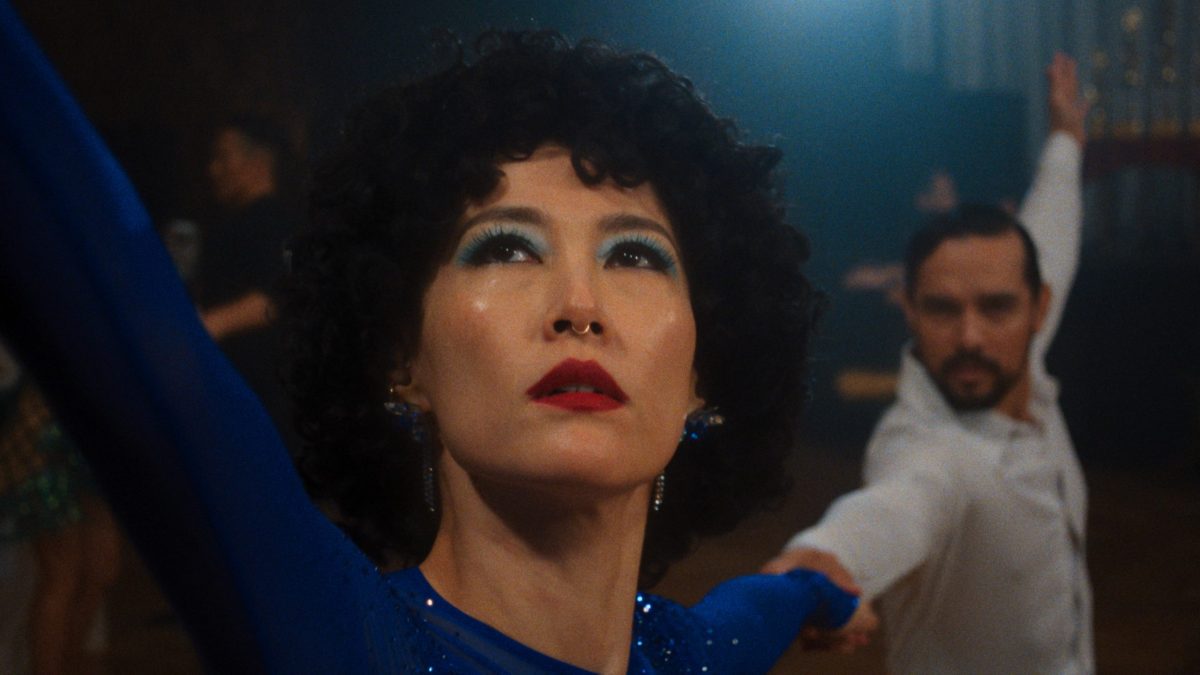
It may have seemed unusual that the director of grim, intensive crime thrillers like “Catch The Fair One” and “Manos sucias” would be interested in making a romantic crowdpleaser, but “Ha-Chan, Shake Your Booty!” is far more complex and depthful than its premise might suggest. Kikuchi stars as Haru, a woman in Tokyo who competes in ballroom dancing competitions with her husband, Luis (Alejandro Edda), who dies tragically from a heart attack.
Withdrawn and completely isolated, Haru is eventually pried out of her self-imposed reclusive state when she’s encouraged by her friends and family to once again take up dancing, at least as a hobby. Returning to cha cha, salsa, samba, and other forms of dancing only occasionally sparks any reignited passion, but Haru’s involvement becomes intensified when she develops an interest in her instructor, Fedir (Alberto Guerra), who is himself a former competitor.
It would seem like, from this point on, “Ha-Chan, Shake Your Booty!” could write itself, but the grieving and recovery process isn’t so easily calculated. Haru has found it difficult to return to the activity that once brought her joy without being eerily reminded of Luis, especially considering how intimate a connection two partners would need to have.
Her apprehension about dancing is considerably less daunting than opening her heart to love again, even if Fedir has charmed nearly every other woman in the class. There’s also the complication that Fedir is married, even if he does claim to have an “open relationship” (of which Haru learns the definition in a particularly humorous moment).
Haru is trapped within a funk that is spurred on by the blend of cultures she’s immersed in, as the advice she receives on how to move forward with her life is confusing and often contradictory. This is a film in which English, Japanese, and Spanish are all spoken, and one of the first conflicts Haru experiences is regarding her husband’s remains. While she believes that he would have wanted to be cremated in the Japanese tradition, her Mexican father-in-law (Damián Alcázar) is insistent that he should be buried alongside the rest of their family.
It’s another case in which Wladyka’s preexisting relationship with the actors helps to add depth to characters that would have otherwise felt too insular. Alcázar was prominently featured on episodes of “Narcos: Mexico” that Wladyka had directed, and is able to have a heartbreaking impact on “Ha-Chan, Shake Your Booty!” in only the briefest of moments.
Although there are gutting moments of stillness as Haru is forced to lean back into routines, “Ha-Chan, Shake Your Booty!” also has an impressionistic means of exploring her emotional state. The use of dreamlike imagery and the presence of metaphorical creatures could easily feel aggressively idiosyncratic for the sake of it, but there’s such a potent understanding of what Haru is feeling that the visual quirks make sense.
Wladyka is also keen to point out that none of these moments can be singularly defined by one emotion, as it’s possible for Haru’s journey to be both achingly sad and sharply funny. Bold chances are taken when inserting physical comedy into the film, including a particularly hilarious sequence involving Haru’s observation of Fedir’s relationship, but they feel consistent with the impromptu nature of her character’s progression.
Also Read: The Physics of Grief in Clint Bentley’s ‘Train Dreams’
Kikuchi first gained the attention of world cinema followers with her deeply moving, affecting performance in Alejando Gonzalez Inarritu’s Best Picture-nominated tragedy “Babel,” and has since found a career for herself in all manner of genre films. “Ha-Chan, Shake Your Booty!” is hardly the first lead role she’s been granted, but the film feels tailored to her sensibilities, allowing the sharpness of her physical expressions and snarky line deliveries to be best exercised.
It’s often that performers with such striking presence are forced to fit themselves within a box in order to fit within Hollywood’s standards, but “Ha-Chan, Shake Your Booty!” seems to expand in order to congeal with Kikuchi’s acting choices. January is far too early to begin thinking about what next year’s awards race will look like, but Kikuchi’s name should at least be put into consideration for Best Actress prizes.
“Ha-Chan, Shake Your Booty!” may be off-putting to some with its occasionally jarring tonal shifts and deliberate act breaks, but the bumpy pacing is a feature, and not a bug. It’s less a statement about grief than a window into the experiences of a character, who would seem to have been significantly informed by reality. “Ha-Chan, Shake Your Booty!” isn’t a traditional crowd-pleaser in the sense that it is always uplifting, but it’s hard to imagine that Wladyka’s film wouldn’t incite some sort of reaction from its viewers.



![Guava Island [2019] Review: Donald Grover’s passion project is more symbolic than substantial](https://www.highonfilms.com/wp-content/uploads/2019/04/Guava-Island-Grover11-768x581.jpg)

![All That Breathes [2022]: ‘Sundance’ Review – Mapping Delhi’s streets & skies into a Stirring, Stunning Miniature](https://www.highonfilms.com/wp-content/uploads/2022/01/All-That-Breathes-Sundance-2022-768x431.png)